

On July 9, 2026, 1X Technologies released footage of its NEO robot pouring tea, snapping LEGO bricks together, and threading a USB-C cable into a port—all tasks performed by a pair of mechanical hands that CEO Bernt Børnich claims "match or surpass human capability across every dimension that matters." Twenty-five degrees of freedom, waterproof to IP68 standards, tendon-driven. The demos looked impressive, almost effortless.
But polished video tells only part of the story. Beneath the choreography lies a messier reality about production economics, the stubborn limits of autonomy, and the punishing arithmetic of selling humanoid robots to a market that isn't entirely sure what to do with them yet.
The timing wasn't accidental. 1X had commenced full-scale production at its Hayward, California factory just two months earlier, and the hand reveal felt like a marker being laid down: humanoid manipulation isn't just an academic exercise anymore. Whether that's actually true depends on questions the company hasn't quite answered—or perhaps hasn't been asked loudly enough.
Building Them Fast, Selling Them Later
1X's decision to own its production line reflects a vertical integration strategy in a field where many companies rely on contract manufacturing. The company says it's already manufactured "hundreds" of the NEO hands and claims capacity to hit 10,000 units this year. The Hayward facility—which the company dubbed "America's first vertically integrated humanoid robot factory" when it opened in April 2026—is targeting 10,000 complete NEO humanoids in 2026, with plans to scale toward 100,000-plus annually by the end of 2027.
That's an aggressive ramp for hardware with no established demand curve. CEO Bernt Børnich, in an April Forbes interview, described humanoids as fundamentally a "manufacturing problem," and 1X's approach suggests the company believes production capacity itself will catalyze market creation. Maybe it will. But capacity without validated use cases is just inventory risk wearing a different label.
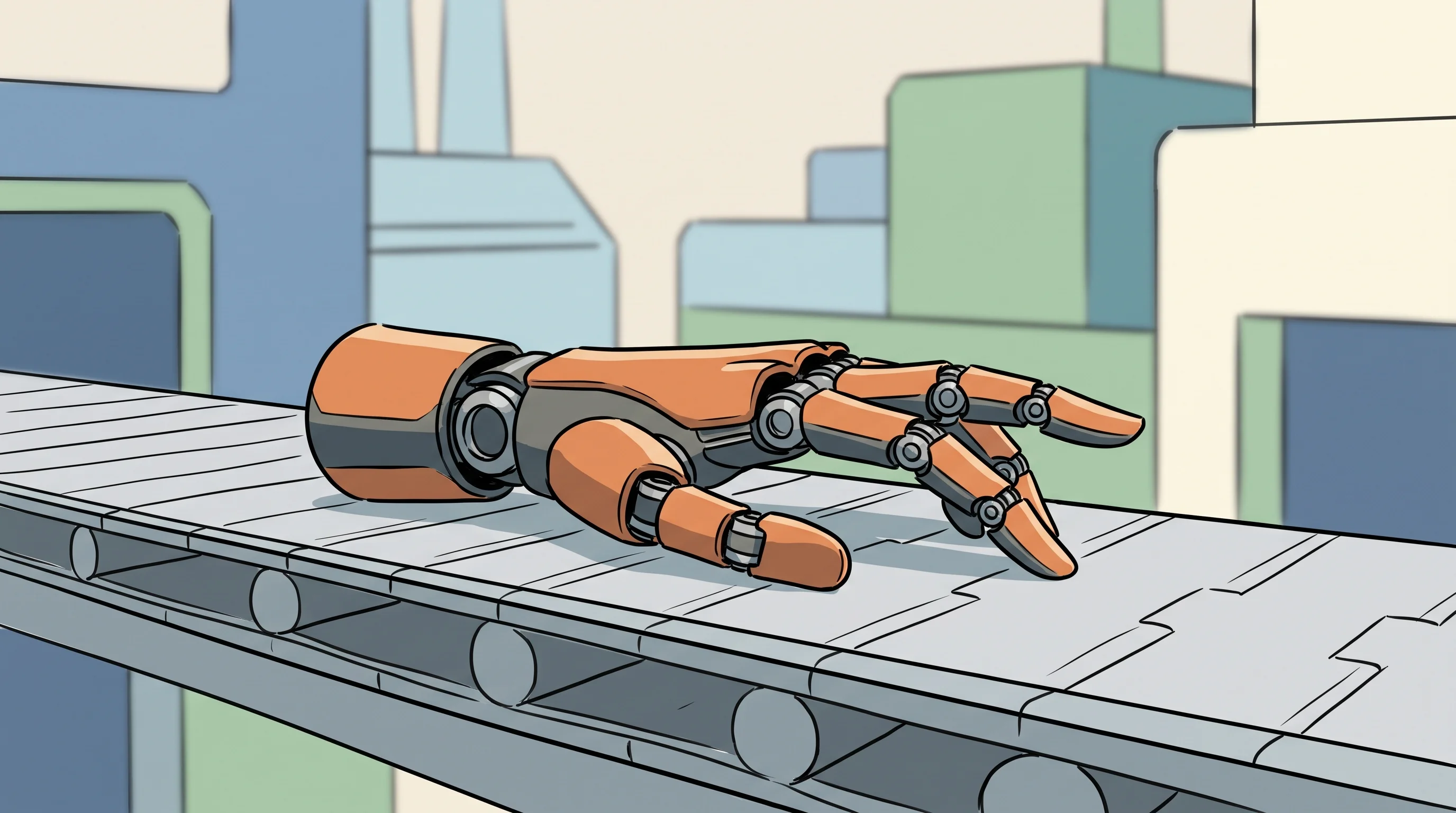
The hands themselves reflect genuine ambition. Twenty-five degrees of freedom—22 fully actuated across fingers and palm, three at the wrist—powered by tendon drive systems with relatively low gear ratios between 5:1 and 15:1 to preserve force transparency and backdrivability. The torque figures read respectably: 3.5 Nm at the thumb's carpometacarpal joint, 2.6 Nm at the finger metacarpophalangeal joints, 17.75 Nm at the wrist. Positioning accuracy is listed at ±0.2 mm. The IP68 rating and food-safe certification hint at consumer ambitions, not just warehouse floors.
Comparisons help frame what's at stake. Shadow Robot Company's Dexterous Hand—a research benchmark for more than a decade—offers 20 actuated degrees of freedom across 24 joints but has never approached anything resembling mass production. Wuji Technology's Hand 2 claims 20 degrees of freedom; its documentation lists a maximum hanging weight of 5 kg for earlier versions, though some reports cite higher figures. China's Linkerbot, which Reuters reported in May 2026 is eyeing a $6 billion valuation, has claimed "more than 80 percent" market share in high-degree-of-freedom robot hands in media reports, though such claims remain unverified and should be treated with skepticism.
In other words, the field is crowded. 1X's advantage isn't the specs alone—it's coupling those specs to a production line and a go-to-market plan. Which brings us to the pricing.
The Price Tag Problem

NEO carries a $20,000 price for early-access ownership (with a three-year warranty and priority delivery) or a $499 monthly subscription. U.S. consumer shipments are expected to begin sometime this year. That pricing sits awkwardly between prosumer gadget and industrial automation—too expensive for impulse buys, too cheap to justify enterprise systems-integrator budgets without serious clarity on total cost of ownership.
And the TCO picture remains frustratingly opaque. Buried in 1X's order materials is a reference to "Expert Mode," where remote operators from the company can supervise tasks NEO "doesn't know" yet. That's teleoperation scaffolding dressed up in friendlier language, and it implies ongoing service costs not captured in the headline number. Independent analyst estimates have suggested NEO's current autonomy may be in the 60–70 percent range for expected 2026 deployments, though 1X hasn't offered its own figure publicly and such estimates remain unverified.
Roland Berger's May 2026 analysis projected potential "$2 per hour" running costs for humanoids in future scenarios as capabilities mature—a forward-looking estimate that should be understood as scenario-building rather than validated economics. Consultancies are paid to imagine futures, not guarantee them. Forrester's March 2026 report on humanoid robots cautioned enterprises against overinvestment and stressed near-term ROI discipline, a polite way of signaling that hype is outpacing readiness.
Meanwhile, competitors with narrower ambitions are hitting tangible milestones. Agility Robotics, which announced plans to go public via a $2.5 billion SPAC deal in June 2026, now operates across nine customer sites including Schaeffler, GXO, and Toyota Motor Manufacturing Canada. Its Digit robot has moved more than 100,000 totes at GXO's Flowery Branch facility—unglamorous work, but validated at scale. BMW deployed Figure's Figure 03 humanoid in June 2026 for "complex logistics sequencing" at its Spartanburg plant, emphasizing the robot's tactile-sensing hands and palm cameras.
These are task-bounded use cases where specialized end-effectors often suffice, and they suggest the market is still figuring out where dexterous humanoid hands actually pay for themselves. Loading totes doesn't require 25 degrees of freedom.
The Autonomy Gap That Won't Close Quietly

1X pitches its Redwood AI—a 160-million-parameter vision-language-action model—and 1X World Model (1XWM, a video-pretrained generative world model) as NEO's "cognitive core." The marketing language radiates confidence. The technical literature whispers caution.
A cluster of datasets and benchmarks emerged in mid-2026: HRDexDB for human and robot grasps across 100 objects (April), RoboTacDex with 6,000 trajectories on Unitree G1's dual-arm setup (June), POMDAR, a taxonomy-grounded evaluation framework (April). These efforts reflect an uncomfortable reality—in-hand manipulation remains data-starved and poorly standardized. Researchers are still teaching robots tasks that human toddlers master instinctively.
Then there's the Any-ttach paper, published in May 2026, which proposed something close to heresy: maybe ultra-complex hands aren't the answer. The authors argued for quick tool-swapping and hybrid end-effector strategies instead—prioritizing reliability and simplicity over biomimicry. It's not a popular argument in a funding environment that rewards moonshots, but it surfaces a question worth asking. If autonomy lags hardware sophistication, does adding degrees of freedom accelerate the path to deployment or just complicate it?
1X isn't alone in this bind. Figure's robots at BMW, TARS's 21-joint DexHand (unveiled at ICRA 2026 in Vienna), even PSYONIC's collaboration with ABB to apply prosthetic-hand data to industrial robots—all are navigating the same fundamental challenge. Hardware is outrunning software, and teleoperation remains the bridge. Nobody's cracked full autonomy yet, no matter what the press releases suggest.
Forecasts, Regulations, and the Long Game
Market forecasts continue their upward march. Goldman Sachs Research updated its humanoid robot TAM projection to $38 billion by 2035, up sharply from earlier $6 billion estimates. BCG's April 2026 analysis framed "physical AI" as the enabling layer but noted wide uncertainty—shipment projections for 2030 ranged from fewer than one million units to more than six million, depending on capability maturity and adoption timelines. The broader industrial robotics market is forecast to grow from around $24 billion in 2026 to more than $77 billion by 2034, per Fortune Business Insights.
Regulatory timelines are tightening in parallel. The EU AI Act's broad applicability date arrived August 2, 2026, two years after initial passage, with conformity assessment obligations now active for providers deploying AI-embedded systems in European markets. In the U.S., UL 3300—the service and consumer robot standard—saw its first public certification granted to Simbe Robotics' Tally AMR in March 2026, signaling that safety pathways exist but remain nascent. The rules are coming, slowly, and companies will need to navigate them.
What Success Actually Looks Like
1X's NEO hands represent a serious engineering effort and a bold manufacturing commitment. The company has moved faster than most from concept to production line, and that velocity matters in a field where momentum often substitutes for clarity. But production capacity isn't the same thing as product-market fit, and dexterous manipulation in unstructured environments remains stubbornly, maddeningly hard.
The demos are impressive. The economics are unproven. And the autonomy that would justify a $20,000 price tag—or even a $499 monthly subscription—appears to rely on human oversight through features like Expert Mode, where company operators can guide the robot through unfamiliar tasks.
The race to commercialize humanoid robots is accelerating, and 1X has placed a significant bet. Whether that bet pays off depends less on what NEO's hands can do in controlled environments and more on whether customers can articulate—and then fund—use cases where 25 degrees of freedom justify the complexity. So far, the market is still asking the question.


