

The Alpine construction site doesn't scream innovation. But inside a sprawling tunnel project beneath Switzerland's Gotthard massif, thousands of steel reinforcement cages—fabricated by robots, not human hands—are being lowered into place. The company behind them, MESH AG, just secured CHF 2.9 million in seed funding led by an unusual trio: specialty chemicals giant Sika AG, automation powerhouse ABB Robotics, and Shimizu Corporation, one of Japan's largest general contractors. Apprecia Capital, buildify.earth, and Aargauische Kantonalbank also participated.
The round, announced on March 26, marks a bet that one of construction's oldest problems—how to build concrete infrastructure faster, with fewer workers—might finally yield to robotic automation. For MESH, the challenge isn't just technical. It's convincing an industry notorious for thin margins and risk aversion that a two-year-old spin-off from ETH Zurich can automate the unglamorous but essential work of bending, tying, and assembling steel rebar.
"It's work that construction companies have struggled to staff," notes one recent industry assessment. More than that, perhaps: it's work that's increasingly difficult to staff at all.
When Strategic Investors Double as Customers
MESH's investor roster reads less like a typical venture syndicate and more like a vertical integration play. Sika, which reported CHF 11.20 billion in revenue last year, doesn't just supply concrete additives and construction chemicals—it wants to sell them alongside digitally manufactured reinforcement. ABB Robotics, already collaborating with MESH on pilot projects, brings both its venture capital arm and hardware partnerships to the table. A 2025 trial with ERNE AG Holzbau and IAR Group tested robotic welding on-site, blurring the line between supplier and strategic partner.
Shimizu's participation extends the deal into Japan, where demographic decline has turned labor shortages into an existential threat for contractors. Japanese construction firms have been among the most aggressive globally in funding automation experiments, driven less by margin optimization than by necessity.
Apprecia Capital, buildify.earth, and Aargauische Kantonalbank also participated, according to funding trackers. The instrument used was convertible preferred stock; some reports translated the sum to roughly $3.8 million, likely reflecting exchange rate shifts or consolidated figures across all backers.
From Academic Experiment to Industrial Tool
MESH emerged from ETH Zurich's Gramazio Kohler Research group, a lab known for exploring digital fabrication techniques that edge toward the sculptural. Founders Ammar Mirjan, the CEO, and Mattis Koh, who serves as COO, worked on projects like "Mesh Mould," an experimental framework for free-form concrete structures. Mirjan, who holds a PhD in architecture from ETH and apprenticed at ABB early in his career, steered the company toward a decidedly less artistic mission: automating the repetitive labor of conventional rebar assembly.
It's a shift that mirrors broader trends in robotics—away from research spectacle, toward industrial scale.
The company now operates from an 800-square-meter facility in Birr, a town in the canton of Aargau. As of mid-2025, ETH Zurich placed the headcount at around 10 employees. Recent LinkedIn postings suggest expansion is underway: open roles include a lead robotics engineer, sales director, and technical project manager. The team, in other words, is being built as the robots are.
A Million Rebar Elements, One Project at a Time
MESH claims to have processed more than one million rebar elements domestically—a figure Sika echoed in its announcement. The company's technology has been deployed on the new Gotthard Road Tunnel, a marquee alpine infrastructure project where delays and cost overruns have long been the norm. Another installation, a "MESH Node" operated at SABAG AG, ran for nine months and produced thousands of reinforcement cages and millions of robotic ties for a separate tunneling project, according to a company LinkedIn post.
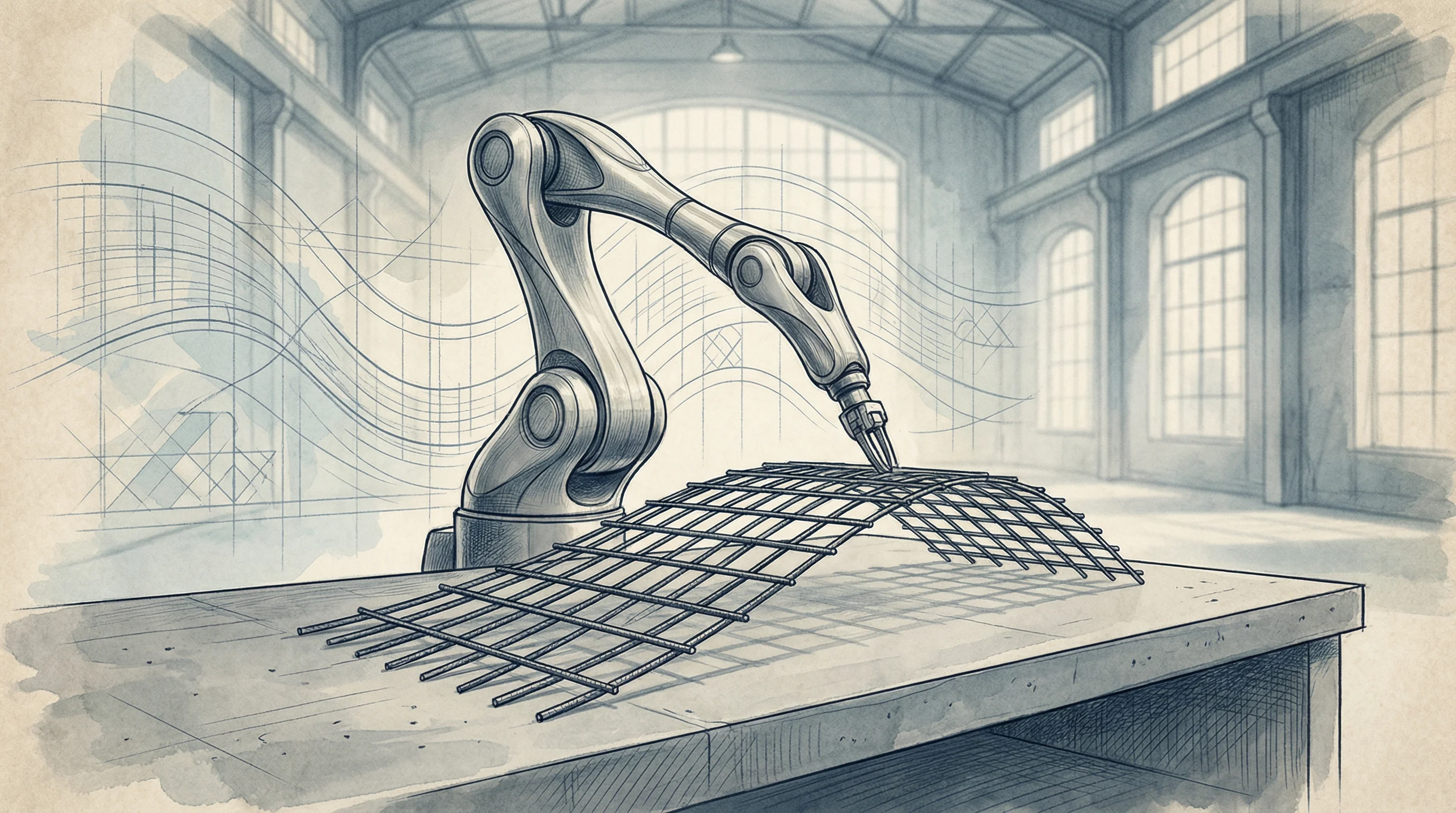
The product line is modular: machine-tending modules for stirrup benders, multi-robot assembly cells, and robotic tying and welding systems. An in-line quality control layer—critical in an industry where rework can blow budgets—aims to catch errors before they're cast in concrete. In 2023, MESH secured a patent assignment from ETH Zurich for "robotic mesh structure generation for concrete formwork and reinforcement."

Whether those patents translate into defensible competitive moats remains an open question. Construction robotics is littered with promising prototypes that never scaled.
The Broader Automation Wave—and Its Limits
The seed capital will fund what MESH and Sika describe as "global expansion" of robot-supported reinforcement manufacturing, with a focus on infrastructure and precast facilities where repetitive rebar work can be moved indoors and subjected to digital planning workflows. Sika emphasized the potential to bundle MESH's automation with its own materials portfolio in those segments—a vertical integration pitch that may resonate with contractors squeezed by labor costs.
The timing, at least, is favorable. Bedrock Robotics pulled in $270 million earlier this year for autonomous earthmoving equipment. Gravis Robotics raised $23 million in late 2025 for AI-driven construction machinery. A recent survey by Zacua Ventures found that AI and robotics ranked among the top investment themes cited by ConTech investors—a sentiment that would have seemed fanciful a decade ago.
Still, the International Federation of Robotics continues to classify construction service robots as a niche segment. For all the capital flowing into the space, actual deployments remain scattered. Construction, unlike manufacturing, is stubbornly site-specific: every project is a prototype. MESH's bet is that rebar—standardized, repetitive, and painful to fabricate by hand—is the exception.
Whether the industry agrees will determine if MESH's seed round is the start of something larger, or just another well-funded experiment in a sector that has seen plenty of both.


