

The data center infrastructure world doesn't often move in lockstep. But when Johnson Controls and Legrand—two companies whose products quietly power much of the world's built environment—both write checks to the same three-year-old startup, it's worth asking what they see coming.
Accelsius, the Austin outfit commercializing cooling technology originally developed at Nokia Bell Labs, closed a $65 million Series B in January 2026, with Johnson Controls leading and Legrand taking a strategic position. It's the kind of deal structure that signals more than financial backing. Legrand negotiated board representation and veto rights on certain decisions. Johnson Controls came in twice: a roughly $25 million tranche last October, then another $10 million to help close the round December 29, according to SEC filings. Legrand added $30 million in that final push.
The round brings Accelsius's total raised to around $90 million, up from a $24 million Series A just over a year ago. But the money, substantial as it is, tells only part of the story.
When Air No Longer Cuts It
What Johnson Controls and Legrand are betting on is a fairly specific thesis: that the era of air-cooled data centers is ending faster than most people realize, and two-phase liquid cooling—still a niche technology—will become infrastructure table stakes as AI workloads push thermal density into territory that fans and chillers simply can't manage.
Accelsius's NeuCool system tackles that problem with a dielectric refrigerant that's waterless and carries an ASHRAE A1 safety rating with low global warming potential. The company claims it can handle heat loads north of 80 kilowatts per rack—densities that are becoming routine as AI model training and inference operations pack more compute into tighter spaces. At the chip level, Accelsius has demonstrated 4,500 watts per GPU socket cooling, keeping processors below thermal throttle thresholds even when facility water runs at 40 degrees Celsius.
That's warmer than competing liquid solutions typically require—6 to 8 degrees warmer, in fact. Which translates, the company says, into more than 25% savings on cooling energy and longer stretches of free-cooling operation when outside temperatures cooperate. Compared to traditional air cooling, Accelsius projects energy reductions in the 40 to 50% range overall.
A reference study conducted by Jacobs found the NeuCool system delivers annual operating expense savings of 35 to 44% versus single-phase direct-to-chip designs, with total cost of ownership improvements of 8 to 17% over five years. Whether those numbers hold at scale remains to be seen—pilot projects and full deployments don't always behave the same way.
The Pipeline Tells Its Own Story

Accelsius isn't just pitching whitepapers. The company announced a 300-megawatt deployment with DarkNX for an AI campus in Ontario, with the first phase targeting two 65-megawatt facilities by late 2026 or early 2027. Systems are already in place at Equinix's Ashburn Co-Innovation Facility, Global Switch London, and labs with Computacenter UK and Telehouse London Docklands. A partnership with iM Data Centers covers a 10-megawatt facility in Miami that's expected to scale to 40 megawatts.
Innventure, the parent company that founded Accelsius in 2022 after acquiring IP rights from Bell Labs, reported in its third quarter 2025 earnings that the startup's pipeline had crossed $1 billion. That's a figure worth scrutinizing—pipeline numbers can be squishy, and converting interest into signed contracts is where many infrastructure startups stumble. Still, it suggests momentum.
What the Money Buys

Accelsius plans to expand manufacturing capacity at its Austin headquarters, accelerate what it's calling global expansion, and scale production of its two-phase cooling products. The company launched its MR250 in-row cooling distribution unit at the OCP Global Summit last October—a system designed to deliver 250 kilowatts of capacity across up to four racks. Its IR80 in-rack unit handles roughly 80 kilowatts.
CEO Josh Claman, who cut his teeth in roles at Dell and Stratasys, leads a team that includes CTO Richard W. Bonner III, formerly of Advanced Cooling Technologies. The company makes a point of noting that 85% of its Tier 1 vendors are North America-based, a nod to supply chain concerns that have become almost reflexive in infrastructure conversations since pandemic-era disruptions.
The Broader Context
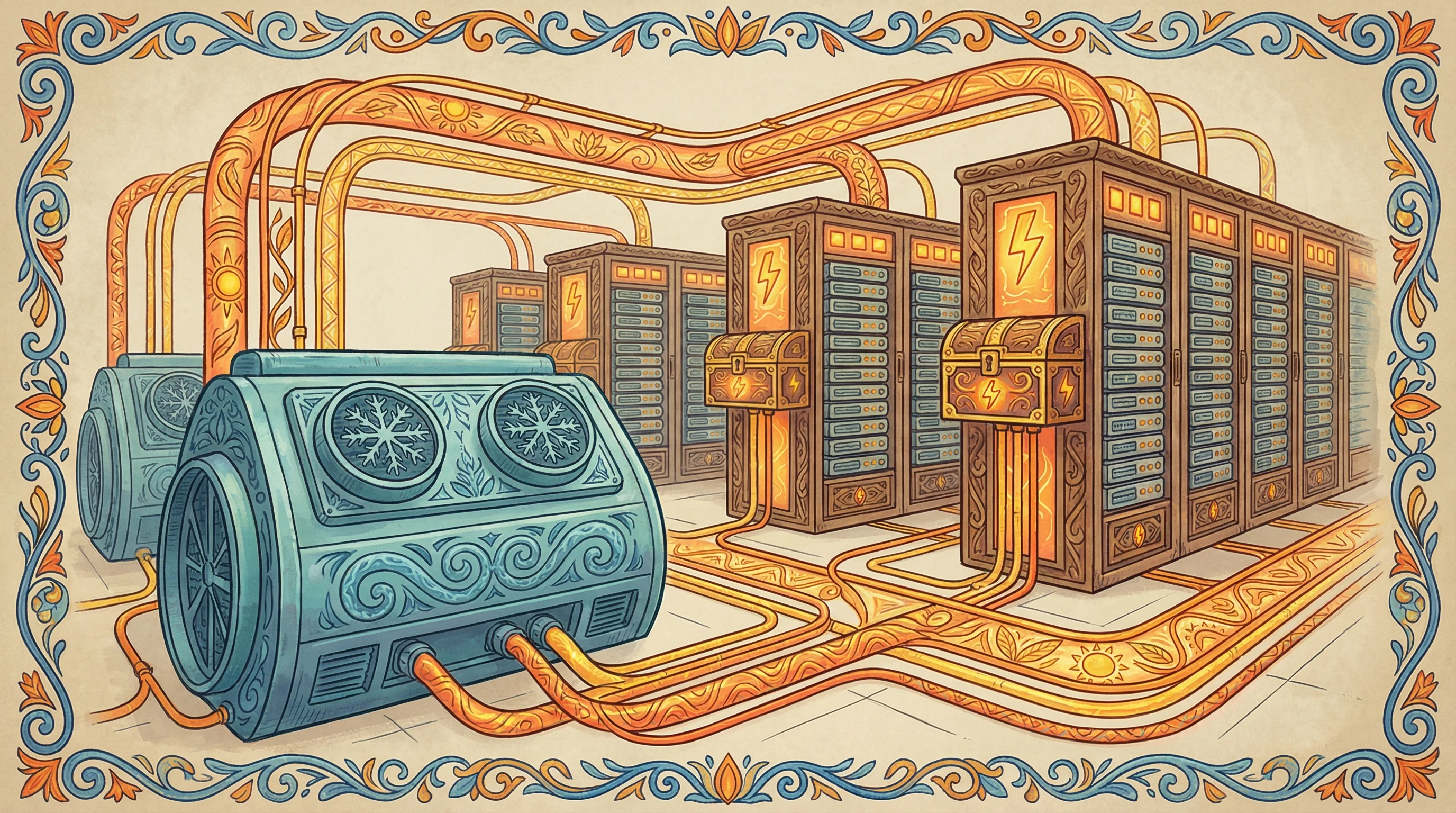
Johnson Controls brings more than capital. Its thermal portfolio—including the YORK YVAM chiller line—aligns with a broader data center push the company has been telegraphing for months. Legrand's move makes sense through a different lens: it already supplies power distribution and rack infrastructure, and cooling is the natural adjacent layer in that stack.
Both are making calculated bets that AI's computational appetite will continue outpacing Moore's Law's ability to deliver efficiency gains, forcing the industry toward more aggressive thermal management. Perhaps the real signal isn't the technology itself—two-phase cooling has been around in various forms for years—but that two establishment players are willing to commit this much capital and governance attention to a company barely out of its startup phase.
The question, as always, is whether the infrastructure build-out everyone expects actually materializes at the pace and scale the forecasts assume. For now, Accelsius has the backing, the pipeline, and the technology demonstrations. What it needs next is repeatability at volume—the unglamorous work of turning pilot wins into production deployments that pencil out quarter after quarter.
That's where the real test begins.


