

The champagne was still flowing from the October chemistry Nobel when the reality check arrived.
AlphaFold 3 had landed five months earlier with the kind of computational swagger Silicon Valley loves—predicting protein-ligand interactions and nucleic acid complexes with a precision that felt almost unsporting. By early 2025, pharmaceutical executives were doing the math on napkins: maybe 30% faster discovery timelines, perhaps 50% cost cuts if the models held up. The architects of computational structure prediction had their Stockholm moment. The future, it seemed, had arrived on schedule.
Then the labs started drowning.
Not the computational labs, mind you. Those were humming along just fine, spitting out protein candidates at a pace that would have seemed like science fiction a decade ago. The bottleneck emerged somewhere far less glamorous: the characterization facilities, where mass spectrometry runs began piling up like delayed flights at O'Hare. Binding kinetics studies developed backlogs measured in weeks. Glycosylation mapping—the painstaking work of understanding sugar modifications on proteins—waited on manual curation that no algorithm could yet replace.
Discovery, it turned out, was moving at the speed of transformers and diffusion models. Characterization was still moving at the speed of instrument cycles and exhausted postdocs.
When the Math Stops Working
The front end of drug development has been thoroughly rewritten. AlphaFold 3, the brainchild of DeepMind and its biopharma sibling Isomorphic Labs, extended structure prediction beyond isolated proteins to the messier reality of complexes—complete with ligands, ions, and the post-translational modifications that textbooks love to footnote. De novo design tools now generate candidate libraries at industrial scale. One consultancy, perhaps optimistically, pegged generative AI as a $4 billion to $7 billion annual opportunity across biopharma operations, with discovery and preclinical work sitting in the bullseye.
But the analytical infrastructure? It hasn't so much kept pace as politely declined to try.
Protein characterization—the unglamorous work of verifying sequences, mapping those sugar decorations, confirming higher-order structure, measuring how tightly two molecules actually bind—remains stubbornly instrument-intensive and labor-hungry. A 2023 review in the Journal of Proteome Research catalogued the persistent headaches in top-down proteomics: fragmentation bottlenecks, the nightmare of localizing post-translational modifications, deconvolution complexity that makes computational chemists wince. Industry veterans describe characterization timelines stretching weeks per candidate. Their AI counterparts, meanwhile, are proposing hundreds.
The math doesn't work. If discovery accelerates by half but characterization stays constant, the bottleneck doesn't disappear—it just migrates downstream. And with it goes the promised return on investment.
Why This Matters More Than You'd Think
Regulatory bodies and market dynamics are conspiring to turn characterization from a back-office function into a competitive weapon.
The FDA released a draft framework this January to assess AI model credibility in drug and biologic submissions. The agency wants validation data, monitoring plans, lineage documentation—the full audit trail. Translation: more analytical rigor, not less, even as the models get smarter. A separate draft guidance in October on biosimilar interchangeability shifted weight toward analytical similarity and pharmacokinetic data, potentially easing the default requirement for head-to-head efficacy trials.
Read between the regulatory lines: high-resolution characterization—glycoform profiling, charge variant mapping, structural confirmation at resolutions that would have been aspirational five years ago—now carries more weight in approval pathways than it ever has.
The established standards, ICH Q6B and Q5E, already call for structural characterization "to the extent possible." As methods improve, that extent keeps expanding. A recent aflibercept biosimilar study (SB15) documented multi-method panels spanning primary sequence through bioactivity before heading into limited clinical confirmation. That's not exceptional anymore. That's table stakes.
The proteomics market is responding with the kind of growth projections that make CFOs pay attention. Multiple research firms project 11% to 12% compound annual growth through the early 2030s, with mass spectrometry capturing roughly 30% of the technology share and pharma and biotech representing 73% of demand. Mordor Intelligence valued the global proteomics market at $44.8 billion this year, climbing toward $134.8 billion by 2035. The mass spectrometry segment for drug discovery alone is expected to nearly double from $890 million in 2024 to $1.69 billion by 2031, according to MarketsandMarkets.
Deloitte's 2025 Life Sciences Outlook found that roughly 60% of executives plan to increase generative AI investments across R&D—but patent cliffs and biosimilar competition are raising the stakes for faster, more efficient analytics. BCG noted that AI-native biotechs are already outpacing incumbents, and scaling AI enterprise-wide could unlock 5% to 15% revenue growth.
The implication: whoever solves the characterization bottleneck captures the productivity gains AI actually promised, not the ones it advertised.
The Technology Fighting Back

A wave of next-generation platforms is attacking different layers of the characterization stack, with varying degrees of Silicon Valley swagger and laboratory pragmatism.
High-throughput biophysics is getting serious. Carterra's Vega and LSA systems claim throughput in the thousands—20,000-plus compounds daily, 200,000-plus interactions weekly—via 48-channel parallel surface plasmon resonance. It's pushing binding kinetics and epitope binning earlier into discovery, where decisions are cheaper to make. Sartorius launched the Octet R8e in May, boosting biolayer interferometry sensitivity with 96- and 384-well plate compatibility and lower sample volumes. Nicoya introduced its Alto Automation Suite in January, integrating digital SPR with Opentrons robotics and cloud APIs to chew through thousands of samples weekly.
The pitch is consistent: collapse weeks of binding studies into days, with automated data pipelines feeding directly into decision systems. Whether the promise matches the reality is something labs are figuring out in real time.
Mass spectrometry is getting an AI makeover. Thermo Fisher unveiled its Stellar MS system in 2024 for high-throughput quantitation, part of a broader Orbitrap platform refresh. The company dropped $3.1 billion on Olink in July 2024, adding proximity extension assay technology to its arsenal. By January, Olink had landed the UK Biobank Pharma Proteomics Project—profiling over 5,400 proteins across 600,000 samples, the kind of dataset that makes computational biologists salivate. Illumina followed with a pilot analyzing 50,000 UK Biobank samples using NGS-based proteomics, roping in deCODE, Standard BioTools, and pharma heavyweights including GSK, Johnson & Johnson, and Novartis.
On the software side, Protein Metrics keeps iterating its Byosphere suite for peptide mapping, glycan analysis, and data-independent acquisition workflows, emphasizing vendor-neutral, templated reporting for CMC packages—the regulatory submissions where precision matters and mistakes get expensive. PEAKS and ProteoformX tackle intact and top-down sequencing. Transformer-based models are emerging for de novo peptide sequencing in DIA data, with preprints showing zero-shot learning for DIA representation.
The ambition: turn raw mass spec data into regulatory-ready reports in minutes rather than weeks. The reality is messier, but the trajectory is clear.
Single-molecule and orthogonal methods are maturing. Quantum-Si's benchtop single-molecule sequencing platform continues generating clinical proteomics and pathogen detection papers through this year and next. Erisyon secured a $2.2 million CPRIT grant in January to develop immuno-oncology diagnostics via its Fluorosequencing approach. Nautilus announced an agreement with the Allen Institute in July for tau and Alzheimer's studies using single-molecule iterative mapping. Refeyn's mass photometry—recognized in the 2025 draft USP chapter on AAV standards—offers rapid, low-sample orthogonal quality control. The company reported its 500th global install, the kind of milestone that suggests the technology is moving beyond early adopters.
Automation and cloud infrastructure are filling gaps. Opentrons announced in January that its Flex robot surpassed 100 open-source protocols, including sample prep for proteomics workflows. A 2026 collaboration with NVIDIA aims to enable "physical-AI" closed-loop experimentation, though the details remain vague enough to raise eyebrows. Emerald Cloud Lab operates a fully instrumented remote facility with integrated analysis stacks and ALCOA+ data integrity—a model for pooling expensive characterization instruments across geographies while maintaining audit trails that satisfy regulators.
Then there are the startups betting their futures on this bottleneck.
David Roberts, CEO and founder of 10x Science, a Y Combinator Winter 2026 company, framed the opportunity with typical founder directness in the startup's launch post: characterization is the bottleneck, and current platforms force teams to choose between speed and depth. His pitch—an AI-native platform reducing analysis time from weeks to minutes—targets pharmaceutical and biotech teams, academic cores, and contract research organizations, claiming potential savings exceeding $150,000 per team monthly.
Roberts brings a pedigree that looks good on pitch decks: a former postdoc in Nobel laureate Carolyn Bertozzi's lab at Stanford with 37-plus publications. His co-founders include Andrew Reiter (Broad Institute Proteomics, Stanford Biology PhD candidate) and Vishnu Tejus (two-time YC founder, founding engineer at Nooks). Bertozzi publicly congratulated the team on LinkedIn, noting the focus on "next-gen protein characterization (including glycoproteomics!)." The exclamation point, one imagines, is doing heavy lifting.
The company's positioning reflects a broader industry realization that arrived later than it should have: AI-accelerated discovery demands AI-accelerated characterization. The alternative is watching your pipeline become a very expensive traffic jam.
Regulatory Winds at Your Back (or in Your Face)
The FDA's evolving guidance framework is amplifying the return on investment for automated, validated analytics—assuming companies can execute.
That January draft on AI credibility in submissions signals rising scrutiny of model validation, performance monitoring, and data lineage. Biopharma companies deploying AI for discovery or manufacturing will need auditable, reproducible analytical pipelines to satisfy reviewers increasingly literate in machine learning jargon. That favors platforms with built-in traceability, version control, and standardized reporting—features legacy software stacks often lack, having been designed in an era when "the cloud" meant bad weather.
The October biosimilar guidance draft shifts the evidentiary burden further toward analytical similarity. If comparative clinical efficacy is no longer the default requirement, demonstrating structural and functional equivalence through characterization becomes the submission centerpiece. Waters emphasized this trend in 2025 product updates, highlighting end-to-end traceability and data integrity in its Alliance iS HPLC system and waters_connect 4.1 software. Bruker's majority stake in Biognosys, announced in 2023, expanded access to Spectronaut and proteomics CRO services—another signal that analytical depth has become a competitive differentiator rather than a commodity service.
Pharmacopeial bodies are reading the same tea leaves. USP's draft Chapter 1029 on good documentation practices and data integrity, published for comment this year, reinforces expectations for lifecycle-managed analytical procedures. The draft AAV chapter recognizes mass photometry as an orthogonal method, validating newer techniques alongside traditional approaches and opening doors for technologies that couldn't have cracked the standards a decade ago.
The regulatory message is consistent, if not exactly subtle: as AI tools proliferate, the analytical controls around them must tighten. Companies that view this as bureaucratic burden rather than strategic opportunity are setting themselves up for disappointment.
What Happens Next
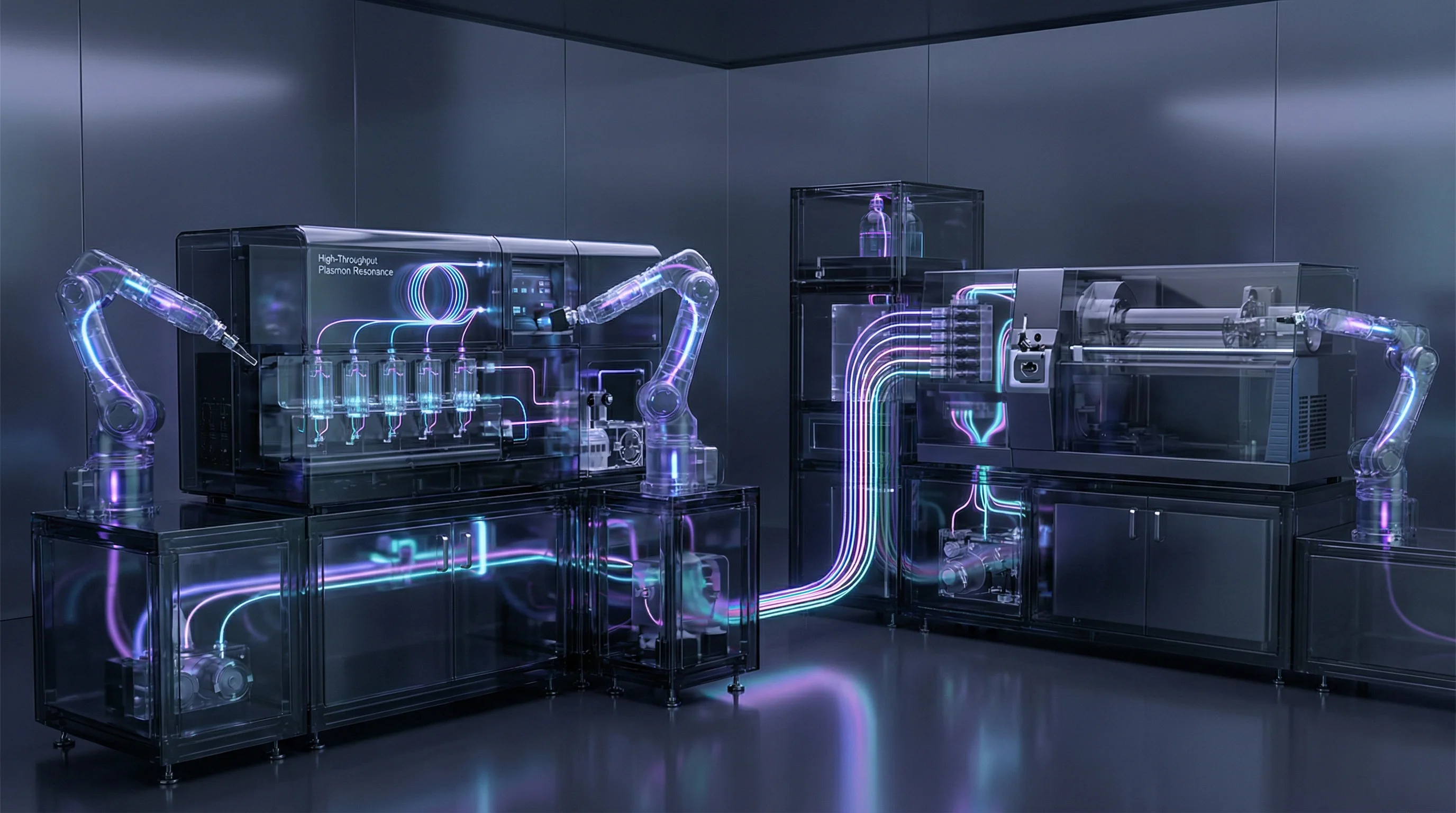
Characterization is shifting left in the development timeline—earlier, higher throughput, deeper integration, more automation. The technology exists to match AI discovery speeds, at least in theory. High-throughput SPR and BLI can screen binding kinetics at scale. Next-generation mass spec platforms with AI-assisted data processing can handle intact analysis, peptide mapping, glycan profiling, and DIA quantitation in unified workflows that would have required separate instruments and weeks of expert time not long ago. Single-molecule sequencing and mass photometry offer orthogonal validation. Cloud labs and automated workcells eliminate manual bottlenecks that nobody particularly enjoyed anyway.
The question isn't capability. It's execution.
McKinsey noted in January that many biopharma AI initiatives remain stuck in what one executive colorfully described as "pilot purgatory"—failing to scale into high-impact operations because nobody wants to be the one who greenlit the expensive mistake. BCG observed that AI-first biotechs move faster precisely because they design analytics infrastructure alongside discovery from day one, rather than attempting to retrofit legacy systems designed in an era when "AI" meant expert systems running on VAX clusters.
For incumbents, the path forward likely involves hybrid models: vendor-neutral software stacks that unify data from Thermo Fisher, Waters, Bruker, and emerging platforms; automation layers that integrate biophysics, mass spec, and reporting into end-to-end pipelines; and partnerships with AI-native startups that can accelerate the characterization feedback loop without requiring multi-year internal builds.
Population-scale proteomics projects—UK Biobank's 600,000-sample study, for instance—will generate massive training datasets, feeding next-generation AI models for risk prediction, diagnostics, and target validation. Those same models, refined on population data, will inform drug development analytics, creating a virtuous cycle between discovery and characterization. Or so the theory goes. The pharmaceutical industry has seen enough virtuous cycles get tangled in reality to maintain healthy skepticism.
The bottleneck is real. But it's also, most likely, temporary. The companies that solve it first—whether through internal builds, strategic acquisitions, or partnerships with AI-native platforms still pitching to Sand Hill Road—will capture the full productivity gains AI discovery promises. The ones that don't will watch their pipelines stall, candidates pile up in characterization queues, and competitors pull steadily ahead.
AI accelerated discovery, delivering on years of hype faster than most expected. Now it's characterization's turn. The champagne will have to wait.


