

The robotaxi wars appeared settled—at least in the United States. Then Waymo decided it wasn't enough.
On February 2, 2026, Alphabet's autonomous driving subsidiary closed a $16 billion financing round that values the company at $126 billion, nearly triple its standing just sixteen months ago. It's the kind of valuation spike that makes venture capitalists giddy and skeptics nervous. But more striking than the number itself is what Waymo plans to do with the capital: expand into more than twenty additional cities this year, including London and Tokyo, its first international markets.
The mega-round—co-led by Sequoia Capital, DST Global, and Dragoneer Investment Group—lands amid mounting evidence that self-driving taxis aren't a parlor trick anymore. They're approaching real business. Waymo now completes more than 400,000 rides each week across six U.S. metros. That's 15 million rides in 2025 alone, triple the year before.
Alphabet remains the majority backer, as expected. But the syndicate reads like a who's who of venture royalty: Andreessen Horowitz, Mubadala Capital, Bessemer, Silver Lake, Tiger Global, T. Rowe Price, Fidelity, Kleiner Perkins. Even CapitalG and GV, Alphabet's own investment arms, piled in. The breadth of the investor roster suggests something has shifted—perhaps more than the founders expected—in how seriously the market takes autonomous mobility.
From Pilot to Platform
Waymo's journey from moonshot project to commercial enterprise has been longer and more turbulent than Google's founders might have imagined when they launched the effort in 2009. For years, critics dismissed the technology as perpetually five years away. The $126 billion valuation suggests investors believe that clock has finally run out.
The last time Waymo raised outside capital, in October 2024, it commanded a roughly $45 billion valuation on a $5.6 billion Series C. That was impressive. This is something else entirely—a near-tripling in just over a year.
What changed? Scale, mostly. Waymo operates in Phoenix, the San Francisco Bay Area, Los Angeles, Austin, Atlanta, and Miami (where service begins this year). The company has logged more than 127 million fully autonomous miles and delivered over 20 million lifetime rides. Its safety data, which claims a 90 percent reduction in serious-injury crashes compared to human drivers, has given regulators room to approve broader deployments.
But numbers only tell part of the story. Waymo's newest robotaxi stack—its sixth generation—features fewer sensors, sharper imaging, and refined lidar and radar systems designed for high-volume manufacturing. The company is moving away from the boxy Jaguar I-PACE that became its signature vehicle. Instead, it's deploying the Zeekr RT minivan and Hyundai Ioniq 5, both better suited for production at scale.
That manufacturing happens at a 239,000-square-foot facility in Mesa, Arizona, run in partnership with Magna. The plant integrates Waymo's autonomous driving system into vehicles and aims to produce tens of thousands of units annually. By the end of 2026, Waymo expects to have roughly 3,500 vehicles on the road, up from about 1,500 today.
The International Gambit
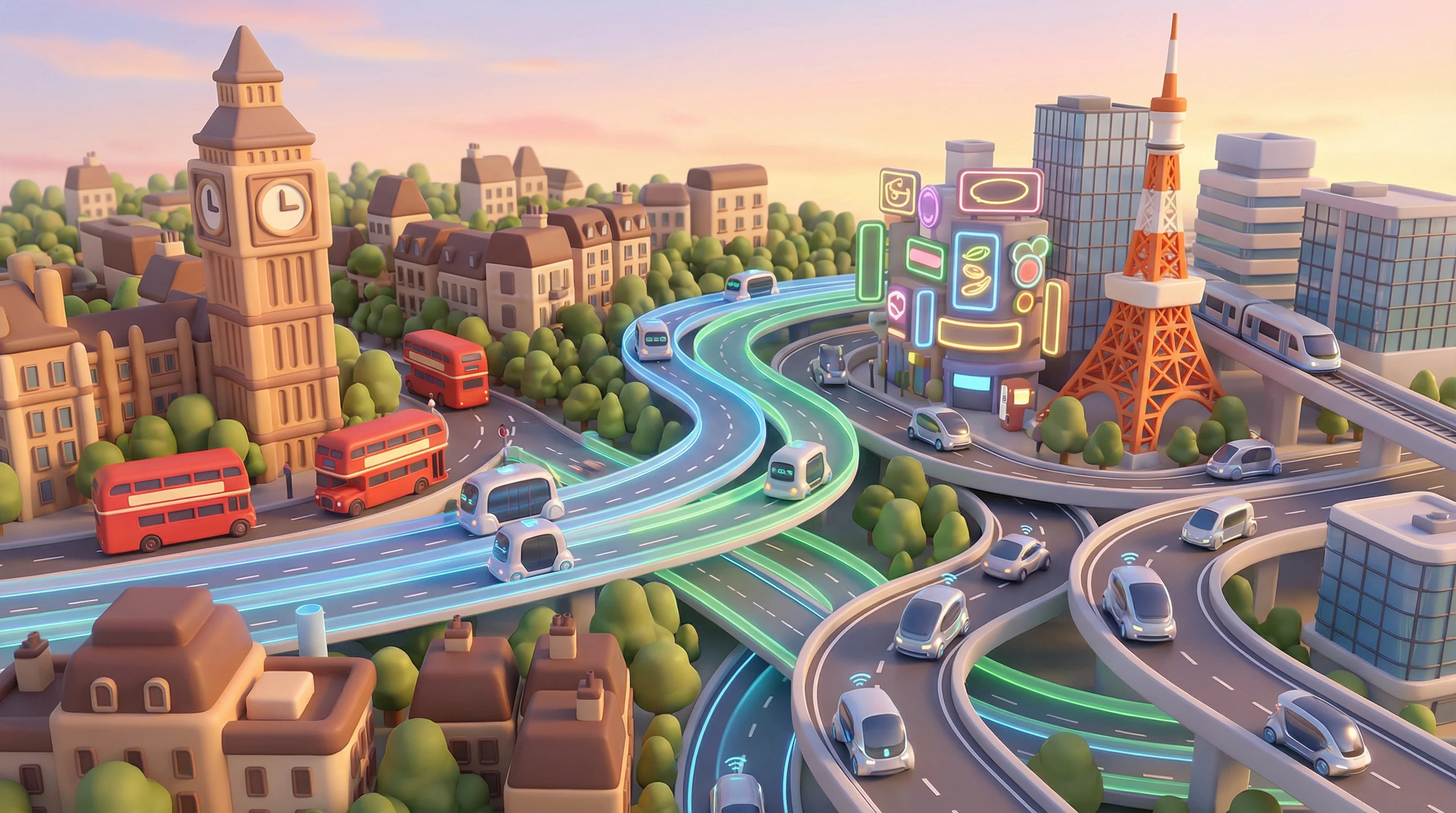
London and Tokyo aren't random choices. Both cities have dense urban cores, sophisticated public transit systems, and regulatory frameworks that—at least in theory—might accommodate autonomous vehicles more readily than U.S. cities hobbled by patchwork state laws.
Still, Waymo hasn't disclosed launch timelines beyond "2026," a vagueness that hints at the complexity ahead. Autonomous driving technology that works in sunny Phoenix doesn't necessarily translate to London's narrow streets or Tokyo's labyrinthine neighborhoods. Weather, pedestrian behavior, traffic patterns—all vary wildly. Waymo will need to prove its system adapts.
The international push also reflects strategic necessity. Waymo's primary U.S. competitor, GM's Cruise, imploded in late 2024 after a series of mishaps forced the company to shut down robotaxi operations. GM laid off staff and folded what remained of Cruise into its broader organization, pivoting toward advanced driver-assistance systems instead of fully autonomous ride-hailing.
That left Waymo with a surprisingly open field—at least temporarily. Amazon-backed Zoox is gearing up to launch paid rides in Las Vegas this year, scaling production at its Hayward, California, facility. Tesla, meanwhile, continues to promise robotaxis centered on Austin, though Elon Musk's timelines have proven elastic. Uber, which partnered with Waymo for exclusive service in Austin and Atlanta, sees autonomous vehicles as complementary to its human driver network rather than a replacement. Uber handles fleet operations—charging, cleaning, depot management—while Waymo focuses on the technology.
Speed Bumps
The fundraise comes at an awkward moment operationally. On January 23, a Waymo vehicle struck a child near a school in Santa Monica, triggering a federal investigation by the National Highway Traffic Safety Administration. Regulators are also examining the company's interactions with school buses in Austin after multiple incidents raised questions about how the vehicles navigate around stopped buses.
Then there was the December power outage in San Francisco that caused Waymo cars to stall across the city, forcing a temporary service suspension. The company scrambled to update software and protocols. And in Atlanta, Waymo launched a pilot program paying DoorDash gig workers to close robotaxi doors left ajar—an operational quirk the company says it's addressing but that highlights the unglamorous realities of running a robot fleet.
None of these issues appear to have spooked investors. "Waymo has demonstrated the ability to operate autonomous vehicles at scale and with industry-leading safety," said Sequoia partner Konstantine Buhler in the firm's announcement.
That confidence may be warranted. Waymo's safety record, imperfect as it is, still compares favorably to human drivers. But the incidents underscore a persistent truth: Autonomous vehicles don't need to be perfect, but they need to be better—or at least perceived as better—than the alternative. A single high-profile accident can erase public trust faster than a million safe rides can build it.
The Profitability Question
Co-CEOs Tekedra Mawakana and Dmitri Dolgov have framed this round as the capital required to reach "global scale" while maintaining safety standards. That's the right language for a company still losing money on every ride.
Waymo generates an estimated $350 million in annual recurring revenue. Projections suggest that figure could hit $2.5 billion by 2030. Whether that's enough to justify a $126 billion valuation depends on assumptions about margin, market size, and how quickly competitors close the gap.
Robotaxis promise structural advantages over human-driven ride-hailing: no driver wages, 24/7 availability, consistent service quality. But those benefits come with offsets—vehicle maintenance, remote operator oversight, insurance, and the capital intensity of building fleets from scratch.
Investors betting on Waymo are wagering that the unit economics eventually work, that cities embrace rather than resist autonomous vehicles, and that no rival leapfrogs the technology. Those are big ifs. Then again, $16 billion in fresh capital buys a lot of runway to figure it out.
For now, Waymo has what every ambitious startup craves: resources, momentum, and a clear shot at defining a new category. Whether London and Tokyo prove as welcoming as Phoenix remains to be seen. But the company has moved past the hardest question—can this even work?—and into the more complicated realm of making it profitable.
That, in some ways, is progress.


