

David S. Roberts remembers the monotony. Hours bent over mass spectrometers at Stanford, coaxing proteins to reveal their secrets one laborious analysis at a time. The work demanded precision—no question—but the pace was glacial. A single sample might take weeks to process from start to final report. Which meant, of course, that drug development timelines were bleeding money the entire time.
He wasn't an outlier. Talk to anyone in biopharma analytics and you'll hear versions of the same story. Protein characterization, it turns out, has become something of a silent assassin in drug development, a bottleneck so severe it's blamed for derailing roughly three-quarters of FDA applications before they reach approval.
The data is blunt. Between 2020 and 2024, the FDA sent Complete Response Letters—essentially rejections requiring fixes—to 202 drug applications. Of those, 150 cited problems with quality, manufacturing, or the catch-all category known as chemistry, manufacturing, and controls. That works out to 74%.
Here's the paradox: While discovery labs race ahead with AI tools like AlphaFold 3 (which arrived in May 2024 and can now predict intricate protein structures alongside nucleic acids and ligands), the downstream analytics infrastructure remains stubbornly, almost defiantly, manual. It's perhaps the most expensive mismatch in modern drug development. And it's costing companies roughly half a million dollars per day.
When Minutes Become Millions
Those aren't hypothetical costs. Recent industry analyses peg the loss at approximately $500,000 for each day a biologic waits for regulatory approval, with Phase II and III trials torching another $40,000 daily just to keep operations running. These aren't the splashy blockbuster figures you sometimes see quoted (those can hit $1 million per day), but they're the averages that apply across the broader pipeline. When protein characterization drags on for weeks instead of minutes, the arithmetic gets brutal fast.
The pressure is mounting. Biologics made up 32% of new drug approvals in 2024. Early projections for 2025 suggest a mix trending toward 70% small molecules, 30% biologics—a ratio that reflects growing complexity. The pipeline itself has never been more intricate. As of 2024-2025, there are over 19 approved bispecific antibodies and more than 200 antibody-drug conjugates in various stages of development. Each one demands exhaustive characterization: higher-order structure, post-translational modifications, glycosylation patterns, aggregation profiles, comparability studies. The analytical workload scales exponentially as molecules get more sophisticated.
Roberts encountered this disconnect during his postdoc in Carolyn Bertozzi's lab, where chemical biology and glycobiology research churned out a steady stream of protein candidates. His co-founder, Andrew Reiter, hit similar walls in the Broad Institute's proteomics group under Steven Carr, and later during his Stanford PhD, co-advised by Bertozzi and Or Gozani. The pattern held: discovery teams could design and identify promising molecules faster than analytical teams could characterize them. Much faster.
That imbalance has only widened. In late 2025, Eli Lilly partnered with Nvidia to build an AI supercomputer dedicated to drug discovery. The AI-in-drug-discovery market is projected to balloon from $1.7 billion in 2024 to $8.5 billion by 2030—a 31% compound annual growth rate. Yet the analytical infrastructure? It's barely budged. A February 2026 industry report noted that biopharma R&D productivity continues to sag despite record pipeline scale, with success rates falling even as spending climbs.
Which is why Roberts, Reiter, and their third co-founder Vishnu R. Tejus—a twice-YC founder with experience engineering AI systems across labs at UW, UCSF, and Stanford—launched 10x Science through Y Combinator's Winter 2026 batch. Their pitch is straightforward: an "AI-native platform for next-generation protein characterization" designed to unclog the CMC analytics bottleneck so development pipelines can actually keep pace with AI-powered discovery.
The Gauntlet
Understanding what 10x Science is attempting requires grasping what comprehensive protein characterization actually entails. Start with intact mass analysis to confirm molecular weight. Then peptide mapping to identify sequence variants and post-translational modifications. Layer in glycosylation profiling—especially critical for antibodies, where glycan structures affect both efficacy and immunogenicity. Add higher-order structure studies using hydrogen-deuterium exchange mass spectrometry or native MS. Include biophysical characterization via surface plasmon resonance, biolayer interferometry, or differential scanning fluorimetry. Follow with size-exclusion chromatography coupled to multi-angle light scattering to assess aggregation.
Each technique generates mountains of data. Each demands specialized expertise to interpret. And each step remains largely manual, performed by highly trained analytical chemists who are, increasingly, in short supply. A May 2025 article in The Analytical Scientist predicted that AI-controlled, user-friendlier chromatography would likely emerge as training gaps widen and specialization for emerging modalities becomes necessary.
Progress has been made, to be fair. Multi-attribute methods (MAM)—which use liquid chromatography-mass spectrometry to simultaneously track multiple product quality attributes—have matured considerably. Amgen, Novartis, and others have shown that MAM can transition from characterization into quality control with proper automation and validation. A Novartis case study using Genedata's software reported sample processing times under 1.5 minutes with high sensitivity and low false positives. Waters integrated multi-angle light scattering detectors into its Empower software in 2025 to simplify biologics QC and regulatory compliance.
Still, the gap persists. In a LinkedIn post from late February 2026, Roberts noted that FDA data on Complete Response Letters underscores how slow, manual protein characterization remains a key driver of the CMC crisis. His framing: 10x Science aims to be the "throughput layer" for characterization, automating raw-to-report workflows and scaling analysis without adding headcount linearly.
The Automation Wave—and Its Limits

The company is entering a market in flux. The mass spectrometry market is projected to grow from $6.6 billion in 2024 to $10.7 billion by 2030, with proteomics as the largest application segment. The broader proteomics market shows even stronger growth: one estimate tracks expansion from $28.3 billion in 2024 to $38.5 billion by 2026, with a long-term compound annual growth rate around 16.5% through 2035.
AI adoption in proteomics is picking up speed. Tools like DIA-NN (data-independent acquisition with deep neural networks) have enabled robust, high-throughput peptide identification across diverse instruments. A 2024 study demonstrated AI-based quality control metrics for data-independent acquisition that achieved AUCs up to 0.97 across 21 instruments, 9 labs, and 31 months of data. Foundation models are starting to emerge; DIA-CLIP, introduced in early 2026, explored zero-shot peptide-spectrum inference.
Instrument vendors have poured money into this space. Bruker advanced machine learning-enhanced 4D-proteomics with timsTOF platforms and tools like TIMSrescore. Evosep unveiled the Eno LC front-end at ASMS 2025, targeting over 500 samples daily with deep coverage. Thermo Fisher completed its acquisition of Olink in July 2024 to expand next-generation proteomics capabilities. Illumina closed its acquisition of SomaLogic on January 30, 2026, strengthening its multi-omics footprint.
Software players have consolidated around enterprise analytics. Genedata's Expressionist platform automates high-throughput mass spectrometry characterization and is deployed across leading biopharma companies. Protein Metrics (acquired by Insightful Science/Dotmatics) provides peptide mapping, intact mass, and glycan/PTM analytics. Waters, SCIEX, Thermo Fisher, and Bruker each offer proprietary software ecosystems tied to their hardware. TetraScience has built a Scientific Data & AI Cloud that harmonizes analytical data across sites, with expanded partnerships at Bayer and Organon, plus integrations with Microsoft, Google Cloud, Snowflake, and Thermo Fisher.
What 10x Science claims to offer is a layer above these systems: end-to-end automation that ingests diverse data types and outputs regulatory-ready reports in minutes rather than weeks. The value proposition hinges on reproducibility, speed, and the ability to scale without proportional headcount increases. Whether this proves meaningfully different in a crowded market will depend on execution, integration depth, and—perhaps most critically—the platform's ability to handle edge cases that typically require expert intervention. That last part is where many automation efforts stumble.
A Regulatory Window, Maybe
Timing might be on the company's side. The regulatory environment is both tightening and opening new pathways, depending on how you look at it. In March 2024, ICH finalized Q14 (Analytical Procedure Development) and Q2(R2) (Analytical Validation), harmonizing science- and risk-based approaches across regions and potentially offering flexibility for post-approval analytical changes when justified. The FDA expanded its Quality Management Maturity program on February 11, 2026, signaling continued focus on systems and culture that prevent quality failures.
More directly relevant: The FDA released draft guidance on using artificial intelligence to support drug development in January 2025. The agency established a CDER AI Council in 2024 and has been publishing cross-center alignment documents on responsible AI adoption. The message is cautiously encouraging. AI can play a role across the drug lifecycle if implemented with appropriate risk-based frameworks, validation, and explainability.
The FDA has demonstrated internal capability with analytical AI. CDER researchers published forced degradation studies of rituximab using multi-attribute methods, showing the agency's technical depth. The push toward AI-assisted quality control, coupled with ICH Q14's emphasis on analytical lifecycle management, creates something of an opening for platforms that can demonstrate robust validation and traceability.
Europe is moving in parallel. The EMA issued a draft reflection paper in April 2025 on tailored clinical approaches for biosimilar development, leaning more heavily on analytical characterization. Greater reliance on comparability analytics raises the stakes for high-fidelity methods, including advanced mass spectrometry approaches.
The regulatory context matters because it shapes adoption curves. If AI-driven characterization platforms can navigate validation requirements and earn regulatory acceptance—perhaps through successful case studies in early submissions—they could become infrastructure-level tools. If validation proves burdensome or regulatory questions linger, adoption will remain confined to internal development use cases. Which is still a market, just a smaller one.
A Crowded Field

The competitive landscape is layered. Established software vendors like Genedata and Protein Metrics have deep pharma relationships and compliant, validated workflows. Instrument manufacturers bundle increasingly sophisticated software with hardware sales, creating switching costs. Data platform companies like TetraScience target the harmonization layer, potentially complementary to or competitive with 10x Science depending on go-to-market strategy.
Emerging proteomics modalities add further complexity. Nautilus Biotechnology is targeting a late-2026 launch of its Voyager platform for single-molecule protein analysis, with early access beginning this year. Quantum-Si continues building its single-molecule protein sequencing ecosystem. Encodia is developing NGS-based protein analysis via ProteoCode. 10x Genomics launched Xenium Protein in August 2025 for same-cell RNA and protein spatial analysis. These technologies may complement or eventually compete with mass spectrometry-based characterization, depending on their cost, throughput, and regulatory acceptance trajectories.
The fundamental question—and it's not a trivial one—is whether the CMC bottleneck can be solved primarily through software or requires deeper integration with hardware, sample prep automation, and cross-site data infrastructure. Industry commentary suggests the problem is as much about talent scarcity and process standardization as it is about data analysis speed. That May 2025 review in The Analytical Scientist noted that training gaps are widening and specialization for emerging modalities is essential, hinting that software alone may not fully address the pipeline constraint.
The Behavior Problem
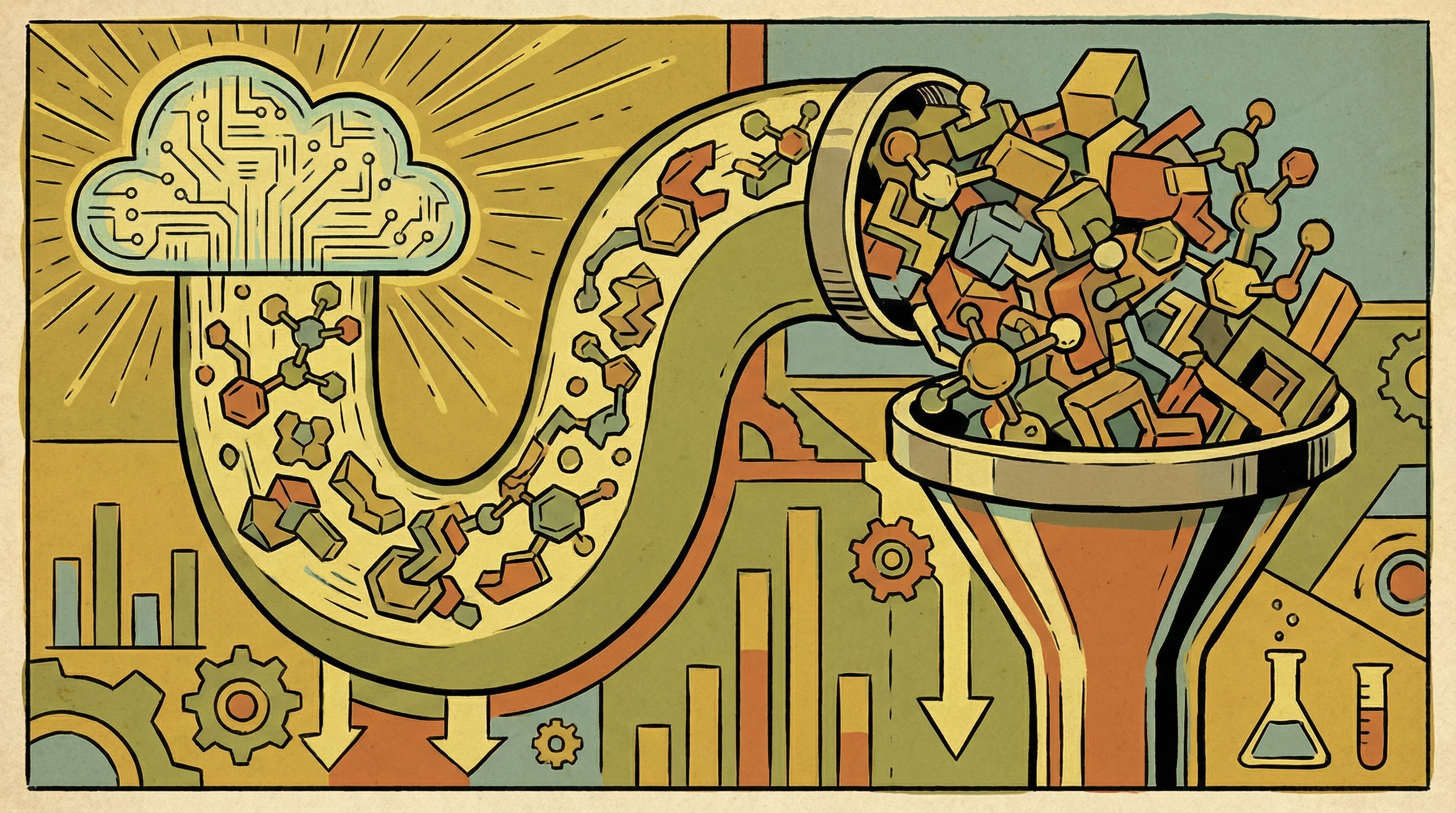
Still, the core insight that Roberts and his co-founders are pursuing seems sound. AI has moved the bottleneck downstream to development. Discovery teams can generate candidate molecules faster than analytical teams can characterize them. The cost of delay is quantifiable and painful. And the regulatory environment, while demanding, is creating pathways for validated AI tools.
If 10x Science can deliver on its promise—reducing characterization timelines from weeks to minutes with reproducible, regulatory-ready outputs—the market opportunity is substantial. The mass spectrometry market alone will add $4 billion in value by 2030. The proteomics market is growing at 16%-plus annually. And every day shaved off the path to approval is worth half a million dollars. The math works, assuming the platform works.
The harder challenge may be changing behavior. Analytical chemists have spent careers building intuition around protein data. CMC teams are conservative by necessity, given the regulatory stakes. Adopting an AI-native platform requires trust that the black box—or at least gray box, if the system offers explainability—can handle the nuances that currently require human judgment. Building that trust will require transparent validation, clear audit trails, and probably a few high-profile successes where automated characterization demonstrably accelerated a drug to approval.
Roberts spent years in the trenches of protein characterization. He knows the pain points intimately. Whether 10x Science can turn that expertise into a platform that reshapes an industry remains to be seen. But the opportunity is real, the timing is arguably right, and the need is urgent.
Three-quarters of FDA rejections cite CMC issues. Development costs compound daily. And the pipeline keeps growing more complex. Somewhere in that collision of constraints and capabilities, there's likely room for a company that can genuinely automate what has remained stubbornly manual. Whether 10x Science becomes that company—or simply one more well-intentioned entrant in a crowded field—will depend on execution, validation, and the willingness of a risk-averse industry to trust machines with judgments that have traditionally belonged to people.
For now, Roberts and his team are betting that the pain of delay has finally exceeded the pain of change. The next year or two will tell us if they're right.


