

The inbox never stops. Another AI team management platform. Another promise to orchestrate agents alongside human developers, another pricing tier that somehow makes less sense than the last one, another beta invite for a product that swears—this time, really—it has cracked the coordination problem.
Multiple platforms have surfaced in recent months with variations on the same pitch: development teams need an operating layer for hybrid human-AI workflows. The challenge for engineering leaders trying to separate signal from noise? These products don't even vaguely resemble each other.
Not in pricing. Not in philosophy. Not in what they think the actual problem is.
When Everyone Spots the Same Gap
Asana crystallized the pain point when it unveiled updates to its AI Teammates product at a London event this past summer. The enterprise software stalwart made the case that agents, for all their promise, aren't team players—they need infrastructure where humans and AI can collaborate on critical workflows without everything devolving into chaos. The argument resonated because it named something CTOs were already bumping into: agents perform admirably in isolation, but coordinating them at any real scale? That's a different beast entirely.
That observation appears to have opened the floodgates. Teamster.ai positions itself as an "AI Team Architect," mining Slack data to recommend agents and execute tasks. Free to start, then $99 monthly for Pro, then custom Enterprise pricing—the familiar SaaS climb. TeamAI.com targets a similar niche with custom agents and Jira integration via MCP, claiming adoption at various companies. TeamLead AI takes a developer-first stance, offering permanent free access for solo engineers plus GitHub integration for daily briefs and conflict detection.
Then there's Generacy.ai, which published a case study earlier this year in which the company claims it shipped a production legal platform in 27 days using 11 concurrent agents that opened 143 pull requests—95% of them originating from the AI side. Pricing runs $20, $50, or $100 per seat monthly, depending on your needs. Wok.io routes between Claude, GPT, Grok, and Gemini, charging $5 per agent and $10 per human seat. Agor.live bills itself as MCP-native with spatial boards and persistent assistants. Stellary.co is free during its beta phase, with an emphasis on human approval gates built into the workflow.
It's a lot. Perhaps more than anyone expected.
The Problem With Competing Visions
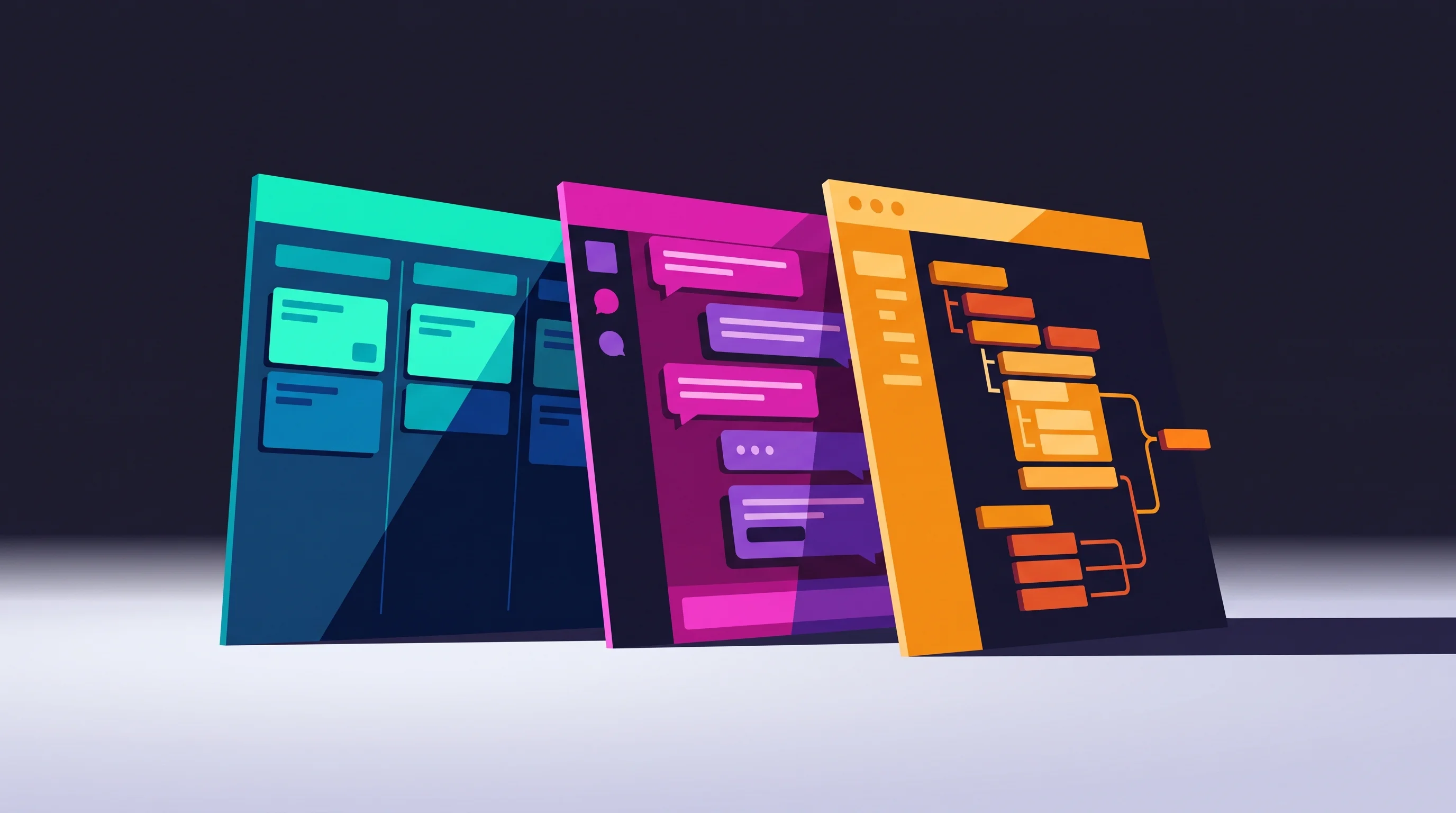
For a CTO trying to make an informed decision, the differences aren't cosmetic. Some platforms treat project structure—cards, boards, approval gates—as the foundational layer. Others assume Slack is where everything should happen. A few treat GitHub as ground truth and build from there. Pricing models range from per-seat to per-agent to per-interaction to the standard freemium-to-enterprise ladder. There's no consistency, which makes apples-to-apples comparisons nearly impossible.
Shortcut's Korey connector, detailed in research materials circulated mid-year, reports velocity improvements in the range of 37–40%—though those figures come from the vendor. Lucerna.team focuses on delivery risk and engineering economics rather than raw velocity metrics. The category hasn't even converged on shared success metrics, let alone a shared understanding of the core problem.
What's conspicuously absent is any clear signal about which approach will prevail. There's no Stripe moment here, no obvious platform pulling ahead in adoption or mindshare. Engineering leaders who want to weave AI agents into their workflows are left evaluating different products with different worldviews—many of them still invite-only.
The market, in other words, is a mess.
What Happens When You Actually Need to Ship

The practical difficulty is that most of these platforms haven't been stress-tested at scale. Agor.live is in private beta. Stellary.co remains free while it's in beta. TeamLead AI explicitly labels itself beta software. When Generacy published its case study—143 pull requests, 11 agents, a DigitalOcean cluster launched directly from the UI—it offered a tantalizing glimpse of what the company claims is feasible. But one success story doesn't establish a pattern, and it certainly doesn't clarify which architectural bets will age well.
The downside risk is adopting too early and getting locked into a platform that doesn't survive the inevitable consolidation. The upside is that early movers might shape these tools while they're still fluid enough to be influenced. Either way, the decision probably can't be postponed much longer. AI agents are already writing code in production environments at a growing number of companies. The question isn't whether to manage them—it's which operating layer to stake your infrastructure on when none of them have meaningful track records.
For now, the market remains stubbornly fragmented, and engineering leaders are left in the unenviable position of testing multiple platforms, comparing feature matrices that refuse to align, and making architectural commitments with incomplete information. It's not ideal, but it's the reality—at least until someone builds the category-defining product that everyone is still waiting for.
Or until the market decides that maybe this particular problem doesn't need a platform at all. That possibility, conspicuously, isn't part of anyone's pitch deck yet.


