

On a spring morning in Shanghai, a surgical team made what may prove to be a quietly significant moment in the brain-computer interface race: the first time a U.S.-based BCI company tested its device in a Chinese patient. The procedure, conducted by Cambridge-based Axoft, wasn't announced with fanfare—Bloomberg caught wind of it later—but it signaled an appetite for expansion that goes well beyond the startup's modest New England roots.
That appetite now has considerably more fuel. Axoft closed a $55 million Series A on April 29, 2026, led by C.P. Group Innovation, with backing from Alumni Ventures, Stanford President's Venture Fund, Hillhouse Investment, and Gaorong Ventures. It's the kind of round that doesn't just extend a runway; it builds new terminals. The company says it has raised more than $60 million since launching in 2021, a significant haul for a startup still in the early stages of human testing.
The capital will fund what every ambitious medical device company eventually needs: global clinical trials, a grinding march toward FDA approval, and—perhaps most critically—a Good Manufacturing Practice facility capable of producing implantable devices at scale. Axoft is also staffing up in software engineering, microfabrication, and chemistry, the unglamorous disciplines that separate lab curiosities from commercial products.
The Material Difference
If you've followed the brain implant space, you know the script: companies tout electrode counts, signal fidelity, surgical simplicity. Axoft's pitch revolves around something more fundamental—texture.
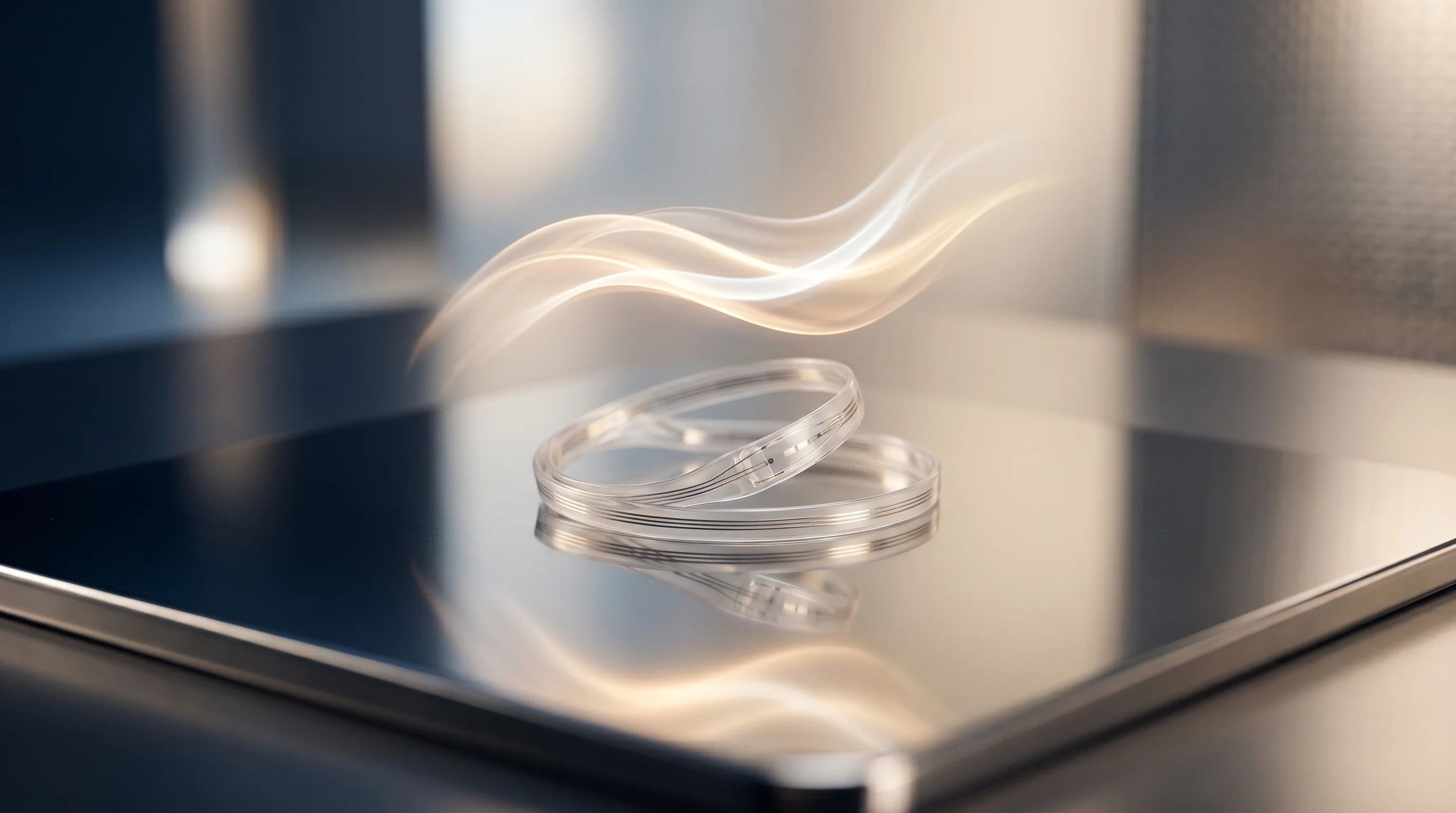
The startup's core technology, a proprietary fluorinated elastomer called Fleuron, is dramatically softer than the polyimide polymers most existing BCIs rely on. How much softer? The company claims up to 10,000 times, a figure that sounds hyperbolic until you consider the physics. Softer materials conform to brain tissue rather than irritating it, potentially improving both signal quality and long-term biocompatibility.
According to Axoft, Fleuron delivers eight times more brain region access and supports 32 times more sensors per thread than polyimide. Signal attenuation—the gradual loss of clarity as electrical impulses travel through the device—is reduced by more than 60 percent compared to polyimide. A single lead, the company says, can handle up to 1,024 sensors, a density that would make any neuroscientist's eyes widen.
The claims have at least some academic backing. Research published in Nature Nanotechnology in December 2023 showed that these elastomers enabled single-cell recordings over months in mouse models, a durability that has eluded stiffer materials prone to triggering inflammatory responses. Whether that translates to human brains over years, not months, remains an open question.
Early Human Data, Cautiously Parsed
Axoft has implanted its device in 11 patients across three sites as of late April, all in temporary intraoperative procedures—meaning the implants come out before the surgery ends. The first four cases took place in Panama City earlier in the year, with preliminary results announced in a press release on April 22. Those sessions, conducted during brain tumor resections, lasted about 20 minutes each and captured single-neuron signals along with what the company described as biomarkers of consciousness.
Temporary implants are a far cry from the chronic, long-term interfaces that companies like Neuralink and Synchron are pursuing, but they offer a lower-risk path to gather human data. The Panama procedures also reflect a pragmatic reality: regulatory pathways can be faster outside the U.S., even if the ultimate prize is FDA clearance.
The Shanghai case and Series A funding were reported by Bloomberg on April 29, 2026, adding a geopolitical wrinkle. CEO Paul Le Floch told the outlet that multiple clinical trials are planned in China throughout the year, a notable strategic move given Beijing's increasing emphasis on domestic BCI development. China has been accelerating its neurotechnology sector with both policy incentives and investor capital, and Axoft appears intent on being part of that wave rather than watching from the sidelines.
Closer to home, the company is running clinical research collaborations with Mass General Brigham, focused on cortical mapping, seizure onset tracking, and language recognition tasks. These partnerships lend academic credibility, though details on timelines and patient numbers remain sparse.
Scaling the Unsexy Stuff

Manufacturing rarely generates headlines, but it's where medical device startups often stumble. Axoft plans to build a GMP facility somewhere in the Boston-Cambridge corridor, funded in part by an $835,000 award from the Massachusetts Manufacturing Innovation Initiative announced on October 29, 2025. That grant comes with workforce development commitments—translation: the company will need to train people in the highly specialized art of making brain implants that meet regulatory standards.
The startup has also planted a flag in Grenoble, France, opening a subsidiary to build a local team and pursue additional preclinical and clinical projects. Whether this reflects genuine European ambitions or a hedge against U.S. regulatory uncertainty is unclear, though it's probably both.
Axoft has been generating some revenue already—not from implants, but from commercializing Fleuron for non-implant uses. The company launched microfluidics products in March, a practical if unglamorous application of its core material science. It's the kind of move that keeps cash flowing while the longer, riskier BCI bet matures.
Regulatory Tailwinds, Market Headwinds

Axoft received FDA Breakthrough Device Designation back in October 2022, a status meant to expedite review for technologies addressing unmet medical needs. That designation doesn't guarantee approval—plenty of "breakthrough" devices have stalled—but it does offer more frequent interactions with regulators, which can shorten timelines if the data holds up.
The broader BCI landscape, meanwhile, is getting crowded and noisy. Neuralink's high-profile trials have sucked up media oxygen; Synchron's endovascular approach offers a less invasive alternative; Paradromics and others are carving out their own niches. Axoft's material-science angle is distinct, but whether it's enough to secure reimbursement, adoption, and market share remains to be seen.
The company was founded by a trio of Harvard-trained researchers: Paul Le Floch (CEO), Tianyang Ye (CTO), and scientific adviser Jia Liu. It spun out of Liu's lab at Harvard's School of Engineering and Applied Sciences, licensing core intellectual property from the university. In May of last year, Axoft secured an exclusive license with Stanford University for additional Fleuron applications, broadening its IP moat.
The startup raised an $8 million seed led by The Engine—MIT's tough-tech venture fund—back in 2022, when the BCI sector was still riding pandemic-era enthusiasm for frontier technologies. Four years later, that enthusiasm has matured into something more measured. Investors want proof points: durability, safety, regulatory traction, and ideally, a path to profitability that doesn't require a decade of patience.
Axoft's Series A suggests it's cleared at least some of those hurdles, but the hardest ones lie ahead. Building a manufacturing facility is expensive and slow. Clinical trials, especially in multiple countries, are logistical marathons. And the FDA, for all its breakthrough designations, doesn't hand out approvals lightly.
Still, the company's bet on material science—on softness as a feature, not a bug—offers a different vector of attack in a field dominated by electrode counts and wireless capabilities. Whether flexibility proves to be a competitive advantage or merely a compelling narrative will depend on what happens when these devices stay in human brains not for 20 minutes, but for 20 years.


