

Eight months. That's how long a hardware team might wait for a critical component they didn't realize was backordered—discovered, of course, only after finalizing the design. Or perhaps they'll spin up a prototype board only to find that two subsystems fundamentally contradict each other, or that the power budget was wishful thinking from the start.
These aren't hypothetical scenarios. They're the recurring nightmares of hardware development, where mistakes caught late don't just burn money—they can kill timelines, investor confidence, and occasionally entire product launches.
BaseFrame, a Y Combinator Winter 2026 company that emerged publicly in early February, thinks it has spotted an opening. The San Francisco startup has built AI agents that live inside Slack and Microsoft Teams, designed to catch these critical errors before the first circuit board gets fabricated. Call it preventative medicine for hardware teams: find the contradictions when they're still conversation threads, not soldered components.
A Copilot That Asks Annoying Questions Early
The premise is deceptively straightforward. Hardware teams describe what they're building in a chat interface, and BaseFrame's AI agents respond like a detail-obsessed colleague who won't let vague specs slide. The system probes for gaps, flags conflicting requirements, and pushes back on assumptions that don't add up.
Those answers get consolidated into a scoping document, then run through parallel validation agents that check against engineering best practices. Unrealistic power budgets? The system surfaces them. Missing specifications that will haunt you later? It flags those too.
The promise, according to BaseFrame's launch materials, is surfacing these issues during the scoping phase—when changes cost hours of conversation rather than weeks of rework or, worse, scrapped inventory.
Once a design is scoped, BaseFrame auto-generates a bill of materials by parsing component datasheets and pulling real-time pricing, availability, and lead times from major vendors. It can also digest data from past projects and internal vendor communications, theoretically making component selection less of a guessing game.
Parallel Universes for Circuit Boards
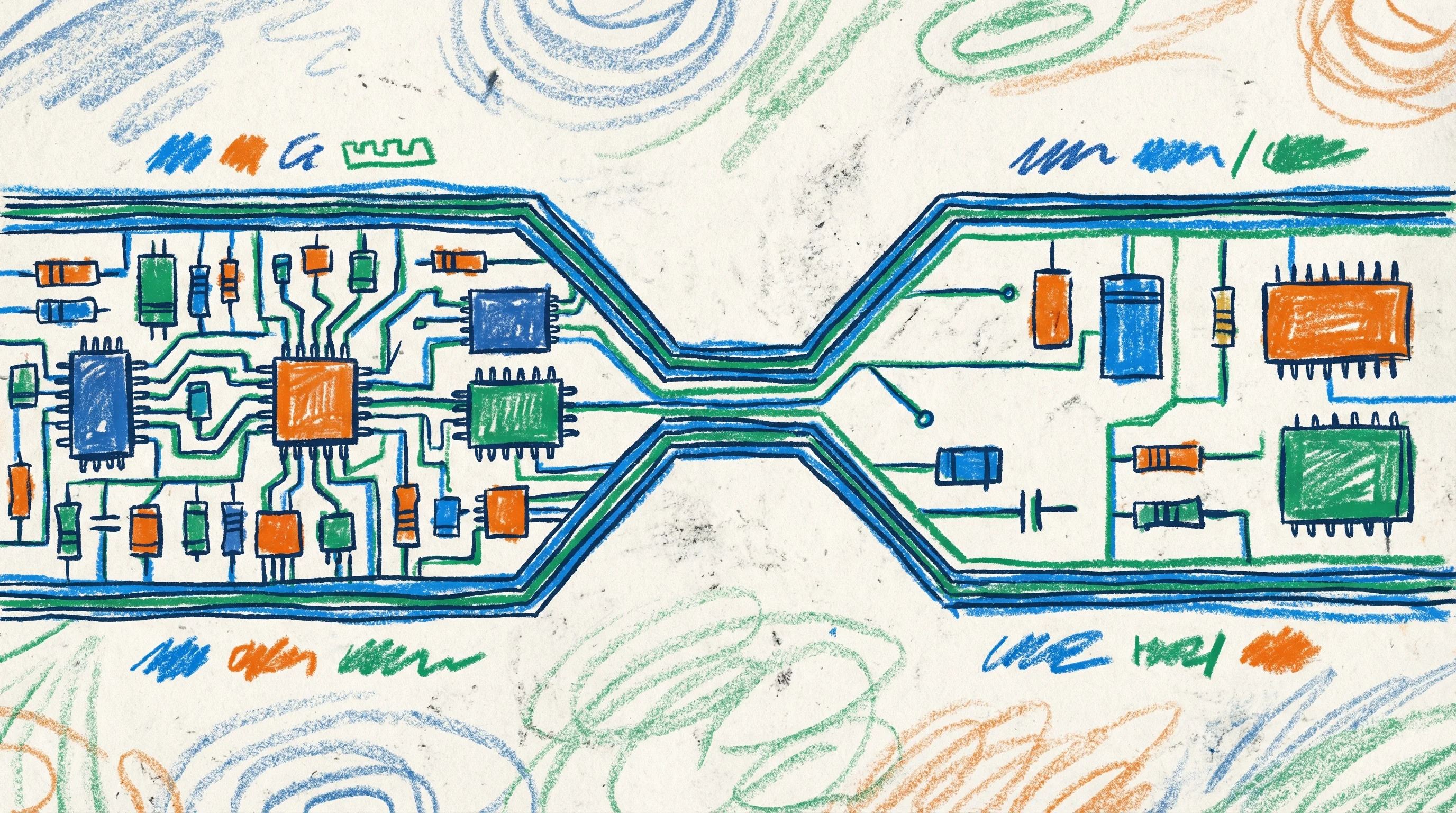
BaseFrame's versioning feature lets teams fork their designs and run side-by-side evaluations. Engineers can model different architectures and quantify the tradeoffs—cost versus performance versus lead time—without manually rebuilding BOMs from scratch. It's the "what if we used this chip instead?" question, but with actual data backing the answer.
The component search itself uses natural language. Ask for "a buck converter that handles 5A at 95% efficiency," and the system surfaces options while showing its work: what it searched, how it parsed specifications, why it ranked results the way it did. Transparency in AI recommendations matters when you're making decisions that affect production timelines.
Two Berkeley Grads, One Bet on AI Agents
Co-founders Anshul Paul and Vaibhav Agrawal come from adjacent but not identical backgrounds. Paul cut his teeth as a founding engineer at HappyRobot, building AI agents for enterprise communications, and graduated from UC Berkeley's M.E.T. program—a joint engineering and business degree. Agrawal worked on data ingestion at Sigma Computing and remote agent orchestration at Augment Code, also a Berkeley computer science grad.
They raised $500,000 via convertible note around February 2026, according to CB Insights. The team currently sits somewhere between 2 and 10 people and is hiring in San Francisco, posting engineering roles with salary bands ranging from $80,000 to $110,000 for growth positions and $150,000 to $200,000 for full-stack engineers.
The AI Hardware Design Gold Rush
BaseFrame is hardly alone in trying to inject AI into hardware workflows. The space is getting crowded, though each player stakes out different territory.
Flux.ai released Copilot, an AI assistant embedded directly in its EDA tool that can modify schematics and interpret datasheets. JITX offers what it calls "software-defined electronics," using physics-based validation to generate PCB designs from high-level requirements. CELUS automates the transition from block diagrams to schematics and BOMs.
Then there's Diode Computers, a fellow YC alum that pulled in an $11.4 million Series A from Andreessen Horowitz in July 2025 for AI-powered PCB automation using code-based layout generation. On the supply chain side, platforms like SiliconExpert and Z2Data focus on lifecycle management, obsolescence tracking, and alternate part sourcing—integrating with established tools like Altium and OrCAD.
BaseFrame's differentiator? It doesn't live inside EDA software or operate as a standalone platform. It embeds in the communication tools teams already use—Slack, Teams, Outlook, Gmail. The underlying wager is that catching errors during casual scoping conversations, before anyone opens Altium or KiCad, prevents costlier mistakes downstream.
Whether that hypothesis holds depends on how well BaseFrame's agents can actually parse the messy, incomplete early-stage descriptions that characterize real hardware projects. The company hasn't published customer names, case studies, or quantitative metrics like hours saved or defect reduction rates. Which is typical for a startup this young, though it leaves the value proposition somewhat theoretical for now.
The Quiet Launch
BaseFrame's website offers a "Get a Quote" option for team plans but doesn't list self-serve pricing. Trademark filings with the USPTO show the company claimed first use in commerce on November 15, 2025, and filed for protection on December 30, 2025. Before the public launch, BaseFrame published blog posts in late 2025 on component selection philosophy—planting flags, perhaps, for the positioning to come.
The platform integrates with the usual suspects: Slack, Microsoft Teams, Outlook, Gmail. Standard enterprise plays for a company betting that hardware teams would rather talk to a bot in their existing workflow than learn another specialized tool.
For hardware teams perpetually discovering critical flaws at the worst possible moment—after the purchase order, mid-assembly, or worse—BaseFrame's pitch is appealingly simple. Surface the contradictions when they're still theoretical. Find the eight-month lead time before it becomes your problem.
Whether AI agents can consistently deliver on that promise, or whether they'll just add another layer of complexity to an already intricate process, remains to be seen. But in a market where a single preventable mistake can derail months of work, the appetite for better early-stage validation is real.
The question is whether BaseFrame can thread the needle: smart enough to catch real issues, unobtrusive enough that teams actually use it, and accurate enough to earn trust when it flags something wrong.
That's a harder engineering problem than it sounds.


