

Jeff Yee Jr. still remembers the bid his company almost lost because someone miscounted junction boxes. It was a straightforward commercial job in Northern California, the kind Bass Electric had done dozens of times. But buried in sheet 147 of a 200-page electrical plan was a cluster of symbols his estimator missed during the manual count. The error shaved the margin too thin. They got lucky that time—a project delay let them reprice. Other contractors aren't so fortunate.
That mundane counting problem, the kind that exists in almost every trade but rarely makes headlines, is what Jesse Choe and Gautham Ramachandran think they can solve. Their startup, Bidflow, emerged from Y Combinator's W26 batch with software that does something deceptively simple: it looks at electrical blueprints and counts things. Outlets, switches, panels, conduit runs. All the small symbols that human estimators squint at for hours, sometimes days.
The company launched in January, positioning itself not as a replacement for estimators but as what it calls an "AI copilot"—a careful framing in an industry where automation often triggers resistance. Construction professionals, perhaps more than most, don't trust black boxes. They want to see the work.
A Familiar Frustration
Both founders grew up adjacent to the electrical trade, which gave them enough familiarity to recognize a pressure point. When they started knocking on doors in the Bay Area looking for design partners, the complaints were consistent. Existing estimating software from established players like Trimble Accubid or McCormick Systems works well enough, but it still demands manual takeoffs—someone physically marking up plans and entering counts. Generic AI tools promise automation but stumble on the specifics: they don't understand that a particular circle-with-a-cross means a duplex outlet, or that mounting heights matter, or how spec sheets cross-reference with floor plans.
The result? Electrical contractors leave money on the table, literally. They turn down projects because they don't have the bandwidth to estimate quickly. Or they rush through takeoffs and submit bids with margins so thin that one missed symbol can tank profitability.
Bidflow's central argument is that computer vision trained specifically on electrical drawings can compress what normally takes days into a few hours. The platform claims accuracy rates that vary by component type—with performance metrics posted on the company's site showing results in the 80-90% range for electrical takeoffs. Those are the kind of numbers that sound promising, though they also underscore that the underlying task—pattern recognition in standardized diagrams—is exactly what modern AI excels at, even if it's not yet perfect.
Showing Your Work
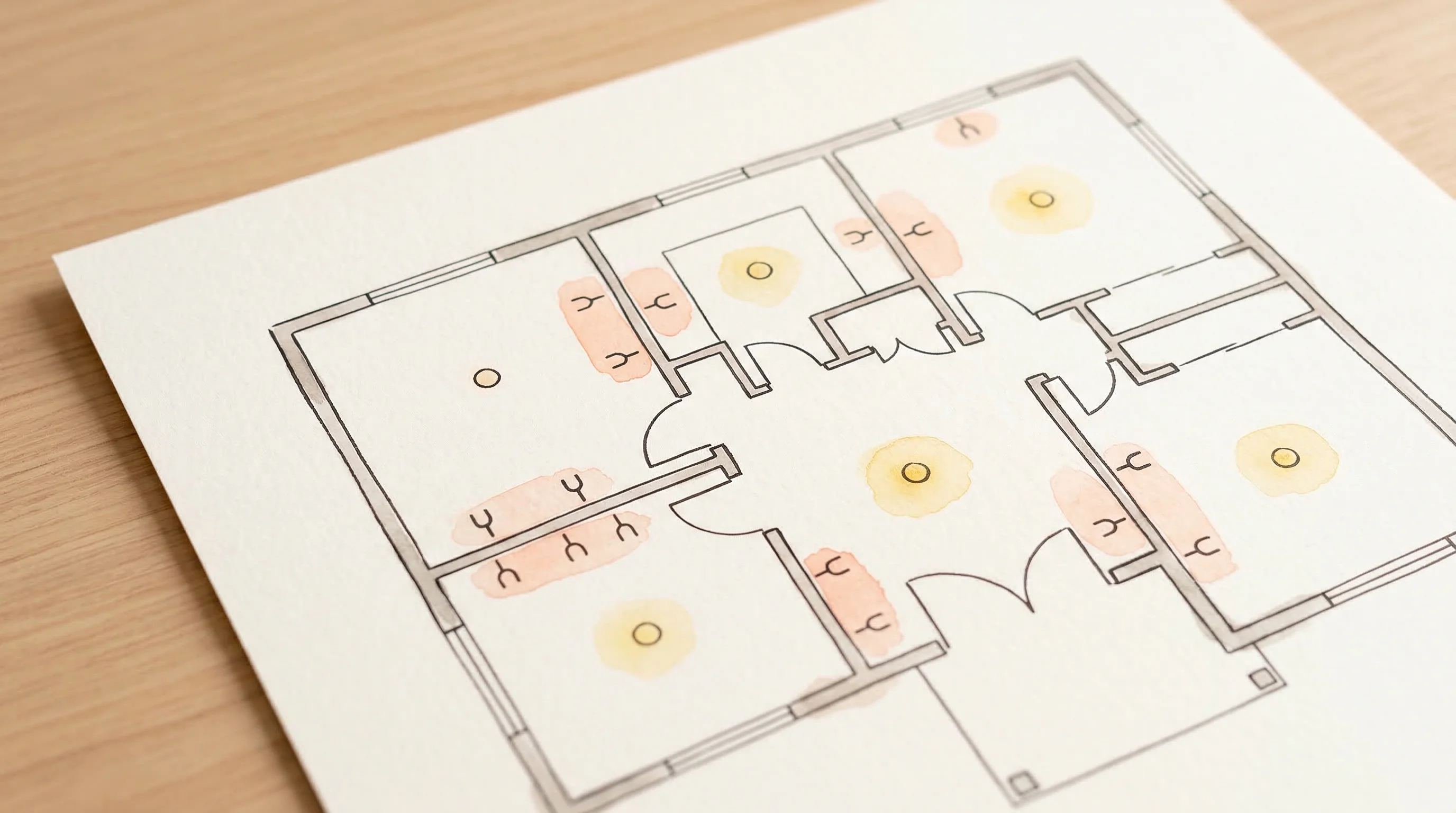
Here's how it operates: Upload a PDF of the electrical plans. Bidflow's models scan the drawings, identifying and counting components—outlets, switches, panels, wire runs, junction boxes. But instead of simply returning a spreadsheet, the software highlights each detected symbol directly on the plan. Estimators can click through and verify that the AI didn't hallucinate a light fixture or miss a panel in a cluttered mechanical room.
That "proof of work" design feels intentional, maybe even necessary. Construction is a show-me industry. You don't hand off a bid based on invisible calculations.
The platform also bundles an AI assistant that fields questions about project specifications. Ask about outlet mounting heights, and it might respond with something like: "Mounting height is 48 inches AFF per spec section 26-51-00"—complete with the citation. It's designed to replace the ctrl+F slog through hundreds of pages of documentation, though how well it handles ambiguous or contradictory specs remains an open question.
Once the takeoff is complete, Bidflow auto-populates an estimate table using its own database of material pricing and labor units. Users can adjust pricing, tweak assemblies, measure wire runs with built-in PDF tools. The workflow consolidates what usually involves juggling takeoff software, Excel spreadsheets, and PDF viewers.
The pricing model is usage-based: three cents per correctly detected symbol, plus $50 per month per user for premium features like the AI assistant and automated data entry. Bidflow claims this undercuts manual estimating by roughly 70%, though the methodology behind that comparison isn't public. (A typical commercial job might involve thousands of symbols, which could add up—though presumably still less than the labor cost of days of manual work.)
A Narrow Wedge Into a Massive Market

Construction technology is littered with startups that overestimated contractors' appetite for change. Bidflow is entering a market dominated by entrenched players—Trimble, ConEst, Foundation Software (which acquired McCormick Systems in 2021). Newer entrants like Togal.AI and PataBid Quantify are also layering AI into takeoff workflows, though most position themselves as multi-trade platforms rather than electrical specialists.
Bidflow's bet is that trade-specific focus matters. The founders argue that a generalized construction AI won't understand the nuances of electrical symbols, code references, or how electricians think about material assemblies. Whether that specialization actually delivers meaningfully better accuracy or just better user experience is, frankly, still unclear.
Early signals are encouraging, if limited. Bass Electric—the company where Yee encountered that near-miss on junction boxes—claims the platform cut average estimate time by a factor of five, according to a case study on Bidflow's site. The company also lists Infinity Electric and Checkmate Electric among its users, though detailed performance metrics aren't publicly available. It's a start, but hardly a groundswell.
Bidflow remains a two-person operation running out of New York under the legal entity Ghostship AI Inc., a remnant of the founders' previous venture into QA automation before they pivoted to construction. No additional funding beyond Y Combinator's standard investment has been publicly announced. For now, the focus is on signing design partners and refining the model based on real-world contractor feedback.
The Long Game

Electrical estimating is a narrow wedge—a small slice of an industry measured in trillions of dollars but notoriously resistant to software adoption. Contractors have seen plenty of tools that promised efficiency and delivered complexity. They've watched construction tech startups burn through venture capital chasing features nobody asked for.
But maybe that's exactly why a focused play like Bidflow might work. It's not trying to reinvent project management or procurement or scheduling. It's just trying to count symbols faster and more accurately than a human can, then get out of the way.
If the accuracy holds—and that's still an if—and if the workflow actually feels faster rather than just different, Bidflow could carve out a foothold in a market that's been waiting for software that genuinely understands the blueprints. Whether that foothold expands into other trades or other parts of the estimating process is a question for later.
For now, it's about proving the model works when the stakes are real and the margins are thin. One miscounted junction box at a time.


