

Yang Lin's career pivot last year came with an unexpected revelation. As requests for synthetic training data poured into his inbox, a pattern emerged that even he found surprising: the autonomous vehicle companies that had kept his previous ventures humming along were going quiet. Meanwhile, robotics firms were desperate for something his ADAS background hadn't quite prepared him for.
They needed hands. Or more precisely, they needed data about what those hands were touching.
"Pure vision cannot solve hand occlusion," Lin explained in a July interview—a blunt assessment of what's become a thorny problem for the humanoid robotics industry. "Must incorporate haptics." When a robot's camera can't see its own manipulators clearly enough during manipulation tasks, computer vision hits a wall. The solution, Lin wagered, wasn't better cameras. It was teaching robots to feel.
Thirteen months after founding Dayan Technology in May 2025, the Tongxiang-based startup announced a multi-million-RMB angel round on July 14, 2026, positioning itself at the intersection of two booming markets: China's surging humanoid robotics sector and the fragmented world of embodied AI training data. The company is building what it calls China's first force-tactile interactive haptic glove, bundled with a head-mounted device and—perhaps more ambitiously—backed by what they're describing as a haptic foundation model.
It's a bet that as humanoid robots move from carefully staged demos to actual deployment, the data bottleneck shifts from visual inputs to something harder to capture: the sensation of touch itself.
Hardware Meets Gig Economy
The device they've built—"Shadow Gauntlet," in Dayan's slightly overwrought branding—integrates 29 array units delivering 1,015 tactile contact points. Maximum response frequency hits 300 Hz. The glove captures both hand skeleton posture and haptic feedback simultaneously, a combination that remains surprisingly rare in commercial offerings. Most enterprise solutions still lean on vibrotactile-only feedback or passive force braking, which Lin clearly considers insufficient.
The technical specifications tell only part of the story. More interesting is the data collection model Dayan has built around the hardware. The company employs what Lin calls "heterogeneous acquisition"—essentially paying workers roughly RMB 100 for an eight-hour shift to wear the glove-and-headset system while performing mundane tasks in real environments. Unmanned stores, for instance.
Think of it as gig-economy data labeling, except instead of annotating images, workers are generating first-person, multimodal demonstrations of robotic manipulation. It's a clever arbitrage: human labor remains cheap enough to generate training data at scale, while the robotics companies buying that data face mounting pressure to ship actual products.
As per a company interview on July 14, 2026, Dayan delivered over RMB 10 million in revenue during Q1 2026—remarkably fast traction for a startup barely a year old. That pace suggests robotics firms are scrambling for this kind of training data, perhaps more desperately than they'd care to admit publicly.
The Autonomous Vehicle Alum
Lin's background helps explain both the pivot and the approach. He holds a PhD from the National University of Singapore and spent seven or eight years working on ADAS and autonomous vehicle algorithms—stints at Sagitar, Coreu, BYD, and Bosch Suzhou. That's a CV built on sensor fusion, computer vision, and the kind of synthetic data that autonomous vehicles consumed voraciously until, well, recently.
Between 2025 and early 2026, demand for autonomous vehicle synthetic data flattened while robotics orders surged. Lin saw it coming and moved early.
The company's planned haptic foundation model, scheduled for release in the second half of this year, will take multimodal inputs and apply physics constraints in latent space to output grasp force direction, magnitude, and optimal pose. Advising that effort is Abdulmotaleb El Saddik, a Fellow of the Canadian Academy of Engineering, the Royal Society of Canada, and IEEE, whose recent work at CHI 2026 in June examined wearable haptics for improving perceptual grounding in XR applications.
First delivery of what Dayan calls a customized "embodied intelligence brain" is slated for the end of 2026. The timeline suggests hardware production, data collection, and foundation model development are running in parallel—an ambitious scope for a seed-stage company, even one with revenue.
Following the Numbers
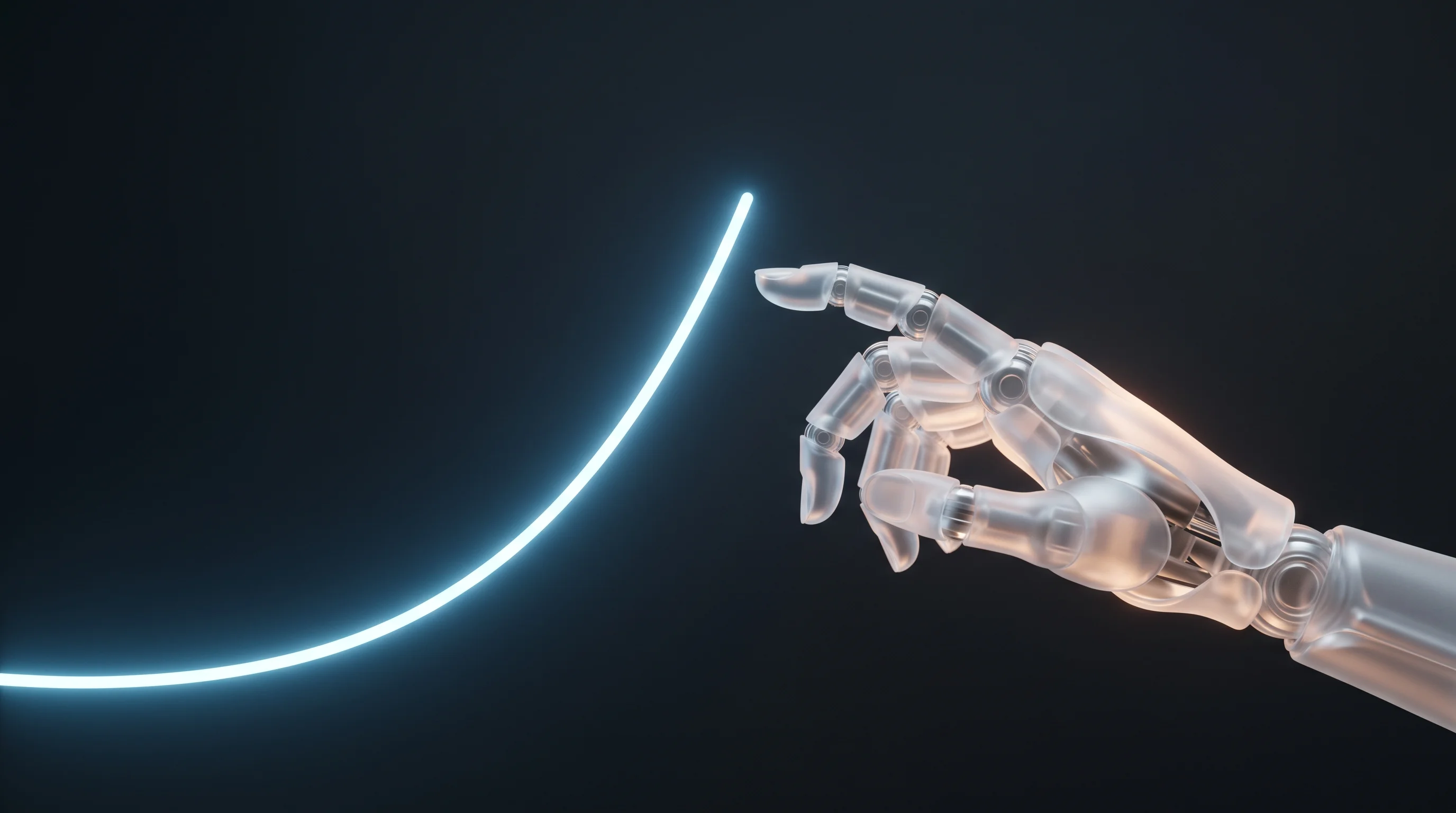
The broader context supports Dayan's thesis, if not necessarily its ability to execute. As of March 2026, 2026 is tracking toward a record $10 billion in humanoid robotics investment, with humanoid developers leading overall robotics deals. Robovations, an industry analyst group, estimated that OEMs are targeting somewhere between 10,000 and 20,000 humanoid shipments this year, with China accounting for roughly 85 percent of that volume.
The math is straightforward enough: more robots require exponentially more training data, especially as the industry moves beyond carefully curated lab environments. NVIDIA's Isaac GR00T foundation model and similar open-source efforts have begun standardizing the software stack. But the data collection infrastructure? Still fragmented, still expensive, still reliant on hardware that wasn't designed for mass-market data generation.
360iResearch and MarkWide Research provided differing projections for the haptic glove market, due to differing methodologies—a sign of early-stage markets where approaches haven't converged. 360iResearch valued the haptic VR glove market at $225.80 million in 2025, growing to $280.77 million in 2026, with a 23.42 percent CAGR projecting to $985.47 million by 2032. MarkWide Research, publishing around two months ago, put the 2026 market at $187.4 million, forecasting $1.80 billion by 2035 at a 28.6 percent CAGR.
The divergence suggests these firms are measuring different things, or making different assumptions about enterprise versus consumer adoption. But the directional signal is consistent: this market is moving fast.
China's synthetic data market itself is projected to grow from RMB 2.1 billion in 2024 to RMB 23 billion by 2030, according to investor estimates shared at Dayan's funding announcement. Investor remarks mentioned government talent support under the Kunpeng program, though specific grant amounts were not disclosed—never are, in these announcements.
A Crowded Field
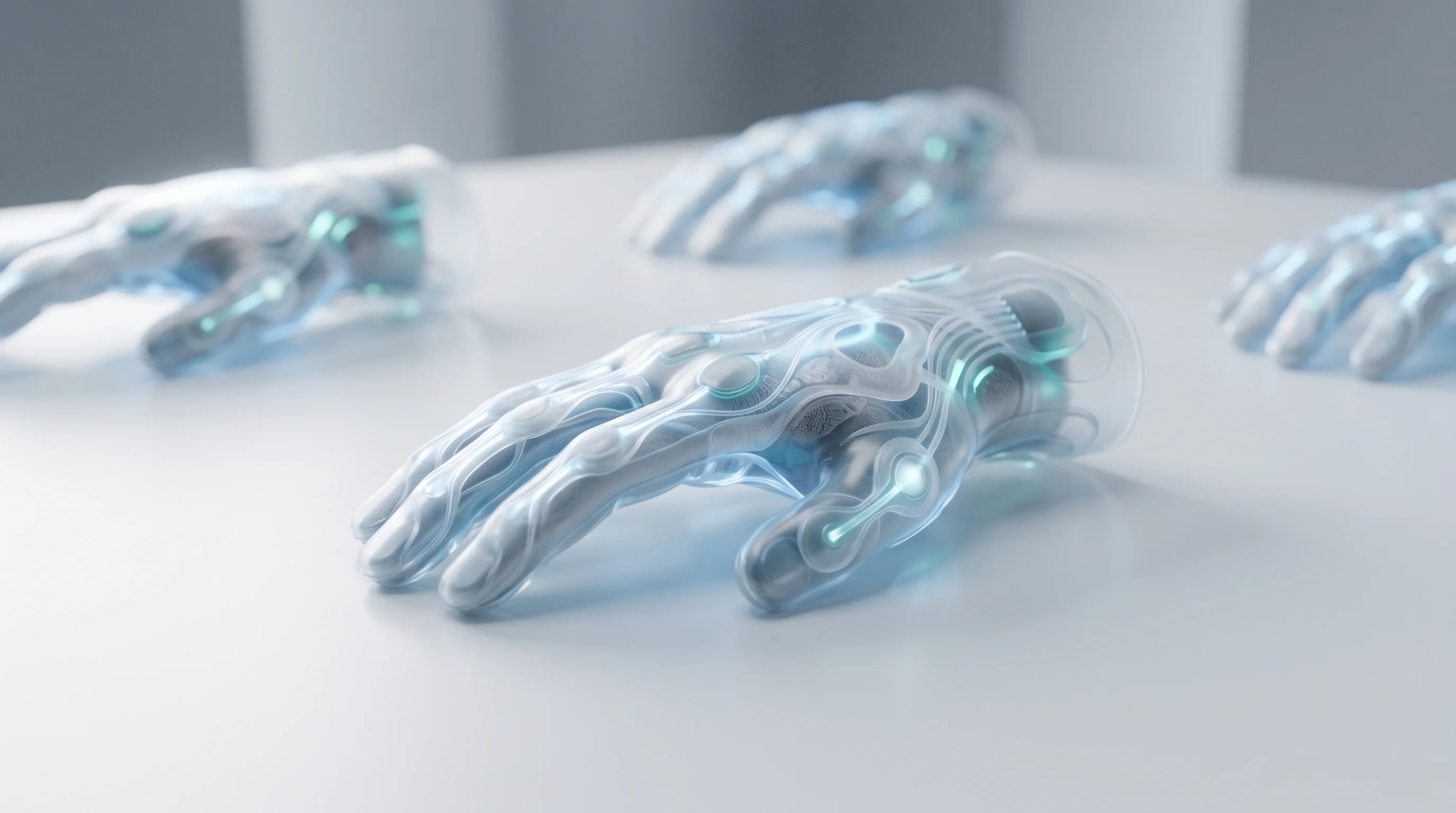
Dayan isn't alone in chasing this opportunity, naturally. Several Chinese competitors have announced funding in recent months. Taction (途见科技) disclosed a pre-A round exceeding RMB 100 million in May for flexible tactile e-skin and data gloves moving toward mass production. Perception Era (感知纪元) closed an angel round in June-July to scale multimodal tactile e-skin, positioning itself as "tactile infrastructure"—a telling bit of positioning. Imprint Intelligence (知行具身) is marketing a tactile glove data product with representations aligned to vision-language model encoders for robot control.
Internationally, established players like HaptX, SenseGlove, and MANUS continue deploying haptic systems for training and teleoperation. Think Volkswagen assembly lines, NASA astronaut preparation, European Space Agency programs. MANUS launched its Metagloves Pro Haptic in January 2026 with partnerships including NVIDIA Isaac Teleop demonstrations at GTC—proof points that the enterprise market exists and is willing to pay.
The academic literature, meanwhile, keeps accelerating. TouchWorld, published July 9 on arXiv, demonstrated a predictive and reactive tactile foundation model achieving 65.0 percent success across long-horizon dexterous tasks, a 15.7 percentage point improvement over baseline approaches. Tencent open-sourced HY-World 2.0 in April-May, a multimodal world model for reconstructing and simulating interactive 3D environments.
What distinguishes Dayan's approach—at least in theory—is the integrated stack. Simultaneous hardware production, data collection infrastructure, and foundation model development, all aimed at robotics companies that need to ship products now, not in three years when the technology matures.
Whether that vertical integration proves defensible depends partly on execution speed and partly on whether the robotics boom materializes at the scale investors currently expect. The humanoid robotics space has seen hype cycles before. This one feels different, more grounded in manufacturing realities and actual deployments.
But "feels different" and "is different" remain two distinct things.
For now, Dayan is placing its chips on haptics as the missing sensory modality in embodied AI. The company has filed multiple patents on the hardware integration, according to Lin's interview, though specific patent numbers weren't disclosed. The revenue trajectory suggests they're solving a real problem for real customers.
The bigger question is whether teaching robots to feel will prove as transformative as teaching them to see. Lin seems convinced. The robotics companies writing those RMB checks seem to agree. And in a market moving this quickly, conviction and capital might be enough—at least until someone figures out what comes after touch.


