

The proposition sounds almost absurdly simple: What if you could sidestep the most expensive parts of nuclear power by burying reactors deep in the earth?
That's the wager a Berkeley startup called Deep Fission is making—and as of February 10, it's an $80 million bet. The company announced it has closed a private placement, selling 5.33 million restricted shares at $15 apiece to a roster of investors convinced that nuclear power, reimagined for the AI era, needs to go underground. Literally.
Founded by UC Berkeley physics professor emeritus Richard Muller and his daughter Elizabeth, who serves as CEO, Deep Fission wants to place small modular reactors roughly one mile beneath the surface in narrow boreholes. The pitch to power-starved data center operators: drastically lower construction costs, faster timelines, and fewer of the regulatory nightmares that have plagued nuclear projects for decades.
Whether it works remains an open question. But the company's timing couldn't be sharper.
The Data Center Power Crunch
Seaport Global Securities and The Benchmark Company handled the placement, with Goldman Sachs advising. Among the buyers: Ed Eisler through EE Holdings, Mark Tompkins via Montrose Capital, and a fund managed by Blue Owl Capital, the investment giant that recently put $7 billion into an 80-20 joint venture with Meta for the $27 billion Hyperion data center campus.
Blue Owl isn't just an investor. Deep Fission disclosed a strategic partnership with the firm's Real Assets platform to deploy reactors for Blue Owl's sprawling digital infrastructure portfolio—which also includes deals with CoreWeave, Crusoe, and other data center developers scrambling to secure power in an overheated market.
The backdrop is urgent. The International Energy Agency projects global data center electricity demand will double to roughly 945 terawatt-hours by 2030, driven largely by AI workloads. Goldman Sachs Research goes further, forecasting U.S. data center power consumption could surge 165 percent by decade's end compared to 2023.
Deep Fission says it already holds letters of intent totaling 12.5 gigawatts—a figure the company announced in October. One partnership with Endeavour and Edged Energy commits to co-developing 2 gigawatts for Edged's facilities, with initial reactors targeted for 2029.
That's ambitious, perhaps more than the founders expected when they emerged from stealth in August 2024 with a modest $4 million pre-seed round led by 8VC.
Going Public, Sort Of
The latest funding arrives roughly five months after Deep Fission became a public-reporting company through a reverse merger with Surfside Acquisition in September 2025. That deal included a concurrent $30 million private placement priced at $3.00 per share—a fraction of the $15.00 valuation in the new round.
The company has filed an S-1 registration statement and applied for OTCQB quotation, though no active public market exists yet for its shares. It's a curious in-between state: public filings, private capital, and growing scrutiny.
The Gravity Reactor
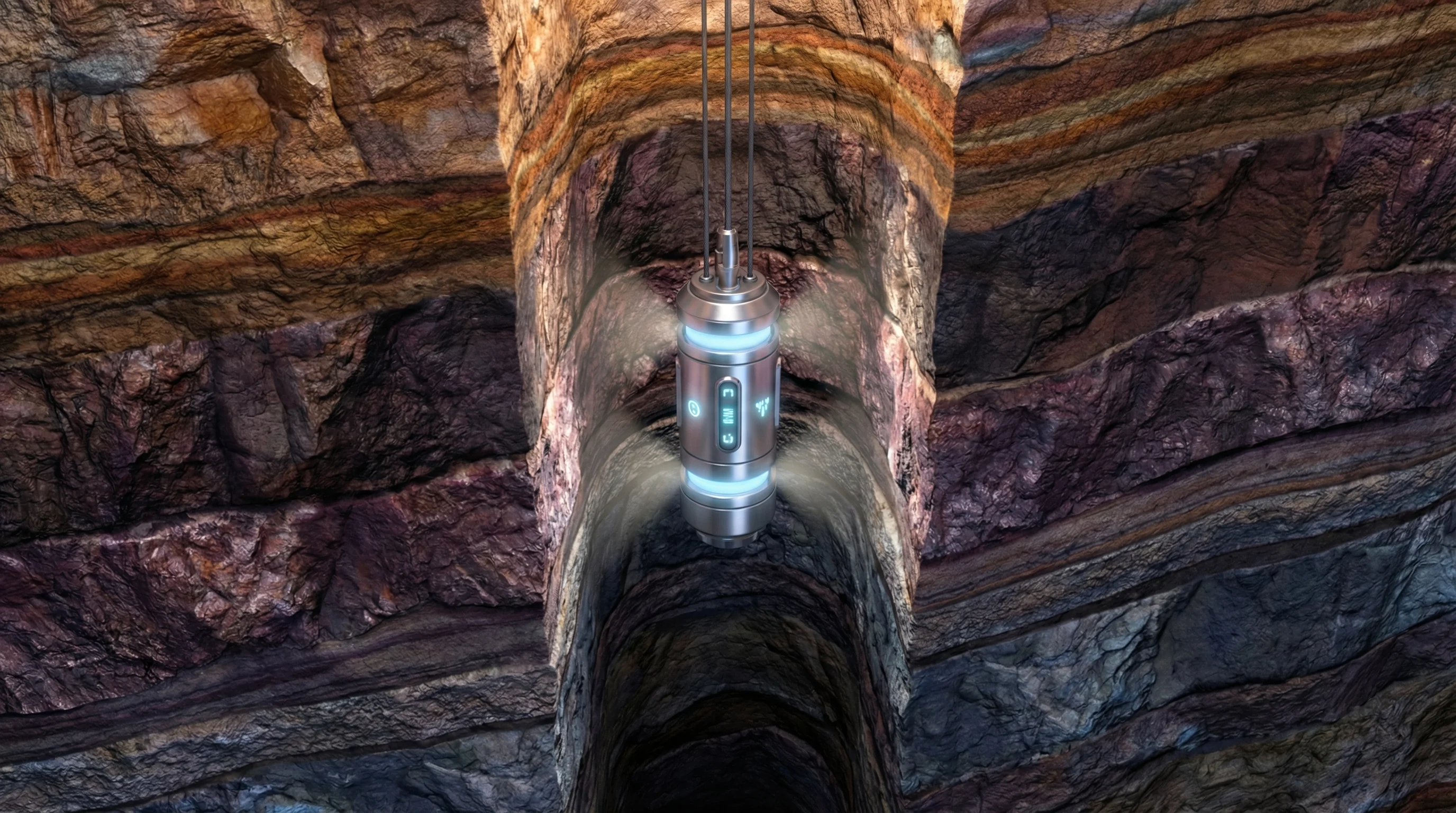
So how does burying a nuclear reactor actually work?
Deep Fission's design—which it calls the Gravity Reactor—uses standard pressurized water reactor technology with low-enriched uranium fuel. The reactors descend into boreholes about 30 inches in diameter, positioned roughly a mile underground. The company claims the surrounding geology and the natural hydrostatic pressure from the water column provide containment, eliminating much of the costly above-ground infrastructure that makes conventional nuclear plants so expensive.
Each reactor generates 15 megawatts of electricity. Modular arrays, the company says, could scale to 1.5 gigawatts on about three acres of surface land.
The economic case is striking, if it holds up. Deep Fission estimates the approach could slash capital expenditures by 70 to 80 percent, compress construction timelines to six months, and achieve a levelized cost of energy between $50 and $70 per megawatt-hour. Those numbers would reshape the economics of both nuclear power and data center development.
But the technical challenges are formidable.
Regulatory Reality
External analysts have raised pointed questions about subsurface modeling, groundwater interactions, heat transfer dynamics, and the logistics of monitoring and maintaining equipment from extreme depth. IEEE Spectrum acknowledged potential advantages in simplified surface infrastructure and security, but also flagged "unprecedented challenges" in remote operations and refueling access.
Deep Fission is candid about the regulatory path ahead. In its public filings, the company notes that Department of Energy authorization for pilot testing does not replace Nuclear Regulatory Commission licensing required for commercial deployment. The NRC has never licensed a reactor like this.
Still, the company has won some federal backing. The DOE selected Deep Fission for its Reactor Pilot Program in August 2025 and executed an Other Transaction Agreement in November. Deep Fission also secured a DOE GAIN voucher for independent thermal-hydraulic modeling at Idaho National Laboratory.
In December, the company broke ground on its Kansas pilot site at Great Plains Industrial Park in Parsons, targeting criticality by July 4, 2026—a deadline that doubles as a marketing statement.
Town halls in Labette County have already surfaced local concerns. Nuclear power, even buried a mile down, carries political and emotional weight that engineering alone can't address.
The Muller Method

The Mullers bring unusual credentials to the challenge. Richard Muller holds over 80 patents and has spent decades in Berkeley's physics department. Elizabeth, who chairs the board, has navigated the steep learning curve of nuclear regulation and venture fundraising simultaneously.
The company now employs 30 people and eight consultants, according to its S-1, and holds more than 20 pending patent applications. It's a lean operation for the scale of ambition.
If the Kansas pilot succeeds—and that's a considerable if—Deep Fission will have demonstrated something no one else has: that you can drill deep, drop in a reactor, and power a data center for a fraction of the cost and time conventional nuclear requires.
If it doesn't, the company becomes another case study in how difficult it is to reinvent infrastructure at the intersection of geology, nuclear physics, and federal regulation.
For now, Deep Fission has capital, partnerships, and a pilot site. What it doesn't yet have is proof.
The clock starts July 4, 2026.


