

The drone hovers beside a high-voltage transmission line somewhere in rural Texas, hesitates, then clamps onto the wire. It's not an accident. This is exactly what it was built to do.
Most industrial drones patrolling the nation's electrical grid suffer from a mundane problem: they run out of juice. Twenty minutes, maybe forty if you're lucky, then it's back to base for a battery swap or a stint on a charging pad. For utilities managing thousands of miles of transmission corridors—often through terrain that makes infrastructure placement a logistical nightmare—that limitation matters more than you'd think.
Voltair, a startup born at the University of Washington and now backed by Y Combinator, believes it has found an answer hiding in plain sight. The company's drones don't just inspect power lines. They perch directly on them, harvesting energy from the magnetic field generated by alternating current. No charging docks. No battery swaps. Just the grid itself, turned into an infinite fuel source.
It's an audacious pitch, one that could upend how utilities approach transmission maintenance. Or it could prove to be one of those engineering ideas that works brilliantly on paper but stumbles in the messy reality of energized infrastructure. The difference will come down to whether Voltair—founded by four students with impressive academic credentials but limited operational track record—can solve problems that have stymied researchers for years.
The Inspection Revolution That Hit a Wall
Utilities embraced drones early, perhaps more enthusiastically than other industries. The economics were too compelling to ignore. A helicopter flyover costs thousands. A truck roll with a crew and bucket lift isn't much cheaper. A drone? A fraction of the price, with high-resolution imagery that feeds directly into predictive maintenance systems.
Xcel Energy became the first U.S. utility to win FAA blessing for routine beyond-visual-line-of-sight transmission inspections back in 2018. National Grid in the UK integrated autonomous pylon inspections with AI corrosion detection. ComEd in Illinois went big on autonomous dock systems. The utility drone market hit roughly $1 billion in 2025, according to Fortune Business Insights, with projections climbing to $3.16 billion by 2034—a 13.5 percent annual growth rate. The broader inspection drone sector, spanning infrastructure and industrial assets, is expected to balloon from $10.8 billion in 2026 to over $60 billion by 2035.
But here's the catch. Most operational systems still depend on what the industry calls "drone-in-a-box" solutions—DJI Dock 2, Skydio Dock, Percepto's autonomous platforms. These require physical installation and maintenance of charging infrastructure along inspection routes. Fixed-wing drones stretch the range—Voltair's own specs cite 50 miles per sortie at 50 mph cruise speed—but they still need to come home eventually.
For a sprawling transmission network, the logistics can be punishing. Every dock needs permitting, power, connectivity, and periodic servicing. In mountainous terrain or remote desert corridors, that's not trivial.
Turning the Grid Into the Charger
Voltair's founders—CEO Ronan Nopp, COO Warren Weissbluth, and co-founders Hayden Gosch and Avi Gotskind—argue there's a simpler approach. Use inductive charging technology to harvest energy from the magnetic field surrounding live transmission lines. The drone perches on the wire, much like a bird might, and draws power directly.
They've been field-testing the concept with Big Bend Electric Cooperative, a Texas-based rural utility. The team won $15,000 at UW's Environmental Innovation Challenge in April 2025, followed by $25,000 at the Dempsey Startup Competition in May. Y Combinator's backing suggests investors see potential in the grid infrastructure opportunity, though Voltair hasn't disclosed specific funding amounts or customer contracts beyond the Big Bend pilot.
The idea isn't brand new in research circles. A team at the University of Southern Denmark demonstrated the world's first public test of a drone recharging on a 150-kV line in Odense back in June 2022. That prototype, part of the Drones4Energy program funded by Danish utility Energinet, achieved 145 watts of power transfer at 600 amps of line current using a split-core current transformer and passive gripper. Academic papers from IEEE and MDPI have documented prototypes capable of 100 to 400 watts of inductive power transfer.
What Voltair is attempting is different: commercial productization. Taking something that worked under controlled conditions in Denmark and making it reliably operational across the varied, often harsh conditions of U.S. transmission networks. The company's job postings hint at the technical complexity—references to EMI shielding, Faraday cage chassis design, precision control laws for perching on 500-kV lines. These are challenges that live beyond the laboratory.
The pitch centers on use cases where persistent deployment matters most. Wildfire detection and rapid response in high-risk areas. Post-storm damage assessment when minutes count. Vegetation management compliance under NERC FAC-003 standards, which utilities take seriously after a series of outages tied to encroaching tree limbs.
A Crowded Field Chasing the Same Problem

Voltair isn't alone in attacking the endurance barrier, and the competitive landscape reveals just how many ways engineers think they can crack it.
Dock-based autonomy has become the incumbent solution, for better or worse. DJI launched Dock 2 globally in March 2024, offering 50-minute flight times within a 10-kilometer radius, faster site evaluation, and remote fleet management. Percepto secured FAA approval for nationwide "shielded BVLOS" operations with no humans on-site, later winning authorization to operate up to 30 drones per operator. These systems work today. They have regulatory approvals, proven deployments across oil and gas, solar, mining, and utilities. The constraint? Infrastructure placement and maintenance, particularly where terrain doesn't cooperate.
Power beaming technologies promise true in-flight charging, which sounds like science fiction until you realize NASA has been testing RF power mesh systems that deliver 256 watts across four transmitters—netting roughly 50 watts to a drone at six meters. PowerLight Technologies partnered with Kraus Hamdani Aerospace to develop a kilowatt-class laser system capable of charging drones at distances up to two kilometers, with tracking to 5,000 feet. Demonstrations are slated for early 2026. The challenges? Safety, airspace integration, and line-of-sight requirements that may limit near-term utility adoption.
Hydrogen fuel cells take a different tack entirely—extended endurance through onboard propulsion rather than wireless charging. Companies like Doosan Mobility Innovation and Heven Drones market systems with flight times exceeding two hours and heavier payload capacity. The trade-off is hydrogen logistics: sourcing, storage, handling. Utilities may not want that complexity.
Voltair's infrastructure-as-charger model sidesteps the dock placement problem. It avoids the safety and regulatory uncertainties of beaming or hydrogen. But it introduces its own set of headaches. Electromagnetic interference risks to sensors and flight controls near high-voltage lines. The mechanical challenge of autonomous perching—not a trivial problem when you're dealing with swaying wires in wind. Line current variability affecting charge rates. And perhaps most critically, the need for utility authorization to physically interact with energized assets.
That last point deserves emphasis. Utilities are conservative institutions by nature. They have to be. One mistake on a transmission line can cascade into blackouts affecting thousands or millions of customers. Convincing them to let a startup's robots grip live 500-kV lines is not a simple sales conversation.
Forces Pushing Utilities to Move Faster
Several converging trends are creating urgency around autonomous inspection technology—and they make the timing potentially favorable for endurance solutions, even unproven ones.
Weather-driven outages are climbing. Roughly 80 percent of major U.S. power outages between 2000 and 2023 were weather-related, according to Water ISAC research. Climate change is intensifying storms, wildfires, extreme temperatures. That pushes utilities toward more frequent, more rapid grid assessments. California's wildfire mitigation regime—overseen by the state's Office of Energy Safety and the California Public Utilities Commission—mandates enhanced inspection cadences, vegetation performance metrics, real-time situational awareness. PG&E's 2026-2028 wildfire mitigation plan includes drone inspections among its layered protections, alongside undergrounding, sensors, and controversial public safety power shutoffs.
Regulatory momentum is building for BVLOS operations. The FAA published a Notice of Proposed Rulemaking for Part 108 in August 2025, proposing performance-based rules for low-altitude BVLOS, UTM service integration, new certification frameworks. While not finalized as of February 2026, the NPRM signals a shift from site-specific waivers to standardized operational authority. That regulatory clarity could unlock multi-drone, corridor-scale operations that today require laborious case-by-case approvals.
Federal funding is flowing. The Department of Energy's Grid Resilience and Innovation Partnerships program has announced over $7.6 billion in awards across two rounds through late 2024, with projects emphasizing resilience, flexible capacity, advanced monitoring. Utilities receiving GRIP dollars have incentives to deploy next-generation inspection and diagnostic tools.
And transmission infrastructure is under strain, perhaps more than most people realize. A report from Americans for a Clean Energy Grid noted that the U.S. is building hundreds of miles of high-voltage transmission per year when thousands are needed to support electrification and renewable integration. Aging assets, deferred maintenance, rising load from AI data centers—all of it forces closer scrutiny of grid reliability. Inspection frequency and quality become critical levers in a system operating closer to its limits.
The Proof Still to Come
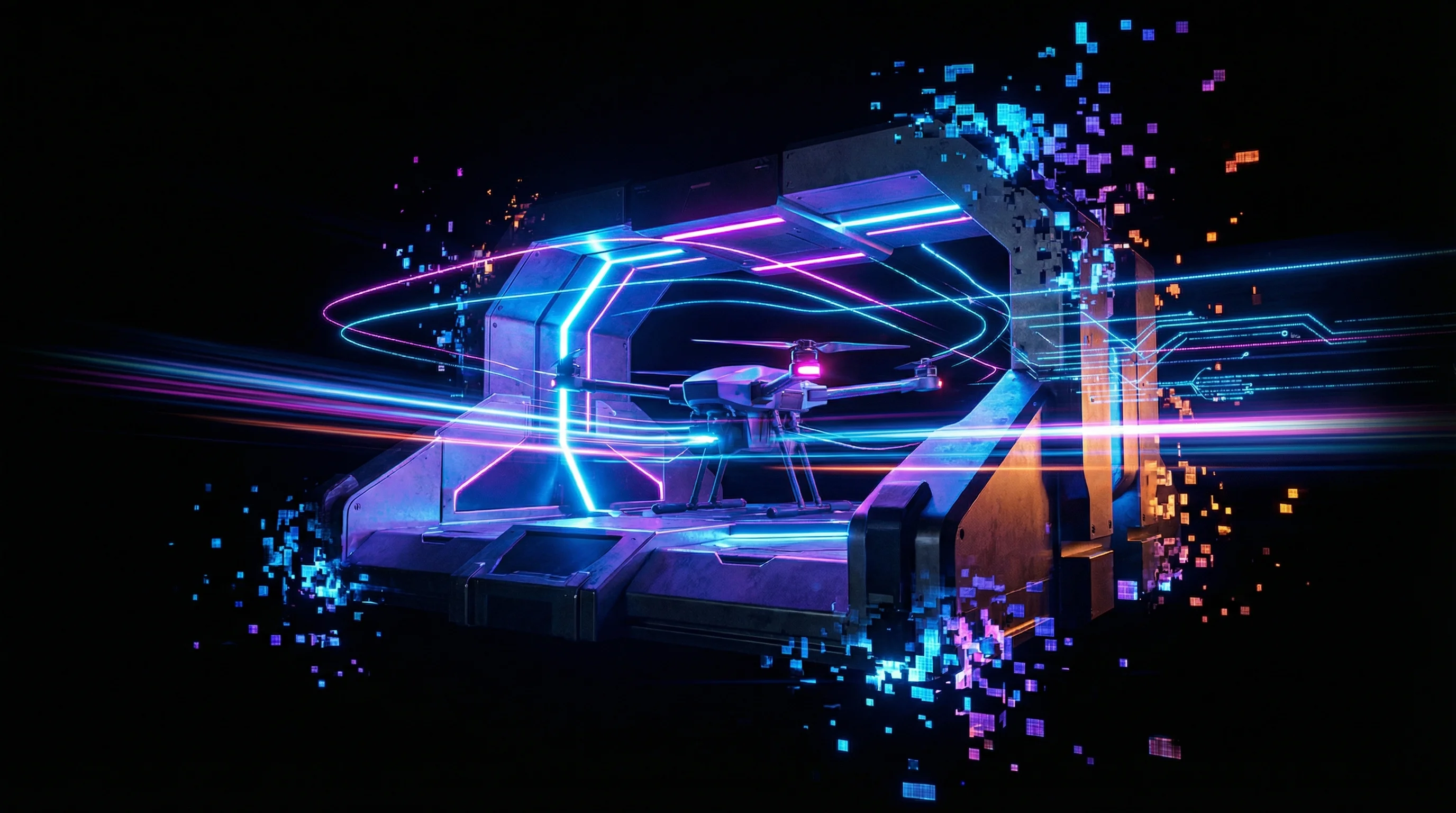
Near-term competitive dynamics will likely favor proven dock-based systems for utilities prioritizing speed to deployment and regulatory simplicity. DJI, Skydio, Percepto—they have mature products, established customer bases, clear paths through FAA approvals. Differentiation is shifting toward software: analytics pipelines that turn terabytes of imagery into actionable work orders, integration with enterprise asset management systems, AI models trained on utility-specific defect libraries.
Power-line charging remains a high-impact innovation if—and it's a meaningful if—the technical and regulatory challenges resolve favorably. Independent third-party validation in U.S. utility environments beyond company statements has not yet surfaced publicly, at least not that this reporter could find. The key unknowns are substantial. Can the system handle EMI safely at the required power levels? Will autonomous perching prove mechanically reliable under varying environmental conditions—wind, ice, heat? Will utilities actually authorize physical contact with live transmission infrastructure? And perhaps most importantly, can recharge throughput support operationally meaningful mission profiles?
What's worth watching closely: pilot deployments with investor-owned utilities or large co-ops beyond the initial Texas trial. Any safety assessment work with EPRI, NERC, or IEEE standards bodies. And real field performance data—charge rates, perching success rates, mean time between failures. If Voltair can demonstrate safe, repeatable operations on energized transmission lines with minimal logistical footprint, the value proposition becomes genuinely compelling for utilities managing hundreds or thousands of miles of corridor in difficult terrain.
The parallel paths—docks, beaming, hydrogen, grid harvesting—suggest the market is still searching for the endurance architecture that balances performance, cost, safety, and regulatory feasibility. It's entirely possible no single solution dominates. Different use cases may favor different technologies, just as aviation relies on multiple propulsion types depending on mission requirements.
But for transmission inspection specifically, a system that eliminates the dock placement problem while leveraging the very asset being inspected has a certain elegance. Whether Voltair can transform that elegance from concept into reliable operations is the question grid operators will be asking. And probably should be.
The drone is still perched on that wire in Texas, harvesting power. Whether that image becomes a footnote in research history or a preview of how utilities maintain critical infrastructure may depend less on the technology itself than on something harder to engineer: trust.


