

Enact, a two-person startup backed by Y Combinator, claims it has pushed robotics success rates to 99% on a controlled packing task by generating targeted recovery data. The company, which launched in mid-August 2026, says the secret isn't more training data but smarter training data: 200 expert demonstrations plus 50 targeted recovery examples outperformed 250 ordinary demonstrations on a π0.5 vision-language-action model running on YAM 6-DoF robotic arms, according to benchmarks posted in the company's Launch YC announcement.
The pitch addresses a reliability gap that has slowed commercial deployments even as foundation models for robotics reached technical milestones this year. Stanford's AI Index, published in April, documented rapid progress in physical AI but stressed that the lab-to-field reliability gap remained wide.
Robots Are Everywhere. Reliable Robots Aren't.
Industrial robot installations hit 542,000 units in 2024, the second-highest on record, the International Federation of Robotics reported in September 2025. The US factory stock stood at 393,700 robots as of 2024, up 3% year-over-year. US installations in 2025 reached 38,000 units, an 11% gain, Manufacturing Dive reported in June citing IFR data.
Mobile robots are forecast to grow faster still. Autonomous mobile robots and automated guided vehicles are projected to expand at a 19% compound annual growth rate from 2024 to 2030, climbing from roughly $5 billion in revenue to $14 billion, according to Interact Analysis data published in January.
Foundation models trained on massive multi-embodiment datasets now demonstrate in-context adaptation and generalization across hardware platforms. Physical Intelligence's π series, NVIDIA's Isaac GR00T ecosystem, Google DeepMind's Gemini Robotics 2, and Covariant's RFM-1 all made headlines this year. NVIDIA updated its GR00T models throughout the first half of the year, adding Cosmos world models and Newton physics libraries, the company said in June and July releases. DeepMind announced Gemini Robotics 2 on July 30, describing it as bringing "whole body intelligence to robots."
But deployments still reveal a stubborn problem. Models that perform well in demonstrations fail on off-nominal states: slipped grips, off-angle grasps, compounding errors that push the policy outside its training distribution. "Robotics models must train on edge cases to be reliable in the real world," James Stevens, Enact's founder and CEO, wrote in the August launch post.
The Data Scarcity Problem
Real-world robotics data remains scarce and expensive. "VLA models in robotics require lots of data of robots performing real tasks in the real world," Sergey Levine, a professor at UC Berkeley, wrote in a July 2025 Substack post. Open datasets such as Open X-Embodiment (updated in May 2025 to version 9) and DROID (76,000 teleoperation trajectories covering 350 hours, updated in April 2025) have fueled pre-training. Task-specific reliability, though, still hinges on targeted post-deployment corrections.
The industry has converged on a pattern. Deploy a policy. Detect recurring failure modes. Collect human interventions or recovery demonstrations for those specific states. Retrain. Repeat. Telemanual's explainer published earlier this year described this loop as a "data flywheel," stressing that if retrain cycles take quarters, fielded fleets cannot improve at the pace of live problems. Hugging Face's LeRobot project published human-in-the-loop data collection documentation in July, and academic papers in 2025 and the first half of this year explored runtime failure detection methods that do not require pre-labeled failure data.
Enact automates that loop. The company's method rolls out an existing model on physical hardware, identifies recurring failure states, recreates those states to demonstrate recovery, uses the trajectories to fine-tune the policy, and repeats, according to the Launch YC post.
In the packing benchmark, simply adding more of the same demonstrations didn't move the needle. Scaling from 200 to 250 ordinary examples left the success rate near 90 out of 100 rollouts. Adding 50 targeted recovery demonstrations to 200 expert examples pushed the rate to 99 out of 100.
What Deployments Look Like Today
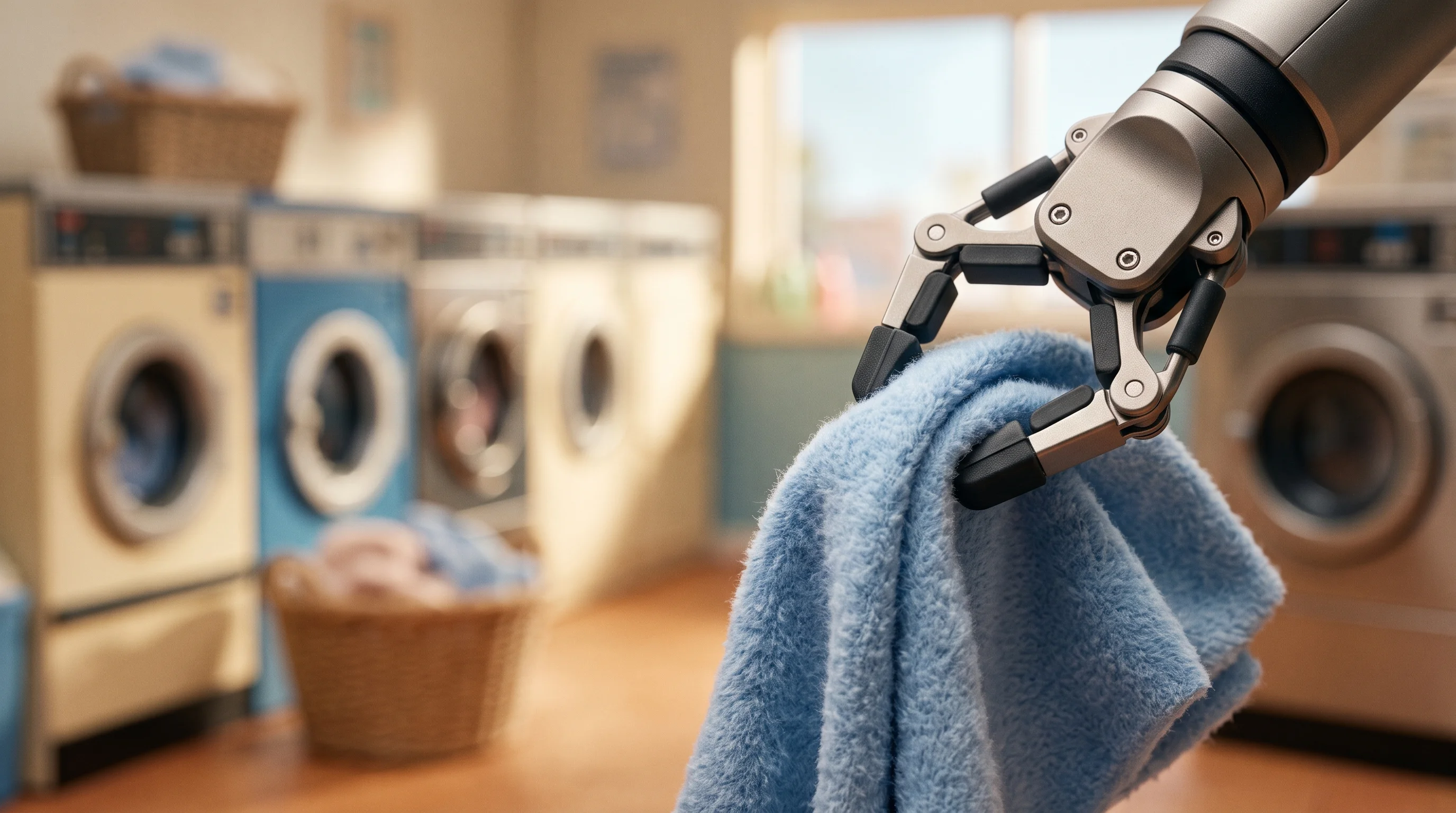
Physical Intelligence reported in a February partner update that Weave Robotics, which operates in commercial laundromats, reduced missed grasps by 42% and human interventions by 50% after upgrading from π0.5 to π0.6 during live deployments. Anecdotal reports in July cited 96.4% autonomy in industrial packaging at Ultra, a YC-backed company, though primary data has not been posted publicly. Ambi Robotics, which sells sorting and stacking systems to Fortune 500 logistics customers, sold out its AmbiStack product for 2025 and ramped deployments into this year, the company said in January and February releases.
Large operators are deploying fleets but still wrestle with edge-case failures. Ocado Group runs 600-Series bots and On-Grid Robotic Pick across 14 customer fulfillment centers as of August 11, according to the company's website. Symbotic disclosed in its 2025 10-K a master automation agreement with Walmart covering pickup and delivery automation, with micro-fulfillment prototypes planned for this year. Figure deployed its F.03 humanoid at a BMW facility, the company announced on June 30, following earlier 2025 trials. Agility Robotics counts Amazon, GXO, Schaeffler, and Toyota Canada as paying customers using its Digit robot, TechCrunch reported on July 17.
Enact said it is already serving first customers but declined to disclose names as of mid-August.
The company lists a team size of two. Stevens holds a Stanford master's in management science and engineering and was an early engineer at a startup that scaled to $1.5 billion in assets under management. Govind Chada conducted robotics research in Chelsea Finn's IRIS Lab at Stanford and worked at Meta Reality Labs, according to Y Combinator's profile updated in August.
The Money Keeps Flowing
Venture capital has flowed into robotics foundation models and infrastructure. Physical Intelligence raised $600 million in November 2025. Skild AI closed a $1.4 billion round led by SoftBank in January, reaching a $14 billion valuation, Business Wire reported via Morningstar.
Adjacent to Enact's post-training focus, YC's Summer batch this year includes Sensei, which offers distributed human operators for robotics training data collection at scale, addressing the upstream data-gathering step.
McKinsey forecast in June that robotics could unlock "at least a trillion dollars" in value by 2040, with near-term gains concentrated in manufacturing and logistics as task-agnostic systems displace bespoke automations. The IFR projected in January that global installations will surpass 700,000 units by 2028, representing roughly 7% compound annual growth from 2025 to 2028, with total market value for industrial robot installations reaching an all-time high of $16.7 billion.
BCG noted in May that "robots can now see, adapt, and adjust in real time, reducing deployment costs and complexity." The firm cautioned, however, that readiness varies by facility, process, and safety case maturity.
Regulatory timelines are tightening. The EU AI Act began enforcing certain provisions on August 2, with high-risk standalone AI systems subject to compliance by December 2027 and AI embedded in regulated products by August 2028, according to the EU AI Office Service Desk pages updated in July and August.
The Open Question

Enact's controlled benchmark offers a concrete metric: 99 successes in 100 rollouts. But the packing task used standard hardware and a known foundation model. Whether the approach scales across diverse tasks, embodiments, and production environments remains an open question.
The company's security page outlines row-level security, zero-trust administration via Tailscale, and static analysis on every code change, signaling enterprise readiness. Customer case studies have yet to surface publicly.
Robotics founders building commercial systems now face a choice. Continue manual improvement loops measured in months, or test whether automated targeted recovery can close the lab-to-field gap at the pace deployments demand. Enact's wager is that fifty smart examples beat two hundred generic ones. The next few months will show whether that arithmetic holds outside the lab.


