

The fundamental problem with most fitness wearables, if you ask serious lifters, is that they're built for runners.
Sure, your Apple Watch can count steps. Your Whoop knows when you slept poorly. But try asking either device whether you've adequately trained your glutes this week—or whether that last set of squats actually brought you close to failure—and you'll be met with digital silence.
Fort, a San Francisco startup that just emerged from Y Combinator's Winter 2026 batch, thinks it has spotted something others missed. Founded by three former Tesla engineers, the company is developing a screenless wearable that promises to automatically track strength training with the kind of granularity typically reserved for $2,000 bar-mounted devices used by Olympic coaches.
Wear the sub-30-gram band on your wrist, the pitch goes, and it detects what exercise you're doing, counts your reps, measures bar speed and velocity, calculates time under tension, times your rest periods, and estimates how close you came to muscular failure. All without you pressing a single button or logging a single set.
The device is available for pre-order at $289—that includes the first year of software—with shipping slated for Q3 2026. Whether it actually works as advertised is another matter entirely.
The Technical Ambition
Fort's core claim is deceptively simple: automatic exercise recognition across 50-plus movements, from barbell compounds to cable accessories. What makes that technically ambitious is the second part—not just identifying that you're doing a Romanian deadlift, but capturing bar speed, velocity, and proximity to failure from a wrist-worn sensor.
Those metrics matter to anyone serious about progressive overload. Velocity-based training has migrated from sports science labs into mainstream strength programming over the past decade, based on research showing that bar speed drops as you approach muscular failure. Track velocity across sessions, and you can program volume and intensity with unusual precision.
The catch? Validated VBT tools cost real money. GymAware's RS system runs about $1,995. Vitruve's encoder costs roughly $447. RepOne offers tethered linear position transducers. All are accurate. All are single-purpose. All live permanently in your gym bag.
Fort wants to collapse that functionality into something you wear all day. The device synthesizes exercise detection, sets, reps, velocity, rest intervals, heart rate, and training goals into what the company calls a "Session Score"—a single number meant to tell you whether your workout actually moved the needle. It also offers a per-muscle breakdown showing weekly volume and whether each muscle group is undertrained, recovering, growing, or overloaded.
And yes, it does the usual wearable things too: continuous heart rate monitoring, sleep stages, VO2max estimates, HRV-based recovery scores, stress detection, cardio tracking with heart rate zones. Battery life hovers around seven days.
The Founders' Pedigree
The Tesla connection isn't incidental here. Founder Miranda Nover worked on the company's 4680 battery cells for Cybertruck and holds a mechanical engineering degree from Carnegie Mellon. Co-founder Paul Schneider handled systems design and autonomy architectures for Tesla's Semi and Robotaxi projects—complex sensor fusion problems, in other words. Zac Valles, heading hardware, spent time at both SpaceX (propulsion, Starlink) and Tesla as a senior engineer.
That résumé reads like preparation for exactly this kind of challenge: taking noisy accelerometer and gyroscope data from a moving wrist, filtering out everything that isn't the bar path, and extracting velocity metrics accurate enough to inform training decisions. Whether a small team can pull that off remains to be seen.
The company has backing from Afore Capital, Weekend Fund, Theory Forge, Banana Capital, Carnegie Mellon's venture arm, and angels from OpenAI and Tesla. Fort hasn't disclosed funding amounts—a familiar Y Combinator deflection at this stage.
How It Stacks Up

Fort isn't entering empty territory, exactly. Whoop introduced its Strength Trainer feature in 2023, quantifying muscular load when users manually log exercises and weights. A February 2026 update added automatic muscular load estimates across the platform. But Whoop doesn't attempt rep-by-rep bar speed tracking or the per-muscle granularity Fort is promising.
Garmin watches offer native rep counting in their strength profiles. The catch? Users must manually advance between sets, and the company's own manuals note that leg exercises may not count reliably—a polite way of saying the technology has limits.
Apple Watch users can pair with third-party apps like Bevel to compute strain and velocity-based metrics. But these typically require selecting exercises beforehand, which defeats the automation Fort is chasing.
The real competition, perhaps weirdly, comes from the high end. For coaches and athletes who care deeply about velocity-based training, the bar-mounted devices remain the gold standard. They're accurate because they measure the bar directly. They're expensive because the market has been small. If Fort can deliver even 80% of that accuracy at 15% of the price, the calculus shifts.
The Validation Gap
Which brings us to the uncomfortable question hovering over this entire product category: does wrist-based bar speed tracking actually work?
Fort's website says the device uses an IMU—accelerometer and gyroscope—plus a PPG heart rate sensor, paired with an iOS companion app. (Android support and data export APIs are notably absent from current materials.) What's missing is any independent validation comparing Fort's velocity readings against established bar-mounted references.
The5krunner, a wearables review site, called this "the central technical question." The Fit Futurist highlighted the absence of validation studies at launch. Both pointed out what anyone familiar with sensor physics already knows: measuring bar velocity from a wrist that's also rotating, flexing, and moving independently of the bar is a fundamentally harder problem than measuring it from a device physically attached to the bar.
Fort may well have solved it. The founders' backgrounds suggest they understand sensor fusion. But promising proximity-to-failure estimates based on wrist-worn accelerometers is the kind of claim that invites skepticism until proven otherwise.
What It Costs, When It Ships
The early access pre-order is $289, which includes the first year of software. After that, full retail is listed as $319 for the hardware, plus $79.99 annually for the membership tier—though Fort says a free tier will always be available. Pre-orders are fully refundable. The company has capped the $289 early discount at 1,000 units.
Shipping dates show some inconsistency that feels very startup-in-motion: the website says Q3 2026, while the Y Combinator company page lists "starting June 2026." Whether that's optimism, miscommunication, or just the chaos of hardware timelines isn't clear.
The Real Test
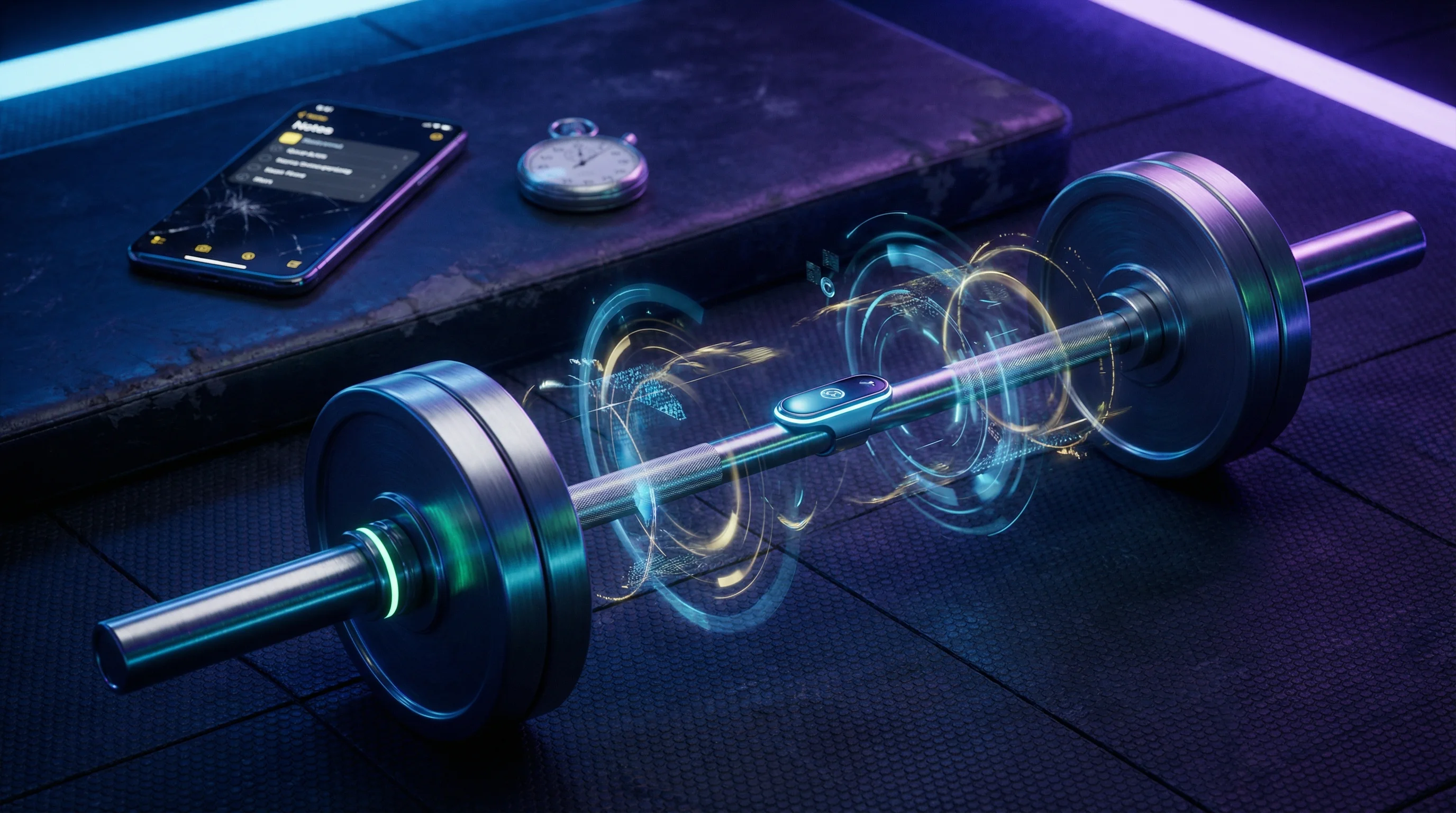
For strength training enthusiasts who've been manually logging workouts in Notes app or dealing with Garmin's set-by-set button taps, Fort's pitch is genuinely appealing. Put it on, lift, let the algorithms figure out the rest.
Whether those algorithms can deliver accurate enough bar speed and fatigue estimates from a wrist-worn form factor remains—generously—an open question. The answer will emerge when units ship and independent reviewers start running Fort's velocity readings against established VBT devices in actual gyms.
If it works, Fort could carve out a legitimate category: serious strength tracking that doesn't require you to choose between your fitness tracker and a dedicated piece of training equipment. If it doesn't, it'll join the long list of wearables that promised more than the sensor physics could deliver.
Either way, we'll know soon enough. Q3 2026 isn't far off.


