

The front end of drug discovery has become, by most measures, astonishingly fast. AlphaFold 3, unveiled in May 2024, can predict protein-ligand complexes with remarkable accuracy. High-throughput screening platforms churn through billions of protein-protein interaction measurements. Computational tools that once required years now deliver molecular designs in months, sometimes weeks.
Which has created an unexpected problem.
For every therapeutic candidate that artificial intelligence helps discover, there's now an analytical queue forming behind it—a weeks-long validation process that hasn't kept pace with the computational revolution upstream. Protein characterization, the unglamorous work of confirming that a drug candidate actually behaves as designed, still demands manual expert analysis and considerable time. AI has accelerated the discovery of new molecules, but it hasn't yet solved the challenge of validating them.
"AI-accelerated discovery is pushing more candidates into wet-lab funnels," observed a February 2026 analysis in Nature Reviews Drug Discovery tracking therapeutic approvals. The instruments that validate those candidates, however, haven't evolved at the same clip. This mismatch—call it the discovery-development disconnect—has caught the attention of a new crop of founders promising to automate what has historically required deep expertise and patience.
When Speed Upstream Meets Slowness Downstream
Consider the numbers. The FDA approved 55 novel drugs in 2024 across its Center for Drug Evaluation and Research and Center for Biologics Evaluation and Research, according to Nature Reviews Drug Discovery. Twenty-two of the 56 novel active substances approved in 2024 were biologics, a February 2026 briefing from the Centre for Innovation in Regulatory Science noted. Biosimilars alone hit 18 approvals in 2024, bringing the U.S. total to 62, BioWorld reported early last year.
These aren't simple molecules. Antibody-drug conjugates—complicated hybrids that link cancer-killing agents to antibodies—have somewhere between 100 and 200 programs in clinical development, depending on whose estimate you trust. Industry sources cite figures ranging from roughly 200 (per Fortrea, April 2025) to over 100 clinical-stage ADCs (Precision for Medicine, October 2025). Bispecifics, multispecifics, and engineered scaffolds are proliferating at a similar pace.
Each iteration multiplies the required assays: binding kinetics, stability profiles, post-translational modifications, drug-antibody ratios, aggregation propensity, glycoform distributions. It's a dizzying array of tests, and someone has to make sense of it all.
The instruments themselves keep improving. Bruker launched the timsTOF Ultra 2 at the annual ASMS conference in June 2024, adding an Athena Ion Processor for single-cell proteomics gains in 2025. Agilent rolled out an ExD cell for its 6545XT AdvanceBio LC/Q-TOF at the same meeting to enhance peptide and protein characterization. Waters completed its acquisition of Wyatt Technology in May 2023, expanding capabilities for biologics analysis.
But here's the rub: sensitivity and throughput gains at the instrument level don't automatically translate to faster answers. Someone still needs to interpret the mass spectra, reconcile orthogonal biophysical measurements, flag anomalies, compile regulatory-grade reports. That work, as McKinsey framed it in a January 2026 analysis, remains "constrained by data plumbing and standardization." Data cleaning, the consultancy warned, has become "a critical bottleneck."
Perhaps more critically, the bottleneck is growing wider as discovery accelerates.
The Three-Person Team With a Bold Thesis
This is where 10x Science enters the picture—a three-person outfit that emerged from Y Combinator's Winter 2026 batch with a pointed argument: protein characterization has become the new rate-limiting step, and the solution isn't faster instruments. It's AI-native infrastructure for analysis and reporting.
Founded in late 2025 and incorporated in Delaware in February 2026, the company claims to reduce analysis time from "weeks to minutes." Their pitch centers on automating the interpretation of mass spectrometry and chromatography data for protein characterization and quality assurance. The potential time savings, according to their YC launch post, could reach $150,000 per team per month.
That's an audacious claim. But maybe not an implausible one? CRO bioanalytical and characterization work frequently runs weeks to months for method development and final reports, according to planning references from USP and IQVIA published in 2025. Industry sources indicate that report generation typically adds one to two weeks after experiments for micro-developability work. Emery Pharma advertises two- to three-week turnaround times for selected biologics characterization assays.
The founders, at least, bring relevant pedigrees. CEO David Roberts is a Damon Runyon Fellow who completed his postdoc in Carolyn Bertozzi's lab at Stanford after earning a chemistry PhD from UW-Madison in 2023. COO Andrew Reiter ran proteomics platforms at the Broad Institute in Steven Carr's lab and is a Stanford Biology PhD student (an NSF-GRFP recipient) co-advised by Bertozzi and Or Gozani. CTO Vishnu R. Tejus is a two-time YC founder and former founding engineer at Nooks, with lab stints spanning UW, UCSF, and Stanford.
Their USPTO trademark applications, filed in January 2026 with first use claimed in November 2025, list goods and services including "downloadable AI software for mass spectrometry, chromatography, and protein/PTM characterization." The target customers: pharmaceutical and biotech companies, academic core facilities, contract research organizations. Anyone, in short, drowning in characterization data.
It's Not Just Volume—It's Variety
The pressure on analytics teams isn't purely about the sheer number of samples. It's the bewildering variety of formats and failure modes.
A 2024 review in the Journal of Pharmaceutical Sciences cautioned against simplistic stability proxies like melting temperature alone, highlighting the need for multi-parametric biophysical characterization for monoclonal antibodies and engineered formats. Early-stage surface plasmon resonance-based relative activity and stability studies help flag potential critical quality attributes, but reproducible, automated data interpretation remains elusive, a 2024 mAbs review noted.
Antibody-drug conjugates exemplify the challenge. Determining drug-antibody ratio requires integrating LC-MS data. Assessing conjugate homogeneity demands orthogonal confirmation from multiple techniques. A November 2024 study on automated intact protein mass spectrometry screening for bispecifics and multispecifics demonstrated end-to-end high-throughput workflow gains—but "automation" here meant instrumentation and sample prep, not the interpretive analytics layer that comes after.
Meanwhile, data-independent acquisition proteomics generates files that can balloon to 8 to 16 gigabytes for 25- to 30-minute runs on newer platforms, based on community benchmarks from 2024-2025. Large datasets—tens to hundreds of gigabytes—stress compute workflows and demand software that can keep pace. Transformer-based deep learning models for DIA de novo sequencing started appearing in arXiv preprints in early 2024, targeting speed and accuracy gains, though these remain largely research-stage tools.
The broader proteomics market is expanding—Mordor Intelligence pegs it at $33.6 billion in 2024, projected to grow to $65.8 billion by 2030 at a 12.6% compound annual growth rate, with mass spectrometry accounting for roughly 30% of revenue share, per a January 2026 update. But market sizing for the narrower "protein characterization and identification" segment varies wildly. 360iResearch estimates $13.5 billion in 2025 growing to $26.3 billion by 2032, while Global Growth Insights pegs it at just $2.31 billion in 2024 reaching $4.97 billion by 2033. The discrepancies likely reflect differing methodologies and scope definitions—or perhaps just the difficulty of pinning down a market in flux.
What the Big Players Are Doing (and Not Doing)

The analytical instrumentation giants are aware of the bottleneck, though their responses have been uneven.
Thermo Fisher completed its acquisition of proteomics firm Olink on July 10, 2024, signaling a strategic bet on proteomics growth. Bruker acquired NanoString in May 2024, building out a Bruker Spatial Biology division. Waters' 2025 "waters_connect for biopharmaceuticals" software emphasizes product quality attribute monitoring, ADC drug-antibody ratio calculations, and RNA LC-MS maps—automation features, certainly, but not AI-native end-to-end report generation.
Dotmatics has pursued an acquisitive strategy to stitch together the analytics stack, buying Protein Metrics in December 2021 and Virscidian in September 2024 to automate mass spectrometry and chromatography workflows for LC-MS protein characterization, PTM analysis, and compliance-minded pipelines. Siemens announced plans to acquire Dotmatics in May 2025, with closing expected in the first half of fiscal year 2026—consolidation that speaks to the perceived value of integrated analytical software, if not necessarily to the urgency of interpretive automation.
Elsewhere, high-throughput label-free platforms like Carterra's SPR systems and Sartorius' Octet BLI instruments (the R8e launched in May 2025) are gaining traction for parallel kinetics and epitope binning. Mass photometry from Refeyn crossed 500 installations as of May 2025 and earned recognition in USP AAV reference standards released in June 2025.
But few of these players position themselves as "AI-native, end-to-end protein characterization report automation" across modalities. Most offer either instruments, point-solution analytics, or general LIMS/ELN informatics. The gap that 10x Science is targeting—automated, minutes-to-report turnaround for multi-assay protein data—remains largely unaddressed by incumbent vendors, who tend to emphasize throughput and sensitivity rather than interpretive automation.
Emerald Cloud Lab represents one alternative model: remote execution for LC-MS, SPR/BLI, and biophysical assays with integrated analysis, though it's more a platform for standardized data capture than AI-driven interpretation. Culture Biosciences has been expanding cloud-connected bioreactors with AI partnerships (Google Cloud in September 2024; Cytiva in August 2025), but its focus remains on bioprocessing rather than downstream analytics.
Which is to say: the opportunity may be real, but it's hardly uncontested territory.
An Inadvertent Tailwind From Regulators
Ironically, regulatory agencies may be creating inadvertent momentum for automation-focused analytics platforms.
ICH Q2(R2) and Q14 reached Step 5 in 2024, introducing lifecycle-based analytical development and supporting enhanced approaches like the multi-attribute method for biologics quality control. The draft ICH M4Q(R2), released in May 2025 with an FDA draft following in January 2026, aims to "enshrine digital CMC" and structured data across modalities, with final sign-off expected mid-2027, according to industry analysts. The push toward digital CMC dossiers and structured, lifecycle-managed analytical knowledge creates demand for systems that can generate validated, reproducible reports directly from raw data.
On December 2, 2025, the FDA released draft guidance proposing to reduce or eliminate some non-human primate testing for monoclonal antibodies. While aimed squarely at animal welfare, the move may reallocate nonclinical budgets and timelines toward earlier CMC and characterization optimization—further compressing development cycles and intensifying the analytics crunch.
Then there's the BIOSECURE Act, which passed on December 18, 2025, restricting U.S. federal procurement and grants involving "biotechnology companies of concern," with phased safe harbors and timelines running through 2028-2029, according to legal client alerts. The law introduces operational impacts on sourcing and outsourcing analytics and equipment strategies. U.S.-centric buyers may increasingly prefer U.S.- or EU-sourced analytics infrastructure with clearer audit trails—potentially benefiting cloud and SaaS providers with compliant data lineage.
All of which is to say: the regulatory environment, usually a drag on innovation, may for once be pushing in the same direction as the technology.
The Questions That Remain
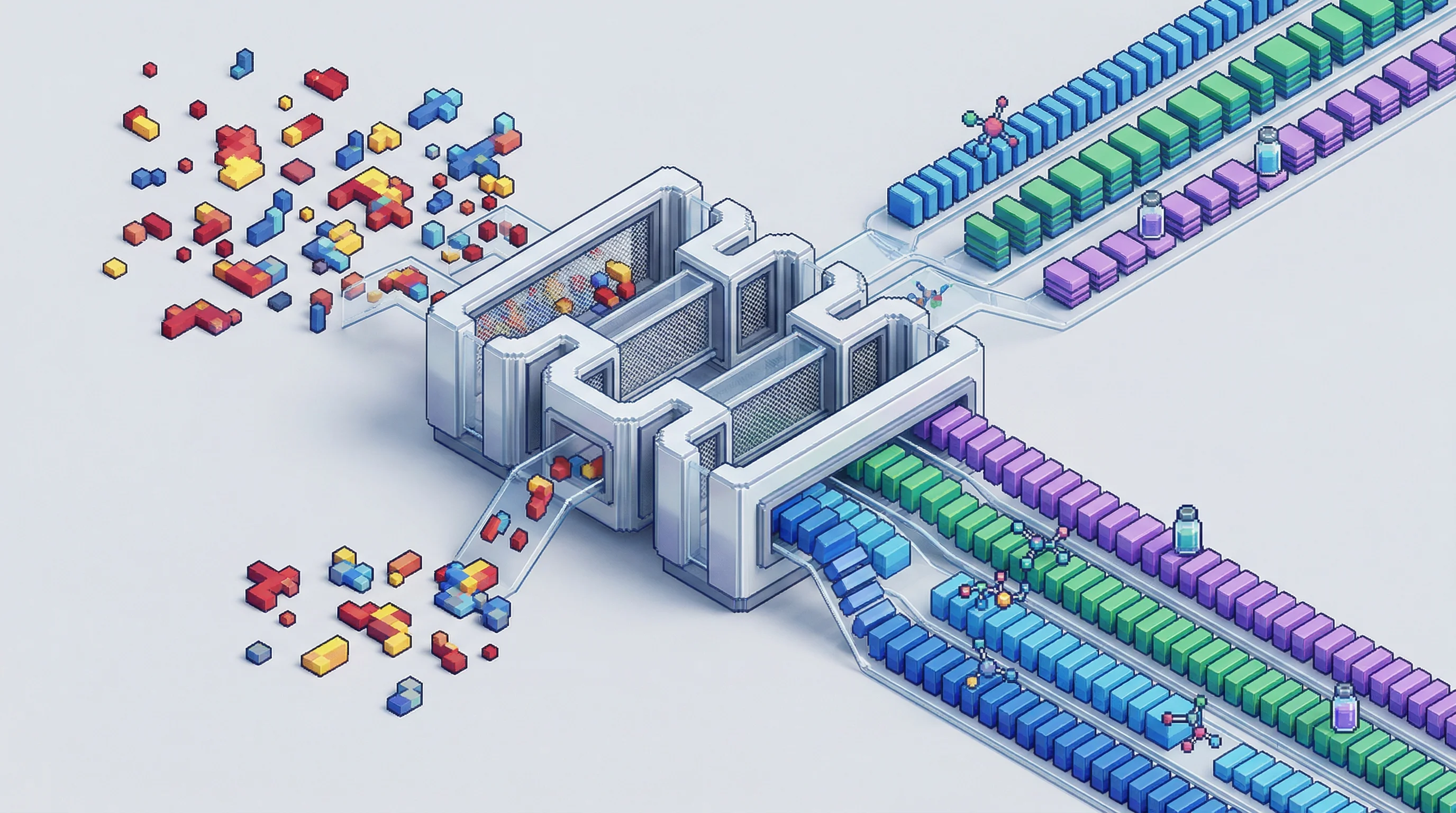
McKinsey's January 2026 assessment that "data cleaning is a critical bottleneck" for realizing agentic AI in biopharma development underscores both the opportunity and the challenge. Harmonized data models, standardized flows, and orchestration matter as much as raw compute power. Maybe more.
10x Science is betting that the industry is ready for an AI-native characterization layer that sits between instruments and decision-makers, compressing the interpretive gap. Whether that bet pays off depends on questions the available research doesn't yet answer convincingly: validation against expert analysis, regulatory acceptance of AI-generated reports, integration with existing LIMS and quality systems, and—perhaps most critically—the willingness of risk-averse organizations to trust minutes-old automated output over weeks of manual review.
That last question may prove the hardest to answer. Pharma, after all, is an industry where caution is often rewarded and speed can be punished.
What seems harder to dispute is that the mismatch between discovery speed and characterization throughput isn't going away. As AlphaFold-adjacent gains push more candidates into wet-lab funnels, organizations that standardize and automate characterization and analysis should, in theory, compress cycle times and reallocate expert time to edge cases and exceptions. The instruments will keep getting better—that much is certain.
The question, as it so often is, is whether the software will finally catch up. And whether anyone will trust it when it does.


