

For decades, the non-alcoholic beer industry has been solving the wrong problem. Billions have gone into perfecting ways to strip alcohol from fully fermented beer—vacuum distillation chambers the size of small cars, reverse osmosis membranes that act like molecular sieves, spinning cone columns that look more at home in an oil refinery than a brewery. Each method wrestles with the same contradiction: how do you remove ethanol without destroying everything that makes beer taste like, well, beer?
A Belgian startup called Bar.on thinks the entire exercise is backwards. Why remove alcohol, they ask, when you could simply never make it in the first place?
Their answer is the "One Tap," a device that doesn't brew beer so much as assemble it—mixing molecular-level flavor compounds with water and, for alcoholic versions, neutral grain spirit. No yeast. No fermentation tanks. No weeks of waiting. A lager in seconds. An IPA configured to order. And for non-alcoholic variants, no dealcoholization required because there was never any alcohol to begin with.
It's chemistry masquerading as craft, and it could reshape how the booming NA beer category thinks about production. If, that is, anyone will drink it.
The Subtraction Problem
Traditional non-alcoholic beer is a game of careful destruction. Brewers start by making real beer—letting yeast metabolize sugars into alcohol while creating the complex esters, phenols, and aldehydes that give each style its character. Then comes the delicate work of pulling out just the ethanol while preserving everything else. It's expensive, technically finicky, and rarely perfect.
The industry has settled on three main approaches, none ideal. Thermal methods—vacuum distillation, spinning cone columns—work efficiently but demand enormous energy. They also tend to strip volatile aromatics along with the alcohol, requiring elaborate recovery systems to capture and reintroduce what was lost.
Membrane technologies like reverse osmosis preserve more flavor compounds than heat-based systems, at least in theory. But a 2021 study in Food Chemistry: X showed they still reduce key volatiles and affect body, with results that vary wildly depending on beer style. Even sophisticated systems like GEA's AromaPlus—which Adnams deployed in 2018 for its Ghost Ship 0.5—require constant optimization.
The third option, restricted fermentation, limits alcohol production from the outset but typically yields a narrower, often maltier flavor profile. Brewers spend months balancing sweetness and body, chasing the complexity that standard fermentation delivers naturally.
As the UK's non-alcoholic market has exploded—up 750% since 2013 to over 200 million pints in 2025—major players have made substantial capital bets on these technologies. Last December, AB InBev opened a dedicated dealcoholization facility in Magor, Wales, using vacuum distillation to localize production of Corona Cero and Stella 0.0. It's the kind of infrastructure commitment that signals executives believe this category is here to stay.
Building Beer Without Brewing It
Bar.on's approach sidesteps the problem entirely, which is either brilliant or heretical depending on who you ask.
The company—led by CEO Dirk Standaert and Chief Product Officer Valentijn Destoop—developed the One Tap in partnership with Prof. Kevin Verstrepen's lab at VIB–KU Leuven, a Belgian research institute that's become something of a ground zero for flavor chemistry. The device uses precision dispensing technology, engineered by Belgian partner Comate, to combine flavor compounds with tap water. Six cartridges hold aroma and flavor molecules, plus a malt mixture. For alcoholic versions, it adds neutral grain spirit to hit the target ABV. For NA? Skip the spirit. Done.
Public demonstrations have produced lagers, blondes, browns, triples, and IPAs. The system lets users dial up or down bitterness, fruitiness, sweetness, and spice—all constructed at the molecular level. Standaert has noted, perhaps unsurprisingly, that styles with assertive flavors like IPAs are easier to replicate. Clean lagers, with nowhere to hide imperfections, remain the Everest. It's a difficulty curve that mirrors traditional brewing, which may or may not be reassuring.
Destoop calls it "digitizing beverages," which sounds very much like something a chief product officer would say. The sustainability pitch is more concrete: since the device assembles beer on-site from concentrated cartridges, there's no shipping finished product—which is mostly water anyway. Bar.on claims major reductions in packaging waste and transportation emissions, positioning molecular mixing as an alternative to both traditional brewing and the dealcoholization infrastructure that's proliferating across Europe.
The company raised €1.8 million in seed funding in 2022 from Astanor Ventures, Exceptional Ventures, and Thia Ventures. Plans for a Series A were mentioned as of April 2023. A commercial "One Tap Pro" aimed at pubs was slated for field testing, though public updates on actual deployment have been... sparse.
The Science of Synthetic Flavor
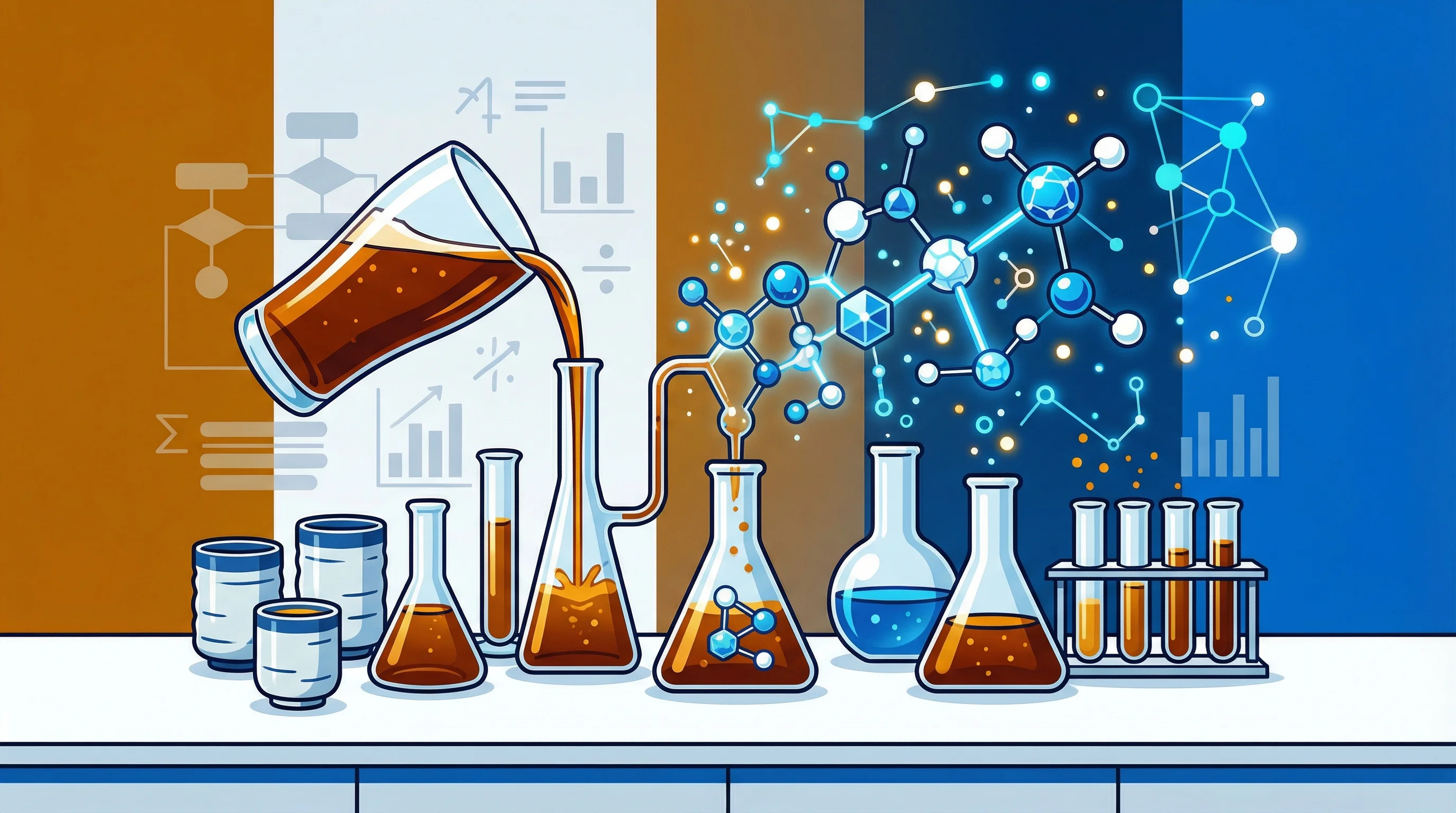
The recipes underpinning Bar.on's system draw from a January 2024 study in Nature Communications, led by Verstrepen's team. Researchers analyzed 250 beers, measuring 226 chemical properties and cross-referencing them with 180,000 consumer reviews scraped from RateBeer. Using gradient boosting models—machine learning techniques that predict outcomes by combining weak predictors—they identified which compounds drive sensory characteristics and consumer appreciation. More importantly, they figured out which additions could improve both alcoholic and non-alcoholic beers.
Coverage in Chemical & Engineering News explicitly noted Bar.on's collaboration on exploring "molecular beers," an extension of French chemist Hervé This's "note-by-note" cooking philosophy. This has argued for years that building foods from pure compounds, rather than traditional ingredients, allows for both customization and waste reduction. Whether that translates to something people actually want to drink is another matter.
Standaert has said the company aims for blind-taste parity with traditional beer and has conducted internal tastings that "performed strongly." Independent verification, however, remains limited. Belgian beer judges quoted in VinePair coverage raised concerns about reducing brewing to "chemistry"—a telling reaction in a country where beer culture runs deep. Bar.on isn't just selling a product. They're challenging an identity.
The Economics of Shipping Air
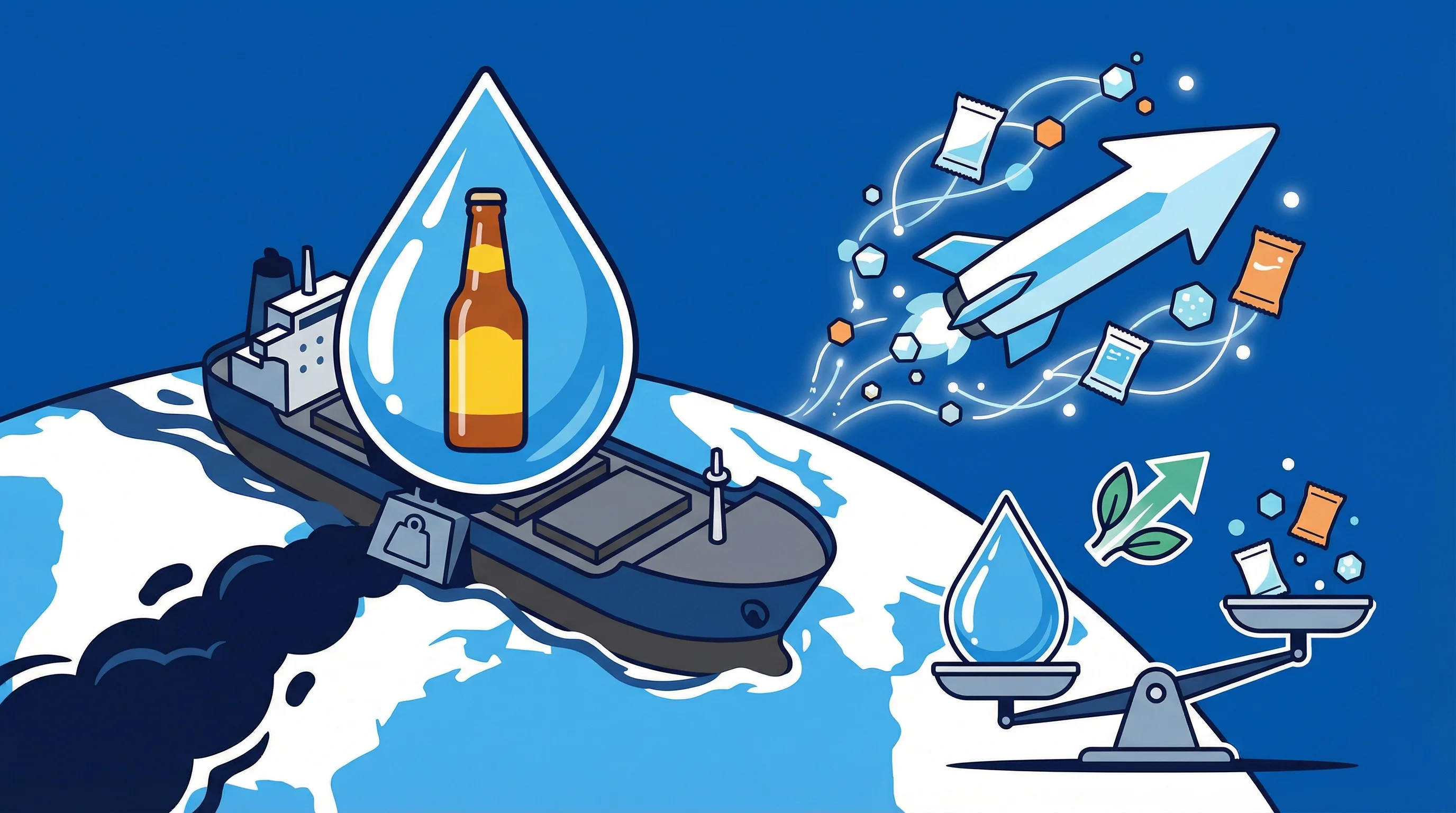
The financial case for molecular beer hinges on one inescapable truth: beer is heavy, and most of that weight is water.
Packaging and transportation account for roughly 31% of craft beer's environmental footprint, according to a 2025 study in ACS Sustainable Resource Management. Shipping beer globally—or even regionally—is both expensive and carbon-intensive. Companies have been chipping away at this problem from different angles.
Alfa Laval's Revos system concentrates finished beer using high-pressure reverse osmosis, reducing transport weight by 65-80% and allowing rehydration near the point of sale. Sustainable Beverage Technologies' BrewVo takes a different tack with "nested fermentation," creating concentrated beer that's rehydrated at the tap via its NexDraft system. Deschutes Brewery invested $5 million in the technology for Black Butte and Fresh Squeezed non-alcoholic IPAs; the latter became the Oregon brewer's fastest-selling product in 2023.
Bar.on takes the concept to its logical extreme by eliminating fermentation infrastructure altogether. A pub deploying the One Tap Pro wouldn't need kegs, extensive cold storage, or a dealcoholization line for NA offerings. The device and cartridges replace all of it. Whether that pencils out depends on cartridge costs, device reliability, and—most critically—whether consumers accept what comes out of the tap.
The hardware go-to-market risk is real, and recent. Cana One, which raised significant capital to build a multi-beverage "molecular printer" using 213 ingredient cartridges, shut down after high-profile launches in 2022-2023. Turns out device economics, reliability, and consumer adoption proved trickier than the pitch deck suggested. Bar.on's B2B focus on pubs may offer more controlled deployment than consumer countertop devices, but it's a reminder: technology that works in a lab doesn't always survive contact with the market.
The Regulatory Minefield
Perhaps the thorniest challenge isn't technical—it's definitional. What, legally speaking, is beer?
In the United States, the Alcohol and Tobacco Tax and Trade Bureau requires that products labeled "beer" or "malt beverage" be fermented from malted barley and hops. Bar.on's molecular beers, particularly alcoholic versions that add neutral grain spirit, don't meet that threshold. They'd likely be classified as specialty beverages or, if non-alcoholic, fall under FDA food labeling. Which means an alcoholic molecular IPA couldn't actually be marketed as an IPA in the U.S. under current rules. That's not a minor branding problem.
The UK offers slightly more flexibility, though the landscape is shifting. Current guidance limits "alcohol-free" to 0.05% ABV, with "de-alcoholised" covering products up to 0.5%. An ongoing consultation proposes allowing "alcohol-free" for products up to 0.5% and acknowledging multiple production methods—including "blending to mimic taste," language that could potentially accommodate molecular approaches. The EU's incoming Packaging and Packaging Waste Regulation, effective August 2026, imposes strict recyclability targets that might indirectly favor low-packaging models like Bar.on's. But it doesn't resolve the fundamental question of what you're allowed to call the liquid in the glass.
Even established players are navigating this minefield carefully. Heineken faced lawsuits in 2024 over its 0.0 labeling, with plaintiffs alleging the product contained up to 0.03% ABV—a microscopic amount that nonetheless underscored how precise claims must be in a rapidly evolving category.
Two Futures, One Market
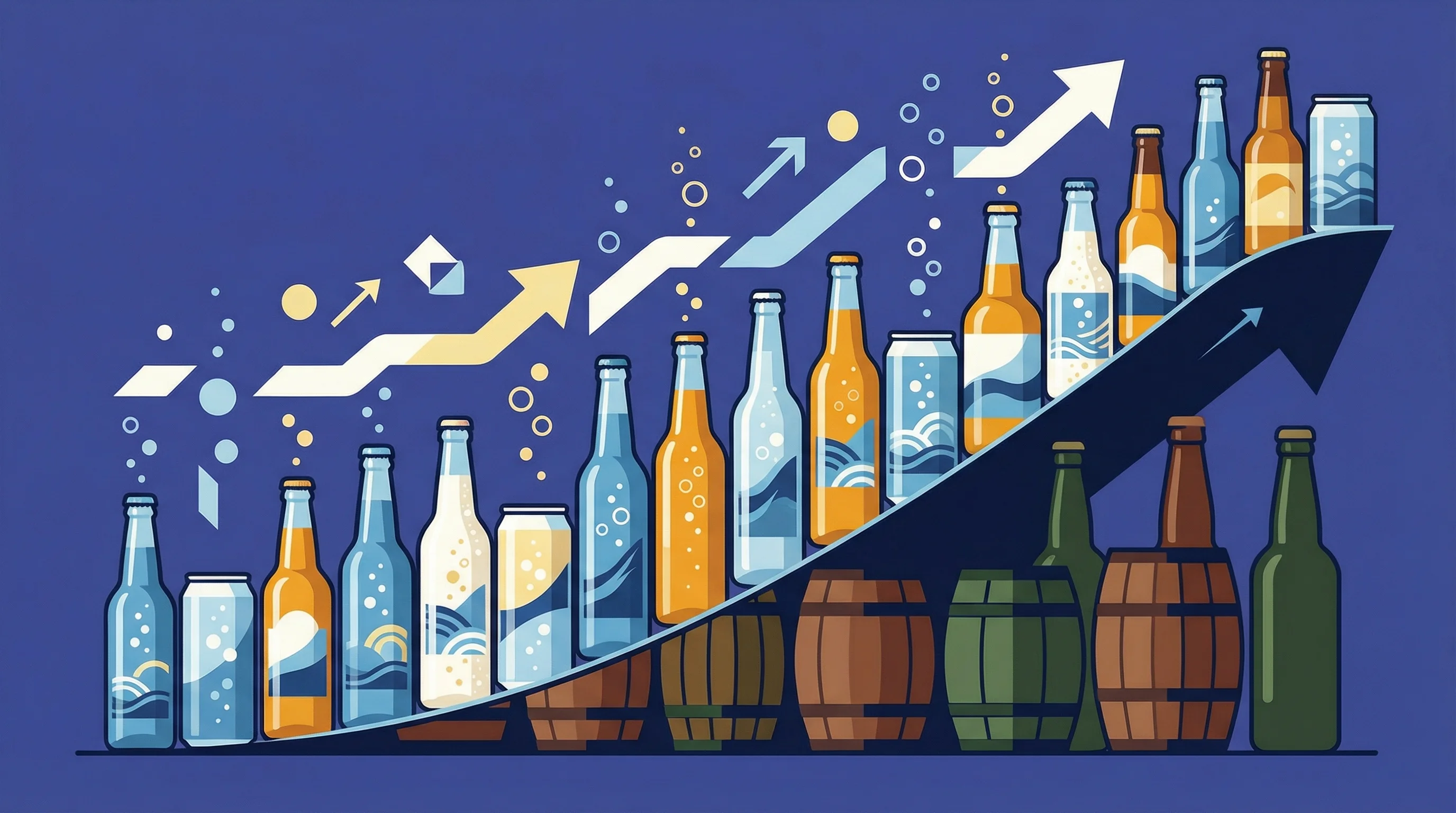
The non-alcoholic beer market is, by any measure, on a tear. IWSR forecasts 7% volume growth annually through 2028. The zero-alcohol subsegment alone is expected to add over $4 billion by 2028. Non-alcoholic beer grew roughly 9% in 2024 and is projected to overtake ale as the second-largest beer category by volume this year. The segment recruited 61 million new consumers between 2022 and 2024 across top markets—not a rounding error.
Athletic Brewing, the U.S. non-alcoholic leader with roughly 19-20% market share, raised $50 million in mid-2024 at an $800 million valuation. The company produced over 258,000 barrels in 2023. Heineken 0.0 grew about 10% last year. AB InBev's no-alcohol portfolio saw strong double-digit growth, with Corona Cero expanding to 27 markets. What was a novelty five years ago is now a standard tap handle.
That growth is driving two divergent philosophies. The first is what you might call "authenticity via process"—improving dealcoholization to deliver beer that tastes like beer because it is beer, just with the alcohol removed. AB InBev's Magor facility, Athletic's capacity expansions, GEA's membrane improvements—all follow this logic. It's capital-intensive, but it's anchored in a consumer understanding of what beer is supposed to be.
The second path is "authenticity via composition." Building beer-like beverages that deliver the sensory experience without the traditional method. Bar.on occupies this space for beer; Endless West's Glyph whiskey (backed by $95 million in funding through 2022) pursues it for spirits. For non-alcoholic applications, the advantage of molecular mixing is clearest: no alcohol to remove means no dealcoholization costs, no flavor compromises from removal processes, and potentially faster SKU development. You could, in theory, launch a new "beer" in the time it takes to mix a new cartridge formula.
The Taste Test No One's Seen
Whether pubs, sports venues, airports, or retailers actually adopt molecular beer systems will come down to three variables: taste, cost, and consumer acceptance. The first remains the biggest unknown.
Bar.on's internal blind tastings may have "performed strongly," but independent sensory panels and broader consumer testing remain conspicuously absent from public view. That's not unusual for a pre-commercial startup protecting trade secrets, but it leaves a significant question mark over the entire proposition. Molecular mixology works for cocktails because spirits are relatively simple flavor matrices. Beer, with its hundreds of volatile compounds interacting in ways that science is still mapping, may prove more stubborn.
The cultural challenge may be even steeper. Beer isn't just a beverage—it's tied to place, tradition, and process in ways that soda or even wine often aren't. The Reinheitsgebot, Germany's 500-year-old beer purity law, isn't about chemistry. It's about identity. Bar.on isn't just asking consumers to try something new. They're asking them to rethink what beer fundamentally is.
If they succeed, it won't be by replacing traditional brewing. That's a fantasy. More likely, they'll carve out niches where customization, logistics, and speed matter more than provenance—airport bars, corporate cafeterias, perhaps festival tents where speed and variety trump authenticity. In a booming NA market that's still defining its boundaries, there may be room for both fermented and synthesized, for process and composition.
Or maybe there isn't. The next year should tell us which side of that bet was right.


