

The promise of using quantum physics to engineer better enzymes has long hovered somewhere between academic curiosity and industrial pipe dream. But Imperagen, a University of Manchester spin-out, is wagering that the convergence of three technologies—quantum simulation, machine learning, and robotic automation—can finally crack the code.
The company secured £5 million in seed funding, with £2.5 million coming from Northern Gritstone as part of the round led by PXN Ventures, with backing from existing investor IQ Capital. The investment brings Imperagen's total raised to £8.5 million, including a previous £3.5 million seed round—a respectable haul for a biotech still in its early stages, though hardly the splashy sums that dominated the sector's frothier years.
Timing the announcement alongside the funding, Imperagen brought in Guy Levy-Yurista as CEO—a notable get. Levy-Yurista, who was appointed as a director on January 5, 2026, was announced as CEO on May 20, 2026. He previously helmed Synthace, a lab automation platform that's become something of a darling in the synthetic biology world. He joins a founding team drawn from the Manchester Institute of Biotechnology: Andrew Almond (CTO), Andrew Currin (CSO), and Timothy Eyes, who leads program development.
The Closed Loop
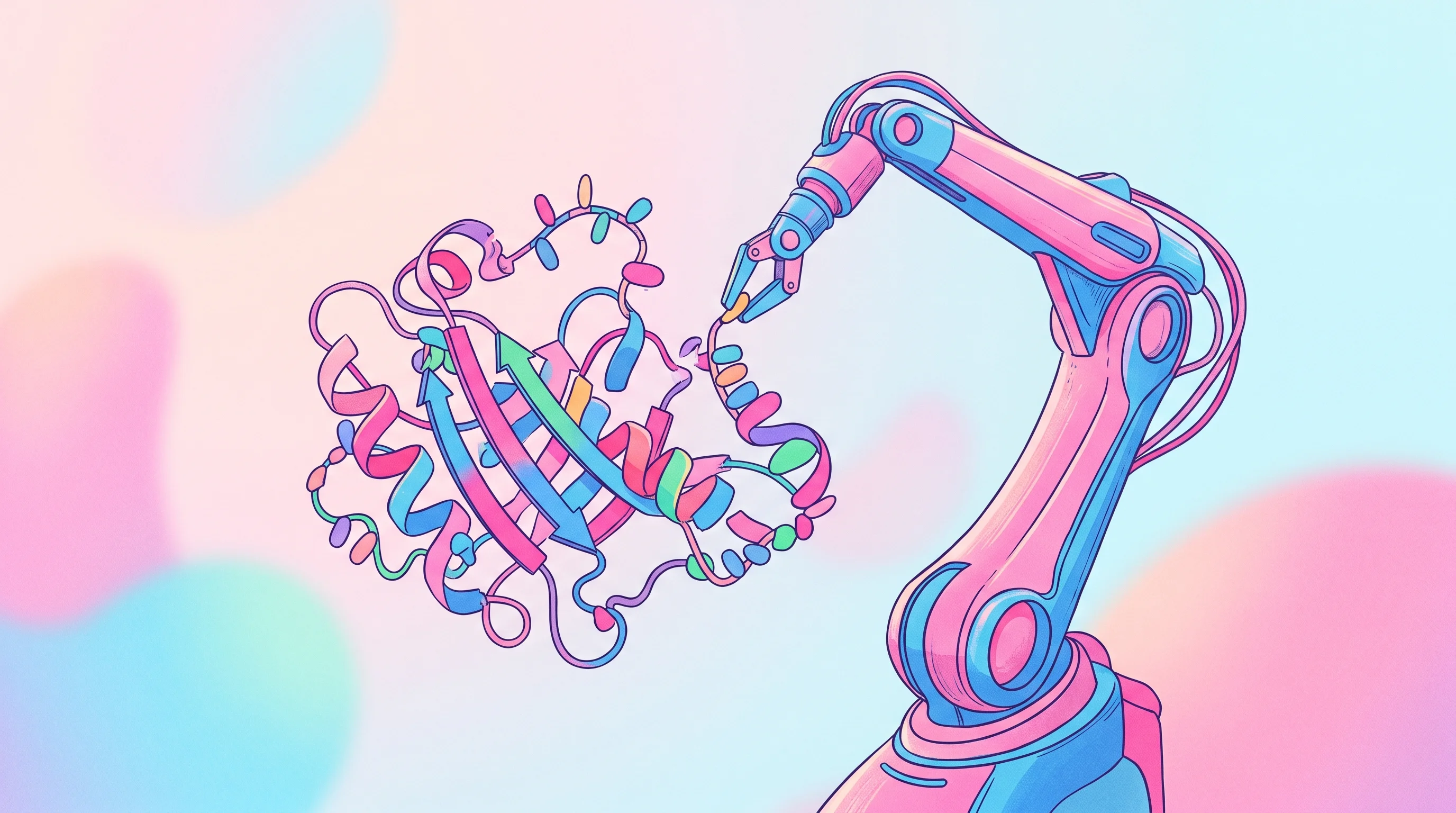
What Imperagen is building, in essence, is an automated feedback system for protein optimization. The platform starts with quantum physics-based simulations to map out which mutations might improve an enzyme's performance. Those predictions get refined by AI models trained on the specific enzyme family in question. Then robotics handle the actual wet-lab work—synthesizing variants, running assays, collecting data.
Here's where it gets interesting: the experimental results loop back into the models, sharpening predictions for the next round. Rinse, repeat. The company says the approach works across enzyme classes, positioning itself for markets spanning pharmaceutical manufacturing, personal care, sustainable chemicals, and the sprawling catch-all of industrial biotech.
It's an ambitious scope. Whether that breadth becomes a strategic advantage or a dilution of focus remains to be seen.
Big Claims, Selective Disclosures

Imperagen has put forward some eye-catching performance numbers. In a project with an unnamed Fortune 500 personal care company, the platform reportedly delivered productivity improvements of 677× and 572× for two separate enzymes over five engineering cycles. According to Northern Gritstone, if replicable, such multipliers could have significant economic impacts on manufacturing economics.
The company also points to work with Zanoprima Lifesciences and Enzymicals AG, where it claims a 10× productivity boost in just two cycles for a tonne-scale production process for (S)-nicotine. Northern Gritstone, which contributed £2.5 million of the latest round, highlighted these metrics in its own materials announcing the deal.
Still, the details remain thin. Which specific enzymes? What were the baseline activities? How generalizable are these results beyond cherry-picked case studies? These are the questions potential partners—and competitors—will be asking.
Capital Deployment and Regional Roots
The fresh funding will go toward the usual growth levers: hiring AI specialists, expanding lab infrastructure, and building out a commercial function over the next 18 to 24 months from the funding announcement. Imperagen remains rooted at Manchester Science Park and has been recruiting for an AI Engineering Director, a signal that machine learning firepower is central to the next phase.
PXN Ventures deployed the investment through two vehicles—the GMC Life Sciences Fund and NPIF II, a Northern Powerhouse fund backed by the British Business Bank. It's a continuation of regional capital flowing to Northern university spin-outs, a trend that's gained momentum as investors look beyond the Cambridge-Oxford-London triangle. Imperagen's earlier £3.5 million raise in late 2022 came from IQ Capital and Northern Gritstone, both now doubling down.
Incorporated in late 2021, the company has also pulled in more than £750,000 from Innovate UK grants and participated in UKRI Engineering Biology research programs, according to materials from prior years.
The Bigger Picture
Enzyme engineering isn't new—directed evolution won Frances Arnold a Nobel Prize in 2018. But the field has historically been slow, expensive, and heavily reliant on human intuition. Imperagen's bet is that automation and AI can collapse timelines and costs enough to unlock applications that were previously uneconomical.
If it works, the implications stretch well beyond lab efficiency. Biocatalysis is increasingly seen as a cleaner alternative to traditional chemical synthesis, particularly as industries face pressure to decarbonize. Pharmaceuticals, in particular, are hunting for greener routes to complex molecules.
But the sector is also crowded. Well-funded players like Arzeda, Cradle, and Basecamp Research are all chasing variations on the AI-for-protein-design theme, each with their own technical twist. Imperagen will need to prove not just that its platform works, but that it works better—and faster—than the alternatives.
For now, the company has capital, a credible leadership team, and some promising early data. Whether that's enough to turn a University of Manchester research project into a category-defining business is the question Levy-Yurista and his team will spend the next few years answering.


