

The pitch sounds almost too tidy: autonomous robots that hover just above the seafloor, plucking up mineral-rich nodules the way a careful gardener might harvest tomatoes, all while leaving the surrounding ecosystem undisturbed. No churning sediment plumes. No razed habitat.
It's the vision Oliver Gunasekara has been refining since he founded Impossible Metals in 2020. And judging by the roughly $15 million the San Jose startup has pulled together—through a combination of venture rounds, angel checks, and government grants—a cross-section of investors seems willing to bet he can pull it off. Or at least that the bet is worth making.
The company has raised around $15 million in total seed funding, which includes a $10.1 million seed that closed back in May 2022, a $2 million pre-seed from September 2021, and assorted follow-on capital. Angel investor Justin Hamilton led that 2022 round, joined by Y Combinator (Impossible Metals went through the accelerator), Chalet.vc, Aureolis Ventures, Climate Collective, Liquid 2 Ventures, Soma Capital, and a roster of other backers. A trio of former ARM executives—Simon Segars, Sir Robin Saxby, and Warren East—signed on as advisors and threw in capital as well.
A Delicate Dance at Four Miles Deep
What Gunasekara's team is building are underwater vehicles designed to operate at depths around four miles, collecting polymetallic nodules scattered across the abyssal plain. These potato-sized rocks contain nickel, cobalt, copper, and manganese—the stuff of lithium-ion batteries. The robots rely on AI-driven computer vision to distinguish nodules from, say, a slow-moving sea cucumber or a coral fragment, according to testimony Gunasekara delivered before the U.S. House of Representatives in April 2025.
Whether the technology can truly avoid ecological harm at scale remains an open question, one that environmental groups and some marine scientists have pressed with considerable urgency. Deep-sea mining, even the "selective" kind, ventures into ecosystems we still barely understand.
Still, the company says its approach sidesteps the sediment plumes and wholesale habitat disruption associated with other seabed collection methods. The stated goal: develop and prove out both the robotic collection system and what it calls "bio-extraction" methods for processing. By mid-2025, AFP reported that the funding would support building and testing the first series of the company's Eureka 3 robot.
Federal Waters and Processing Partnerships
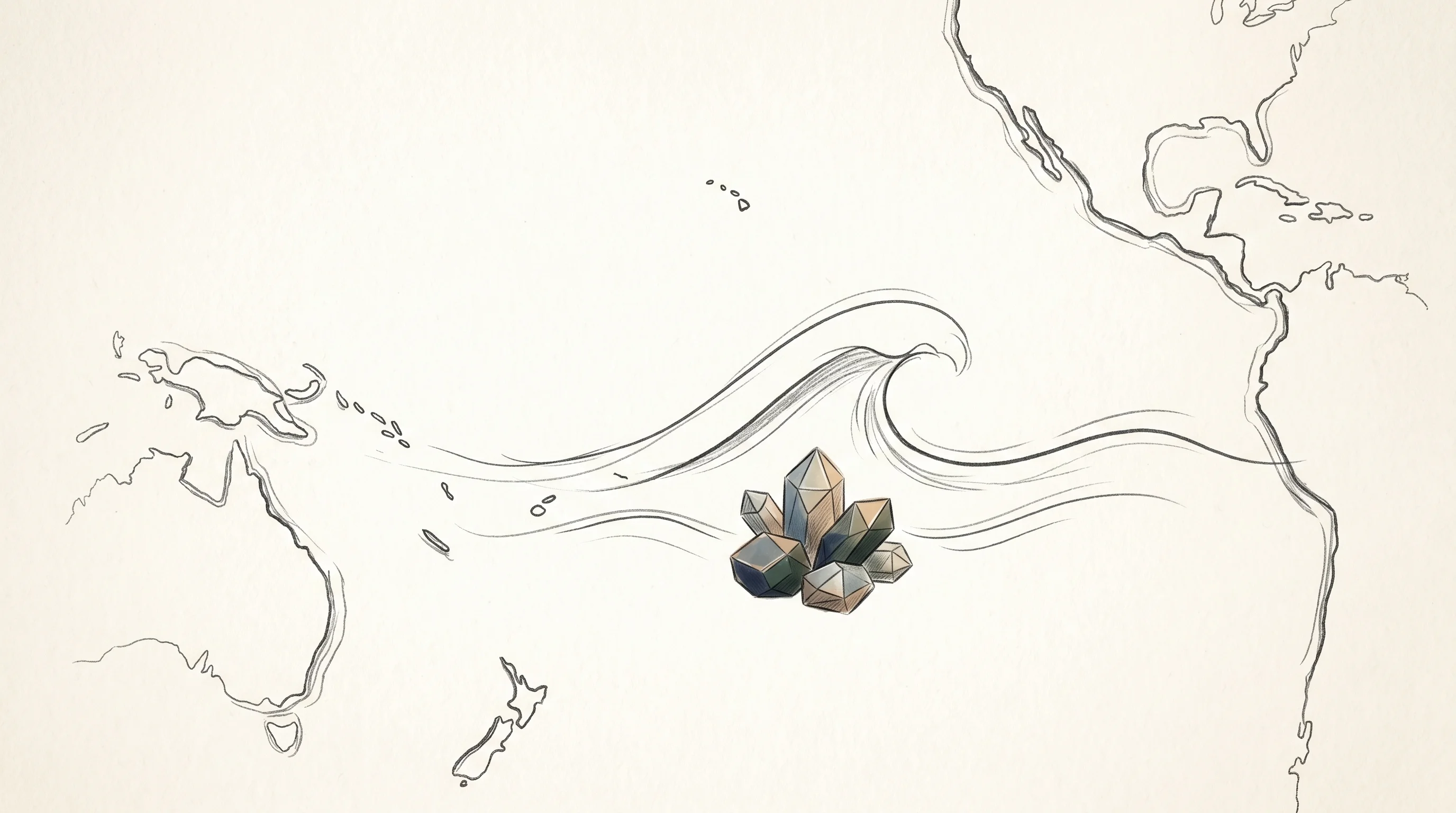
Impossible Metals cleared a regulatory milestone in May 2025 when it secured Bureau of Ocean Energy Management approval to begin the leasing process in U.S. federal waters near American Samoa. It's one of the first such approvals in what could become a broader domestic push to secure critical minerals closer to home, rather than relying on supply chains that run through geopolitically complex regions.
The startup has since inked memorandums of understanding with ReElement Technologies—envisioning a refining pipeline stretching from American Samoa waters to processing facilities in Indiana—and with Aqua Metals to explore pairing seabed collection with electrochemical refining techniques.
In June 2025, Canada's Ocean Supercluster announced a $4 million "Smart Hook" project led by Impossible Metals Canada. The cluster is kicking in $1.2 million in non-dilutive support, alongside other partners.
Meanwhile, headcount has fluctuated. As of the company's 2024 annual report published in April 2025, it had 14 full-time employees, down from 20 at the close of 2023. In June, it brought on Mike Regan as Chief Growth Officer to steer capital strategy—perhaps a signal of what was reported the following month. Axios noted in July that Impossible Metals is eyeing a fundraising round north of $1 billion as it inches toward commercial operations.
That's a hefty figure. Even in frothier capital markets, scaling deep-sea robotics isn't exactly a well-worn fundraising path.
The Market Backdrop

Demand for battery metals has been climbing, though not without turbulence. Prices have swung. Investment momentum softened in 2024, the International Energy Agency observed in its 2025 outlook, even as the energy sector continued to account for 85 percent of total demand growth for key battery materials.
Looking ahead to 2040 under a Net Zero Emissions scenario, the IEA projects demand for nickel and cobalt will double, copper will rise 50 percent, and graphite will quadruple. Those are the kinds of numbers that make deep-sea nodules—sitting there in international and federal waters, un-mined—look increasingly strategic.
Impossible Metals is targeting commercial readiness sometime around 2027. Deep-sea testing of the Eureka III system is slated for 2027-2028, in collaboration with Germany's Federal Institute for Geosciences and Natural Resources.
Whether that timeline holds, and whether the company can raise the capital it says it needs, will depend on more than just engineering milestones. It will hinge on regulatory clarity, environmental scrutiny, and a question that hovers over the entire category: can you really harvest the ocean floor without breaking it?


