

The machine powered up in rural Maharashtra on Christmas morning, and almost no one outside the medical imaging world understood why it mattered. A 1.5 Tesla MRI scanner—the kind that usually demands liquid helium kept colder than outer space—was scanning its first patients at the Chandrapur Cancer Care Foundation. But this one, built in a Bengaluru cleanroom by a startup called Voxelgrids Innovations, carried an unusual distinction: it would never need a helium refill.
Four months later, that technical detail became a geopolitical flashpoint. When Axios reported in April 2026 that Middle East conflicts had disrupted roughly a third of the world's helium supply—Qatar's production snarled by regional instability—hospital administrators who'd been grumbling about helium costs suddenly faced a starker reality. The supply chain they'd taken for granted was fragile. And the bet that Voxelgrids and a handful of MRI giants had placed years earlier on sealed-magnet technology looked prescient, perhaps more than the founders had dared hope. (While the Axios report provided the most detailed account of the disruption, the helium supply shock was subsequently documented across industry publications and market analyses.)
A Market Built on Scarcity
India operates something like 5,000 MRI scanners for 1.4 billion people. Do the math: that's roughly 3.5 units per million—a figure cited by Hyperfine in its 2024 market analysis, though as a vendor estimate now over a year old. Compare that to 50-plus per million in wealthier nations, and you grasp the scale of the access gap. The MRI market here clocked in between $274 million and $278 million in 2025, per IMARC and Mordor Intelligence estimates, with growth projections at 7.1% annually through the decade according to Mordor Intelligence. Demand isn't the problem—infrastructure is.
Conventional 1.5T systems are beasts. Four to six tonnes of equipment requiring reinforced floors, quench pipes venting through roofs, and a continuous supply of liquid helium chilled to 4.2 Kelvin. Installation timelines stretch six to nine months, sometimes longer when civil engineering stumbles. Operating costs include not just helium refills—historically volatile, now shadowed by geopolitical risk—but the structural overhaul required to house a machine designed for hospitals in Tokyo and Frankfurt, not Tier-2 Indian cities.
Yet over the past five years, the industry has quietly rewritten its playbook. Philips kicked things off in 2018 with BlueSeal, sealing about seven liters of helium in a closed loop that eliminates refills and quench pipes. By March 2026, the company counted 2,100-plus helium-free units installed across 120 countries. Siemens answered with DryCool technology, shrinking helium volume to a mere 0.7 liters in its Magnetom Flow platform, which cleared FDA review in early 2025. GE HealthCare unveiled Freelium, its own sealed-magnet design, at the European Congress of Radiology last year.
This isn't experimental anymore. Radiology Business declared last December that "the future of MRI is helium-free." Philips has publicly committed to converting its entire portfolio to helium-free operations by 2028. What was once a niche engineering challenge has become table stakes.
The Slow-Motion Crisis That Suddenly Accelerated
Helium scarcity has been simmering for years, punctuated by acute shortages that caught hospital procurement departments off guard. When the U.S. privatized its federal helium reserve in June 2024—ending decades of government-managed supply—the market dynamics shifted. Trade publication gasworld reported in October 2025 that supply had actually swung to oversupply: 6.5 billion cubic feet against 6.0 Bcf of demand. Then came April 2026 and the Qatari disruption, exposing how precariously the market balanced.
For hospitals, the operational logic is blunt. Traditional MRI magnets experience helium losses over time under normal conditions—losses that vary by system age and maintenance but that sealed systems eliminate entirely. A quench event—when the superconducting magnet suddenly warms and vents—can release hundreds of liters in seconds. Refills run tens of thousands of dollars and require specialized logistics. A sealed or helium-free system eliminates that line item entirely. And in a country where infrastructure reliability can be... variable... that independence matters.
India has added policy incentives. The Production-Linked Incentive scheme for medical devices, designed to boost domestic manufacturing, now explicitly supports MRI production. Siemens inaugurated an MRI line in Bengaluru in April 2023 under the program. By December 2024, government data showed 19 greenfield projects commissioned, with cumulative sales of medical devices under PLI hitting Rs 8,040 crore through September.
Regulatory frameworks have tightened in parallel. Since April 2021, MRI equipment has been classified as Class C medical devices under India's Medical Devices Rules, requiring CDSCO manufacturing or import licenses. Public tenders—from ESIC Kerala, IISc Bangalore, and others in 2025 and 2026—now explicitly demand valid CDSCO licenses at the time of bid submission. The paperwork matters as much as the physics.
The technology itself has matured beyond prototypes. Sealed-magnet designs use cryocoolers and advanced vacuum insulation to keep superconducting coils cold without continuous helium replenishment. Dry magnets—the approach Voxelgrids claims to employ—use alternative superconducting materials or engineered cooling loops that avoid helium altogether. Lower-field systems, like Hyperfine's 0.064T portable Swoop scanner, sidestep superconductivity entirely, trading image resolution for portability and radically lower cost.
The Bengaluru Bet
Arjun Arunachalam spent two years at GE Global Research before landing on the electrical engineering faculty at IIT Bombay. When he incorporated Voxelgrids in March 2017, the ambition bordered on audacious: build an MRI from scratch. Magnet, gradients, RF coils, pulse sequences, reconstruction algorithms—all in-house, all indigenous.
A July 2022 profile by Tata Trusts captured the company's pitch: resilience to India's infrastructure realities. "We don't need the expensive liquid cryogenics," Arunachalam explained. The system would be a "dry magnet," weighing 2-3 tonnes instead of 4-6, consuming half the power, and robust enough to withstand erratic grid supply. It could be deployed in stationary or mobile configurations, reaching the places conventional MRI couldn't.
Funding came through unconventional channels. Voxelgrids was incubated under the Foundation for Innovation in Science and Entrepreneurship, backed by Tata Trusts and Social Alpha. BIRAC—the biotech commercialization arm of India's Department of Biotechnology—provided grants through its National Biopharma Mission. In 2021, Zoho led a $5 million Series A. Yes, that Zoho: the Chennai-based SaaS company better known for productivity software than medical devices. Early prototypes were validated at Sri Sathya Sai Institute of Higher Medical Sciences.
The Chandrapur installation last December marked the first clinical deployment. Media coverage described it as India's first fully indigenous 1.5T MRI, though CDSCO public records as of mid-2026 didn't list a manufacturing license for the device. BIRAC's 2024-25 annual report noted the system as "developed and deployed," stopping short of regulatory specifics. The gap between "deployed" and "licensed for commercial manufacture" isn't trivial—it's the difference between a proof-of-concept and a scalable business.
Competition From All Angles
Voxelgrids faces rivals on multiple fronts. In August 2025, Aarthi Scans & Labs in Bengaluru announced what it called India's first helium-free 1.5T MRI—a Siemens Magnetom Flow system. Time Medical, a Fischer Medical subsidiary, secured a CDSCO manufacturing license in January 2025 and launched two 1.5T platforms at the Indian Radiological and Imaging Association conference in 2026, including one it described as helium-free.
The global incumbents aren't standing still, either. Philips marked 50 BlueSeal installations in UK community diagnostic centers by February 2025, claiming to have saved more than 70,000 liters of helium. The systems weigh 900 kilograms less than previous-generation magnets and require no quench pipe, enabling basement installations and siting near sensitive equipment. Last November, Philips unveiled BlueSeal Horizon—the industry's first helium-free 3.0T platform—and positioned itself to transition its entire portfolio by 2028.
Siemens' DryCool technology, with just 0.7 liters of sealed helium, cleared FDA review for the Flow.Ace model in early 2025. The sealed design eliminates the quench pipe and allows the scanner to be installed close to linear accelerators for radiation therapy planning—a siting constraint that historically required separate facilities. By January 2025, Siemens was showcasing the Flow platform at its Annual Oncology and Clinical Radiology Conference in India, making clear this wasn't just export product but locally manufactured under PLI incentives.
GE HealthCare's Freelium platform, unveiled at ECR 2025, follows a similar sealed-helium architecture. The company describes it as "helium-free" in operations even as the gas remains enclosed in the magnet—a semantic distinction that matters more to marketing than hospital CFOs. The messaging across all three multinationals is consistent: eliminate refills, simplify infrastructure, reduce lifecycle costs. And critically, localize supply chains.
A different technological approach has emerged at the low end of the field-strength spectrum. Hyperfine's Swoop system operates at just 0.064 Tesla—orders of magnitude weaker than conventional MRI but portable enough to wheel to a patient's bedside. The FDA-cleared device entered India through a distribution agreement in May 2024, received CDSCO approval in December 2025, and by April 2026 was performing bedside brain imaging at AIIMS Delhi, the country's flagship public hospital. Christian Medical College Vellore had acquired one earlier, making it the first hospital in India to deploy the technology.
The trade-off is image quality, which matters enormously depending on the clinical application. A 1.5T or 3.0T scanner delivers the resolution and signal-to-noise ratio required for detailed musculoskeletal, abdominal, and cardiac imaging. Low-field devices like Swoop are designed for neuro applications where portability and speed trump granular detail—stroke triage, ICU monitoring, rural screening. It's a different market segment entirely, though one that addresses the same access gap from a different angle.
The Regulatory Gauntlet
Regulatory clearance will separate contenders from also-rans, and India's Class C classification for MRI equipment doesn't hand out participation trophies. Manufacturers must demonstrate substantial equivalence or conduct clinical investigations. CDSCO's public license databases, as of mid-2026, listed approved imports and manufacturing lines from established players but offered limited visibility into newer entrants' status. Tender specifications increasingly demand proof of licensing at the point of bid submission, raising the stakes for any company seeking hospital contracts.
Voxelgrids' path forward depends on translating its first clinical installation into a scalable production line and securing the regulatory credentials that unlock government tenders and private-hospital purchases. The company's ISO 13485 certification covers quality management for medical devices—a prerequisite, but not sufficient. Time Medical's January 2025 CDSCO manufacturing license gave it a head start in that race. Whether Voxelgrids follows suit, and how quickly, will determine its competitive positioning in a market where incumbents aren't waiting around.
Market dynamics increasingly favor sealed and helium-free designs. The April 2026 geopolitical shock to helium supply reinforced what hospital CFOs already suspected: operational independence from volatile commodity inputs is worth paying for upfront. Philips' investor materials project that helium-free systems will command the majority of new MRI sales within three years. Siemens' Flow platform is already rolling off production lines at its Bengaluru facility under PLI incentives, shortening lead times and localizing the supply chain in ways that matter when import duties and logistics costs compound.
AI-enabled reconstruction is accelerating adoption of mid- and low-field systems by compensating for lower signal strength with algorithmic enhancements. Philips' SmartSpeed and Siemens' Deep Resolve technologies use machine learning to reduce scan times and improve image quality, narrowing the performance gap between field strengths. That opens clinical use cases previously reserved for high-field magnets and makes lower-cost, helium-free platforms more viable for Tier-2 and Tier-3 cities where the economics have never quite worked.
The Economics of Access
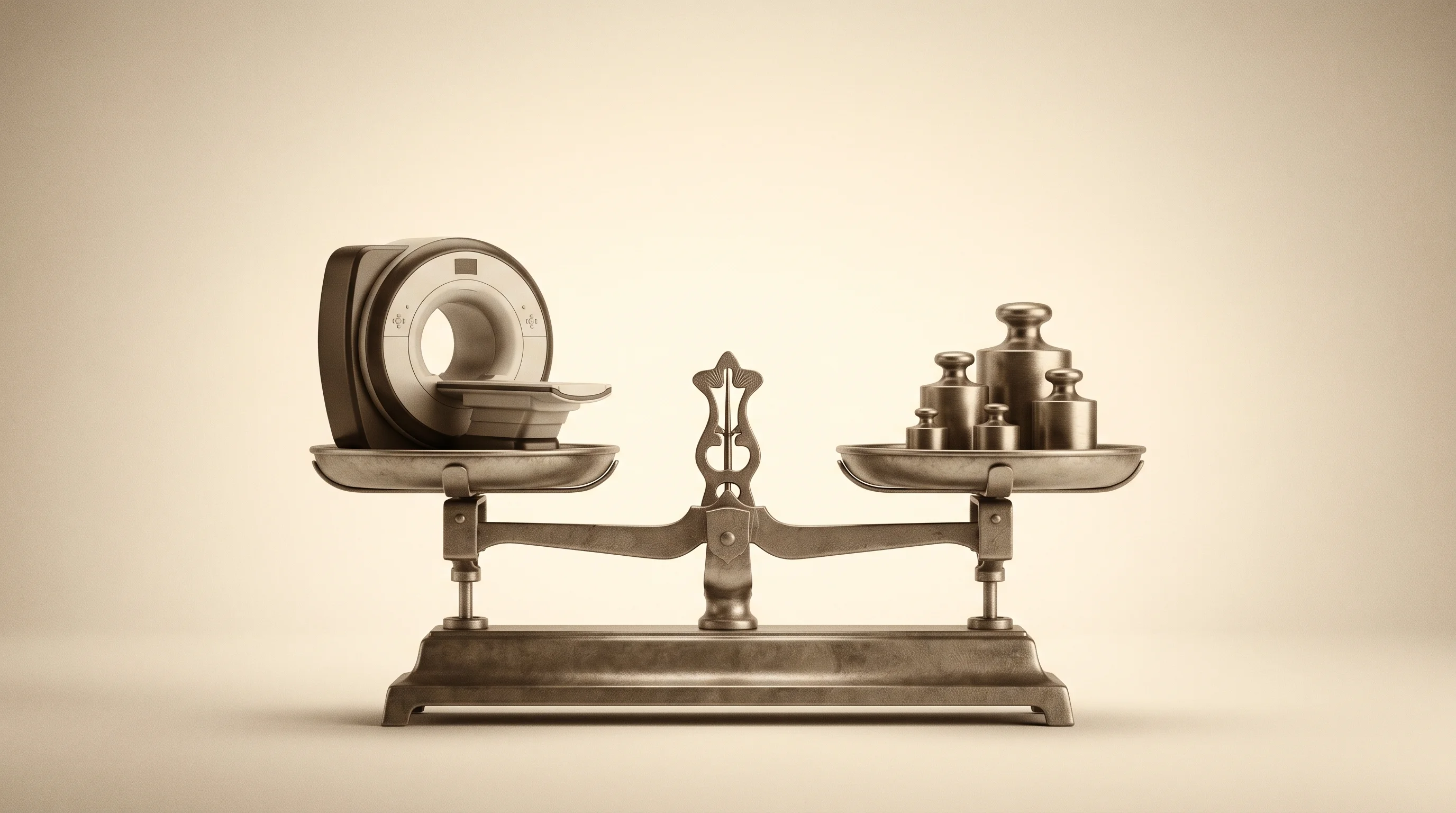
The numbers are compelling but not guaranteed. A conventional 1.5T MRI can run INR 6-10 crore; lighter, sealed systems promise lower installation costs, faster deployment, and reduced operating expenses. Yet hospitals must weigh upfront price against image quality, throughput, and service ecosystems. Established OEMs offer decades of clinical validation, nationwide service networks, and financing partnerships that smooth cash flow. Startups offer lower costs and localized support but carry execution risk—if the machine breaks and spare parts take weeks to arrive, that's revenue lost and patients unserved.
India's imaging access gap remains vast: 3.5 MRI scanners per million people versus 50-plus per million in high-income countries. Closing that gap will require not just better technology but payment models that make MRI accessible beyond metro oncology centers. Government hospitals, district facilities, and mobile diagnostic units represent the untapped frontier. Helium-free designs—whether from Bengaluru or Boston—lower one significant barrier to entry. Distribution, training, reimbursement, and regulatory cadence will determine how fast the rest of the market follows.
Philips framed it simply in its November 2025 press release unveiling the 3.0T BlueSeal Horizon: "Freeing MRI from dependence on a valuable resource the world can't replace." The same logic applies to India's healthcare infrastructure. The question is whether indigenous innovation can compete with multinational scale—or whether the real story is that helium scarcity forced the entire industry toward a technological inflection point that benefits every market, regardless of who builds the magnet.
That Christmas morning in Chandrapur, when Voxelgrids' scanner hummed to life, it was both a milestone and a data point. One indigenous MRI installation doesn't close an access gap measured in thousands of missing scanners. But it suggests a market in motion, where commodity scarcity, policy incentives, and engineering ambition have converged. Whether that convergence produces a durable Indian MRI industry or simply accelerates multinational localization strategies remains an open question. Either way, the helium problem that seemed like a technical nuisance a few years ago has become the forcing function that's reshaping medical imaging—here and everywhere else.


