

A vending machine for prescription drugs. That's essentially what Queue is selling, though the Palo Alto startup prefers "autonomous robotic pharmacy." Pop your code into the kiosk, wait half a minute, grab your pills. No pharmacist hovering behind plexiglass, no insurance snafus at the counter, no waiting while someone two customers ahead argues about copays.
The pitch sounds almost too simple—which is probably why it's taken $18.6 million in venture funding and a tangle of state-by-state regulatory battles to get this far.
Queue stepped into public view in mid-2026 with $12.6 million in fresh seed capital and a prototype already installed with an undisclosed national pharmacy chain. The company's claim borders on audacious: it has built the first truly autonomous pharmacy system that can dispense medications without a licensed pharmacist on site. Whether state regulators will actually let it operate that way is another question entirely.
The founders aren't naive about the regulatory gauntlet ahead. But they're betting the industry is desperate enough—broken enough, in their words—that the path will open faster than skeptics expect.
An Industry Shedding Skin
Nearly a third of America's retail pharmacies have shuttered since 2010. That figure comes from a UC Berkeley School of Public Health study published in late 2024, and it understates the crisis in rural counties where closures have left entire communities without easy prescription access. Queue's founders see those empty storefronts as proof that the traditional model doesn't work anymore, not just evidence of a rough patch.
Nick Desai, Queue's CEO and a serial healthcare entrepreneur, previously co-founded Heal, the house-call medical service that burned through north of $200 million in venture capital before he departed in 2021. His co-founder, Josh Liu, spent years at Tesla and Zipline—companies where "move fast and automate everything" isn't a slogan, it's doctrine. Liu's assessment of the pharmacy sector is blunt: "structurally broken."
What they mean is that the economics have collapsed. Reimbursement rates from pharmacy benefit managers have been squeezed for years. Pharmacist and technician vacancies reportedly exceed 40% in some markets. The staffing model that once sustained corner drugstores now barely pencils out for the big chains, let alone independents.
Queue's solution is to strip out the human labor almost entirely.
Inside the Kiosk
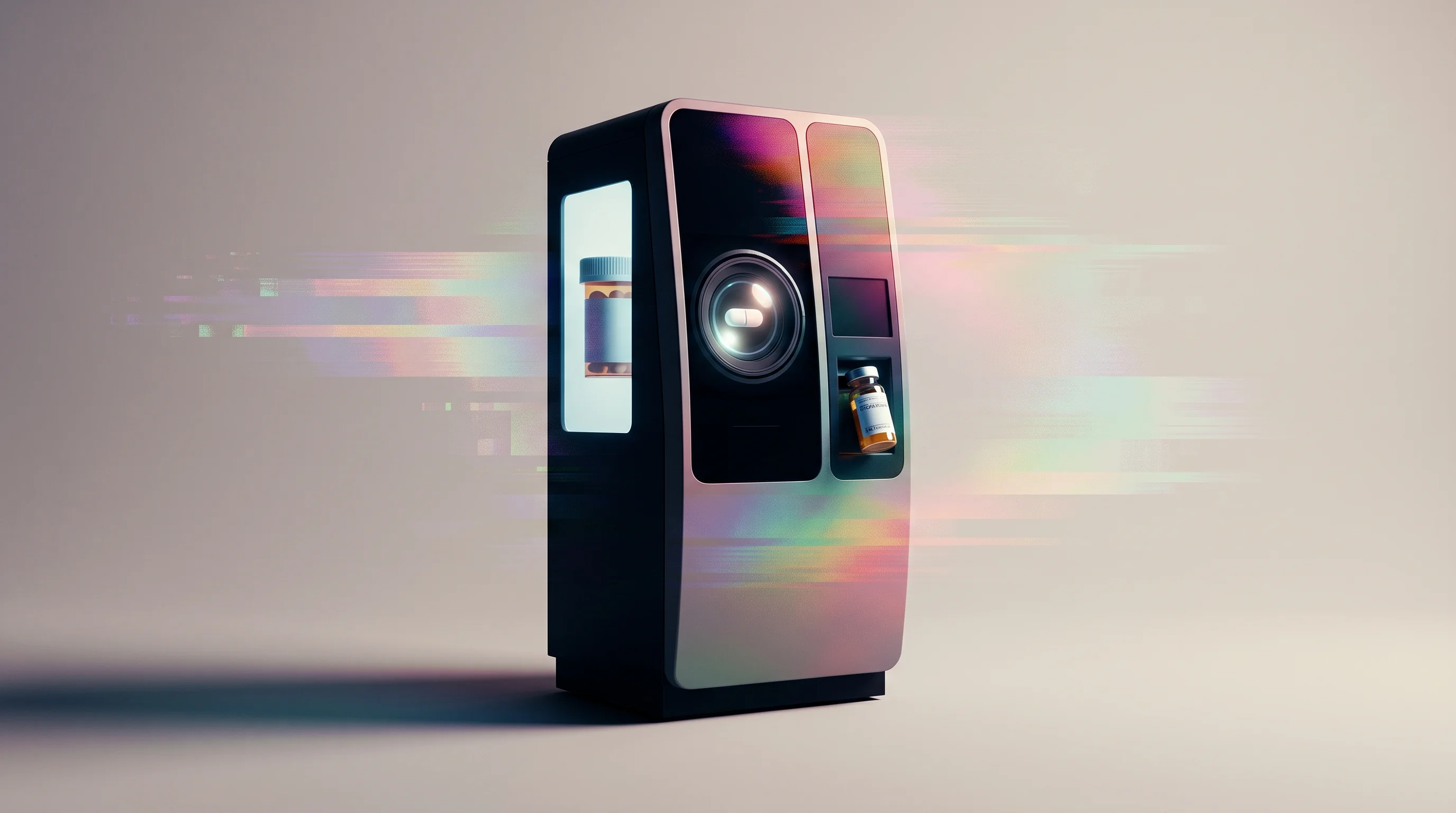
The machine itself is deceptively straightforward. It's a floor-standing unit, roughly the size of a large ATM, that accepts sealed wholesale pill bottles on one end and spits out labeled prescription vials on the other. Computer vision technology reads each pill, verifies it against the National Drug Code database, counts precisely, and packages the medication for pickup—all in about 30 seconds for a standard 60-pill prescription.
The system handles approximately 250 of the most commonly prescribed medications in the U.S. outpatient setting. That won't cover specialty biologics or compounded creams, but it does cover statins, blood pressure meds, diabetes drugs, antibiotics—the bread and butter of retail pharmacy volume.
Queue claims the kiosks can process up to 600 pills per minute, operating around the clock without breaks, benefits, or overtime. The company says per-prescription costs could drop as much as 96% compared to traditional staffed locations. If that figure holds at scale—and it's a big if—it would fundamentally reshape the cost structure of an industry with razor-thin margins.
Patients authenticate with a QR code tied to their prescription, which has already been transmitted electronically by their doctor. Wait a beat. Collect your medication. Walk out.
No chitchat with the pharmacist about drug interactions. Which is either the future of healthcare efficiency or a troubling elimination of the last safeguard between patients and dangerous medication errors, depending on your perspective.
The Regulator Problem
Here's where Queue's story gets complicated. The company's marketing materials emphasize "no on-site pharmacist," positioning full autonomy as the breakthrough. But state pharmacy boards don't necessarily see it that way.
Regulations vary wildly by jurisdiction. Some states have begun issuing guidance on automated dispensing systems; others haven't updated their rules since the fax machine was cutting-edge technology. Many still require a licensed pharmacist to provide final verification before medication reaches a patient—even if that verification happens remotely via video link.
The Next Web, covering Queue's announcement, flagged this immediately: "The regulators are the catch." And they're right. Queue may need pharmacist oversight in many states, at least initially, which dilutes the autonomy claim even if the physical dispensing remains fully automated.
There is precedent, scattered and uneven. Ohio's Board of Pharmacy has issued guidance on hospital self-service kiosks for employee prescriptions. Nevada has codified regulations for automated drug dispensing systems. New Jersey approved hospital-based ScriptCenter kiosks back in 2012. But winning approvals across all 50 states—each with its own board, its own pace, its own political considerations—will take years, not quarters.
Queue will likely need to operate in a hybrid model for the foreseeable future: machines doing the mechanical work, humans reviewing remotely. That's still an improvement over today's staffing requirements, but it's a far cry from the vending-machine simplicity the company is selling.
Not Exactly Alone
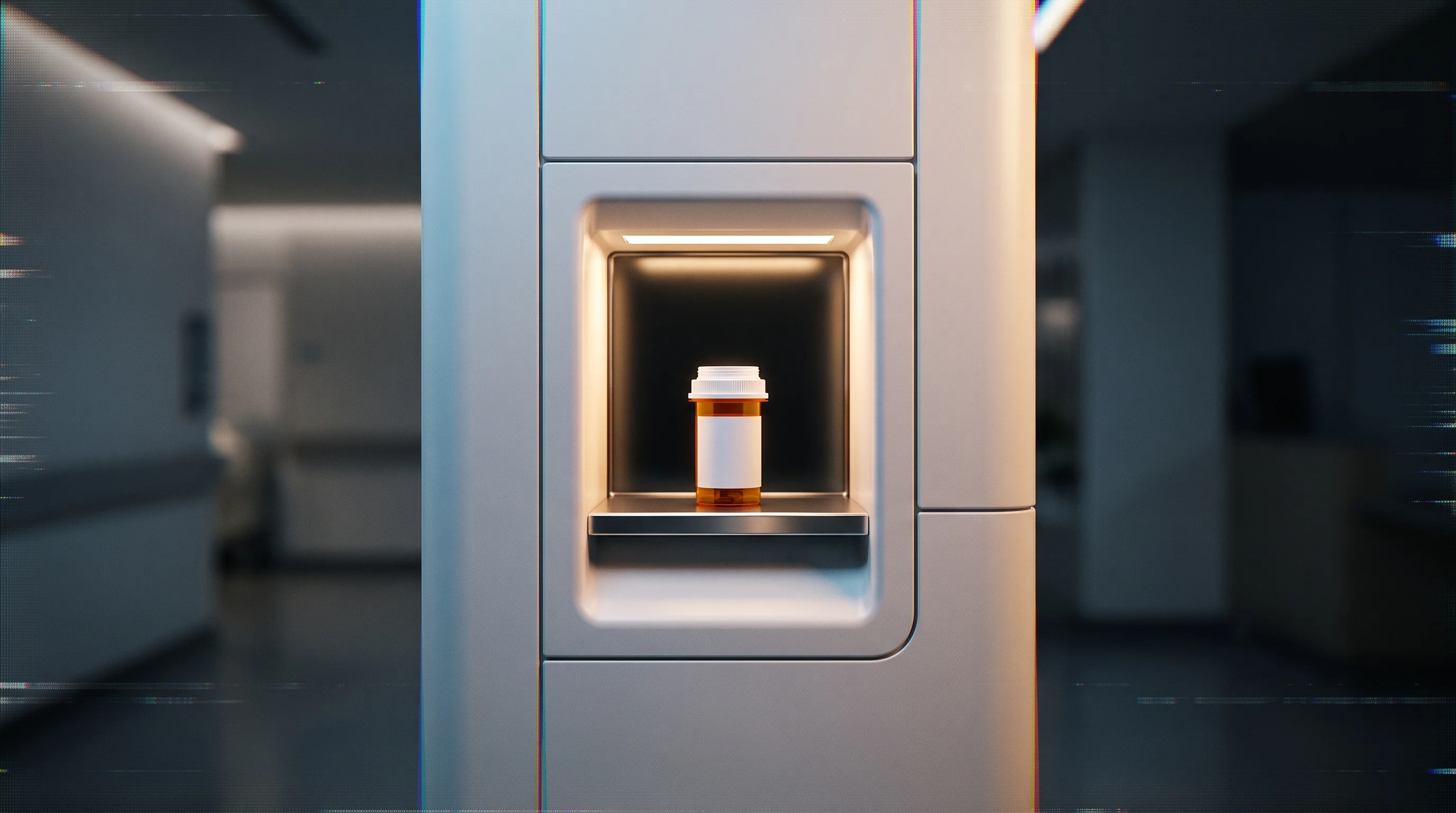
Queue isn't pioneering automated pharmacy from scratch. Amazon launched prescription pickup kiosks at One Medical clinics in Los Angeles in late 2025, with expansion planned beyond California. Those units offer convenient 24/7 pickup, but Amazon pharmacists at a central facility still verify and fill each prescription—the kiosk is just a smart locker.
Asteres has operated ScriptCenter lockers in hospitals and retail settings for years, claiming millions of pickups across 31 states. Again, those are pickup points, not dispensing machines. MedAvail tried an in-clinic kiosk model supported by remote pharmacists but sold its assets to CVS in 2023 after failing to reach profitability.
The real heavy machinery in pharmacy automation lives in back-office central fill facilities. Companies like Omnicell, BD (which paid roughly $1.5 billion for Parata Systems in 2022), ScriptPro, and McKesson have built sophisticated robotic systems that churn out thousands of prescriptions per day. But those aren't consumer-facing. They're warehouse infrastructure.
Queue's distinction is that it's building a patient-facing autonomous unit that handles the entire dispensing workflow on-site, in seconds. Whether that's a meaningful difference or just a repackaging of existing technology with a sleeker interface is something the market will decide.
Money and Momentum
AlleyCorp led Queue's $12.6 million seed round, joined by House Capital, Ubiquity Ventures, Grep Ventures, and Banter Capital. That came less than a year after a $6 million pre-seed led by Riot Ventures. Total funding as of mid-2026: $18.6 million.
Will Coffield at Riot Ventures described the investment as a bet on "automating the physical fulfillment layer" of pharmacy—Silicon Valley speak for turning a people-intensive process into a software-and-hardware problem. It's the same logic that's driven billions into warehouse robotics, autonomous vehicles, and drone delivery.
Queue has assembled a team of about 20 engineers, many poached from Tesla, Zipline, Waymo, and Rivian. The company is hiring aggressively across robotics, hardware, software, and—interestingly—pharmacy operations roles. That last category suggests Queue knows it can't fully eliminate humans from the workflow, at least not yet.
The company has hinted at broader commercial rollout beginning in early 2027. The unnamed national pharmacy chain customer is significant—it means at least one major player is willing to pilot the technology in real stores with real patients. Whether that translates to hundreds or thousands of units deployed, or just a handful of test sites that never scale, remains to be seen.
What Problem Are We Solving?
Queue frames its technology as a response to pharmacy deserts and workforce shortages, pointing to a $670.6 billion annual U.S. retail pharmacy market under severe strain. The numbers back up the crisis narrative: pharmacist burnout is real, technician vacancies are widespread, and rural communities are losing access to basic prescription services.
But there's a darker reading of the same story. Retail pharmacy chains have been cutting pharmacist hours and closing locations for years, driven by profit pressures and falling reimbursements. Automation doesn't reverse those economic forces—it makes them easier to justify. If a kiosk can do the job cheaper, why keep human pharmacists on staff at all?
Queue's public messaging emphasizes "freeing" pharmacists from rote dispensing tasks so they can focus on clinical consultation and patient counseling. That's a nice vision. It's also what every automation company says when displacing workers: we're not eliminating jobs, we're elevating them.
Whether pharmacy chains actually redeploy their pharmacists into higher-value clinical roles, or simply cut payroll, will tell us which narrative is closer to the truth.
The Test Ahead
Queue has built a machine that works, at least in prototype form. It has venture capital, a marquee customer, and a team stacked with automation expertise. What it doesn't yet have is regulatory clarity in most states, a proven safety record at scale, or evidence that patients will trust a robot to fill their medications without human oversight.
The company is betting that the industry's pain points—collapsing margins, staffing shortages, closing locations—will force regulators and consumers to accept a future most people haven't seriously considered: prescription drugs dispensed by software and servo motors, no pharmacist in sight.
Maybe the bet pays off. Maybe Queue's kiosks show up in thousands of grocery stores and urgent care clinics, dispensing pills as routinely as ATMs dispense cash. Or maybe the regulatory hurdles prove insurmountable, patient trust never materializes, and the whole thing becomes another case study in Silicon Valley overestimating how fast complex, heavily regulated industries can actually change.
By sometime in 2027, we'll start to know which version of the future we're getting. Until then, Queue is just another startup with a bold claim, a working prototype, and a pile of venture money betting it can rewrite the rules faster than the rule-makers can stop it.


