

The pitch meeting in New Delhi this past February had an unusual quality to it. A Technology Advisory Group convened by the Indian government sat listening as entrepreneurs walked them through wheeled humanoids for warehouses, robot dogs designed for Indian terrain, and policy frameworks borrowed from China's manufacturing playbook. One founder, a former social media executive turned robotics entrepreneur, made the case for production-linked incentives, shared data platforms, and government procurement rules that wouldn't simply default to established foreign suppliers.
It was the kind of conversation that, even five years ago, would have felt improbable. India's tech story has long been written in lines of code, not metal and actuators. But something is shifting.
By late July of this year, the country's robotics sector had pulled in roughly $55 million in closed and announced funding commitments—a modest figure by Silicon Valley or Shenzhen standards, but a meaningful inflection point nonetheless. Tracxn data from June showed $42.1 million closed across multiple deals in the first half of the year alone, nearly doubling the $22.7 million raised in the same period last year. The checks are getting larger. The ambitions more tangible. And the investor base—once skeptical of hardware's capital intensity and long timelines—is diversifying beyond the usual venture suspects to include strategic corporates and government-aligned funds.
This isn't the India of call centers. The companies raising money now are building warehouse humanoids, snake-like robotic arms for hazardous industrial sites, autonomous underwater platforms for naval inspection, and foundation models that teach factory robots through visual demonstration rather than lines of code. Call it the convergence of embodied AI, improved domestic manufacturing muscle, and a cohort of founder-entrepreneurs who've grown tired of waiting for someone else to build the future.
A Wider Aperture
The deals closed through mid-year trace a remarkably broad set of bets. In January, Pune-based Unbox Robotics secured a $28 million Series B led by ICICI Venture and Redstart Labs, the venture arm of Info Edge. The round, structured with both primary and secondary components, positions the company to expand its parcel sortation systems across Indian logistics hubs and push into international markets. They're offering both capital expenditure models and robotics-as-a-service subscriptions—hedging, in effect, on which procurement structure will win out among cost-conscious logistics operators.
At the other end of the spectrum sits Rekise Marine, a Bengaluru startup that raised $9.7 million in June from Accel and Nikhil Kamath's NKSquared. The company is developing autonomous naval platforms in partnership with Indian shipyards, including Goa Shipyard and GRSE. The thesis is straightforward, if ambitious: deliver low-cost autonomous surface and subsurface systems for inspection, surveillance, and maritime operations—applications where legacy defense contractors have little incentive to compete on price.
Between those poles, the pattern becomes clearer. Anscer Robotics closed a ₹45 crore (roughly $5.4 million) Series A in May, led by IAN Alpha Fund with participation from Info Edge, to scale its AI-native industrial robotics platform. Mowito, which is building foundation models for robotic arms using a "teach by demonstration" approach, secured $3 million in July from Version One Ventures. They're expanding operations in the U.S. while maintaining a dual presence in Bengaluru and Detroit—a geographic split that mirrors the ambitions of many Indian robotics founders, who want to compete globally but build and iterate at home.
For context: the first quarter of this year saw $16.3 billion invested across 492 robotics and physical AI deals globally, according to PitchBook data cited in July. India's slice remains small in absolute terms. But the velocity of early-stage deals and the breadth of applications under development suggest something more than incremental growth. Investors, it seems, are beginning to believe India can compete not just on cost arbitrage but on technical innovation—a bet that remains unproven but no longer implausible.
Three Forces Converging

The activity isn't happening in a vacuum. Three interrelated forces are fueling this moment, and understanding them helps explain why now, and why India.
First, policy momentum. The IndiaAI Mission, approved in March 2024 with a ₹10,371.92 crore outlay, emphasized specific pillars like compute access and startup financing in its 2026 rollouts. More recently, the Research, Development & Innovation Fund—a ₹1 lakh crore corpus confirmed in 2026 with robotics explicitly named among sunrise sectors—signals government intent to back hardware-intensive R&D that has historically struggled to attract private capital at scale. Whether that intent translates into actual disbursements and coherent support mechanisms remains an open question, but the signaling matters.
That February advisory meeting wasn't just talk. One cofounder from General Autonomy briefed officials on the need for production-linked incentive schemes tailored to robotics components, shared data platforms for model training, and procurement mechanisms that don't automatically favor established foreign players. The emphasis, according to those familiar with the discussions, was on coherence: PLI support, deployment challenges, calibrated government procurement—building an ecosystem rather than scattering incentives.
Second, market demand. India's warehouse automation market was valued at approximately $560 million last year, with forecasts projecting growth to $660 million this year and around $1.5 billion by 2031—a compound annual growth rate of 17.8%, according to industry estimates. Major logistics operators are expanding their automation footprints. Delhivery has rolled out AI-powered location intelligence and autonomous transport management systems through partnerships with NVIDIA. Flipkart continues expanding its Ekart logistics network with automation deployments that, while still modest by Amazon standards, signal a shift in how Indian e-commerce thinks about fulfillment infrastructure.
Manufacturing is accelerating, too. Last year, India installed more than 9,000 industrial robots, climbing to sixth globally in annual installations. Total robot stock reached approximately 52,570 units, according to the International Federation of Robotics. Robot density remains below global averages—way below—but the trajectory suggests sustained growth as standards alignment improves. India's Bureau of Indian Standards adopted the ISO 10218:2025 series for industrial robot safety earlier this year, a technical milestone that matters more than it sounds. Export competitiveness and enterprise trust hinge on such alignments.
The third force is technological readiness—or, perhaps more accurately, the belief among certain founders and investors that the gap between what's possible and what exists in India has narrowed enough to be bridgeable. The term "physical AI" has become shorthand for systems that integrate perception, planning, and manipulation in real-world environments, moving beyond the deterministic automation of earlier industrial robotics. Startups like Mowito are building foundation models that let robots learn tasks through visual demonstration, eliminating the need for complex manual programming. It's an approach that mirrors broader trends in embodied AI and large-scale model training, adapted for resource-constrained manufacturing and logistics environments where data collection, edge inference, and total cost of ownership are make-or-break constraints.
There's an odd wrinkle here worth noting. Reports from May and June documented Indian workers being paid to record first-person task data—filming themselves performing assembly, sorting, or inspection tasks—to train embodied AI systems, often for international robotics companies. The ethics and labor implications are being debated in certain circles, but the existence of such programs underscores India's dual role: both consumer and enabler of global robotics advancement. It's not clear yet which role will prove more lucrative or strategically important.
The Companies Building It
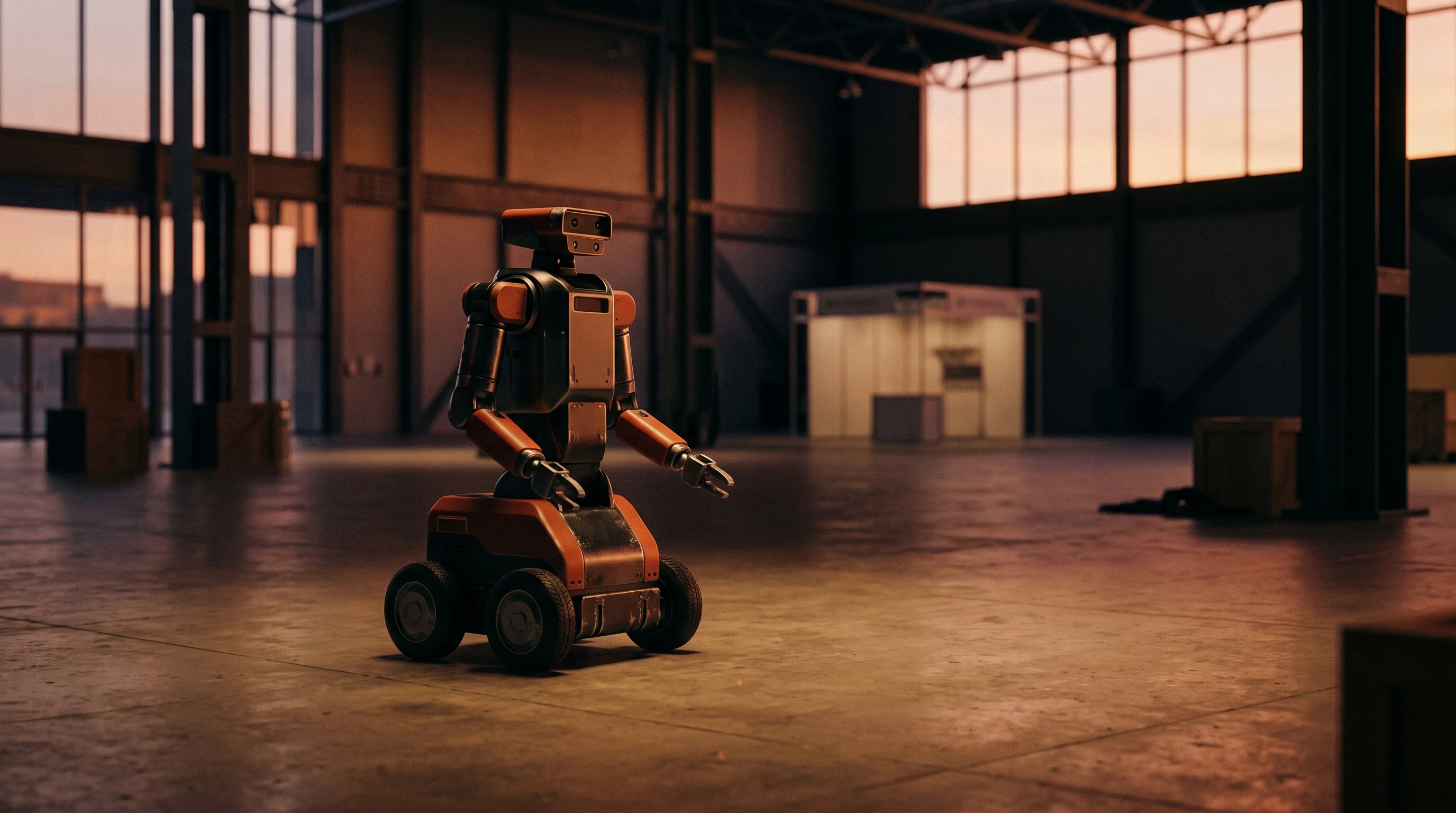
The startups raising capital this year reveal distinct strategic postures, shaped as much by founder background and market positioning as by technology choices.
Addverb, the Noida-based industrial robotics firm, unveiled its Elixis-W wheeled humanoid at LogiMAT India in February. CEO Sangeet Kumar has been refreshingly candid in interviews and podcasts about the cost-ROI tradeoffs of humanoid robotics, noting that wheeled platforms offer faster deployment timelines and clearer value propositions than fully bipedal systems—which the company still plans to launch by year's end. Addverb was targeting a fundraise north of $100 million as of June 2026 to scale its humanoid roadmap, invest in AI infrastructure, and potentially acquire or partner with component suppliers to build a more vertically integrated stack. Whether they'll close a round of that size remains uncertain, but the ambition signals how quickly expectations have shifted.
General Autonomy, founded by former ShareChat executives, raised approximately ₹32 crore (around $3.8 million) in seed funding in May. The company is developing robot dogs and humanoids with an explicit India-first R&D approach, balancing cost constraints with the technical ambition to build systems that operate in unstructured, resource-limited environments. The founding team briefed those government officials in February, positioning themselves as advocates for a national robotics mission alongside their commercial product development—a dual strategy that could prove shrewd or distracting, depending on how policy evolves.
At the far end of the application spectrum sits Armatrix, which secured $2.1 million in February, led by pi Ventures, to commercialize snake-like robotic arms designed for hazardous industrial environments—confined spaces, high radiation areas, disaster zones where human access is dangerous or impossible. The company is exploring both robotics-as-a-service and direct sales models, navigating the tension between intellectual property constraints and customer preferences.
Flo Mobility, which raised $2.5 million in May co-led by Mela Ventures and Arali Ventures, is applying autonomy to construction jobsites, building perception stacks and navigation systems for heavy equipment and material handling in dynamic, outdoor environments. Octobotics announced a ₹10 crore seed round in February to focus on AI-enabled non-destructive testing robots for asset integrity across oil and gas, power generation, and infrastructure sectors. AquaAirX raised ₹12.5 crore in January from Zerodha's Rainmatter, Prime Venture Partners, and others to develop drones that transition between aerial and underwater operation—a hybrid platform for inspection, surveying, and environmental monitoring.
These companies share certain traits: hardware-software integration, focus on vertical applications with clear return on investment, and a willingness to operate in markets where established global players have limited presence or cost structures too high to compete. They also face common challenges. Access to precision manufacturing. Component supply chains dominated by imports. The need to balance product-market fit with R&D cycles measured in years, not quarters.
What Comes Next

Multiple industry observers have described this as an inflection point, though the path forward depends on policy execution and capital formation at larger scales than what's materialized so far. The roughly $55 million in closed and announced funding through July is progress, certainly. But if you include announced-but-not-yet-closed rounds—Addverb's targeted $100 million-plus raise, for instance—the aggregate figure climbs toward $155 million or more. That suggests significant capital is circling the sector even if deal timelines remain uncertain and some rounds may not materialize as announced.
The component supply chain remains a structural gap. Industry commentary from July highlighted India's dependence on imported precision components—actuators, sensors, specialized processors—and the need for domestic manufacturing scale in these critical inputs. Addverb has stated its intent to invest in or partner with component suppliers, recognizing that a sustainable robotics industry requires vertical depth, not just system integration prowess. Whether other startups can afford similar strategies, or whether some government-backed consortium emerges to build shared infrastructure, remains an open question.
Standards and safety infrastructure are also in flux, though moving in the right direction. The adoption of ISO 10218:2025 by India's Bureau of Indian Standards signals alignment with international best practices for industrial robot safety—essential for export competitiveness and for building trust with large enterprise customers. Research published earlier this year analyzed the integration of collaborative robot standards (ISO/TS 15066) with the updated safety frameworks, examining implications for human-robot collaboration in Indian manufacturing settings. These are not trivial considerations. As humanoids and collaborative robots move from controlled pilots to production floors, safety certifications and liability frameworks will matter as much as the underlying technology.
The government's role will likely prove decisive, though bureaucratic timelines rarely match entrepreneurial urgency. The Technology Advisory Group discussions in February, the RDI Fund's ₹1 lakh crore corpus, and ongoing IndiaAI Mission rollouts suggest policymakers understand the strategic importance of robotics and embodied AI. But understanding and execution are different things. Translating intent into actionable support—PLI schemes for robotics components, procurement mandates that favor domestic systems, shared data platforms, deployment challenges that derisk early adoption—will determine whether India captures a meaningful share of the global robotics market or remains dependent on imported systems and platforms developed elsewhere.
For founders, the opportunity is clear but demanding. The companies raising capital this year are not building incremental software layers atop imported hardware. They're designing novel actuation systems, training embodied AI models on limited data, delivering ROI in environments where margins are tight and failure costs high. The investors backing them—a mix of domestic VCs, strategic corporates, and government-aligned funds—are betting that India's combination of engineering talent, cost structure, and proximity to underserved markets can produce globally competitive robotics companies, not just regional systems integrators.
It's a bet that hinges on execution across technology, capital, and policy—all at once, and over timelines longer than most venture models prefer.
What to watch: the trajectory of component localization efforts, the success or failure of early humanoid deployments in logistics and manufacturing, the pace of government procurement and PLI rollouts, and whether larger late-stage rounds materialize to scale the most promising platforms. The data from this year suggests momentum. Whether that momentum translates into durable competitive advantage remains unwritten. But for the first time in a while, it doesn't feel impossible.


