

The LinkedIn post read like performance art. Matan Hazanov had asked Claude, Anthropic's AI assistant, to "spin up a $50M micro-fund." What followed wasn't a simple pitch deck—though there was one of those, complete with logo and 42 slides on "AI-native verticalized agents." The system also scraped 12,000 founder profiles from LinkedIn, then auto-booked diligence calls.
Cue the venture capital internet losing its collective mind.
Was this satire? Absolutely. A genuine preview of the future? Maybe that, too. The demo landed at an awkward moment for an industry that prides itself on pattern recognition and relationship-building—two things, until recently, no machine could fake. Except now they sort of can. Not perfectly. Not autonomously, despite what the hype suggests. But well enough that veteran investors are quietly rethinking what their junior analysts actually do all day.
The uncomfortable truth: large swaths of venture capital operations are already being automated. Just not in the fire-all-the-humans way that makes for viral content.
The Tech Stack Behind the Curtain
Claude's evolution from chatbot to something approaching an operational agent happened faster than most people tracked. When Anthropic released Claude Sonnet 4.6 this past February, the model delivered near-Opus-level reasoning for a fraction of the cost—$3 per million input tokens, $15 for output. Not earth-shattering on its own.
What mattered more was the surrounding infrastructure. Computer Use, which lets the AI manipulate graphical interfaces. Gmail and Calendar integration, rolled out last April. A 1-million-token context window that can swallow entire software codebases. Each upgrade incremental. Together, transformative.
The real unlock, though, came from something less flashy: the Model Context Protocol. Anthropic released this open standard in November 2024 and donated it to the Linux Foundation's Agentic AI Foundation last December. MCP created standardized connectors—think of them as secure pipes—allowing Claude to read and write to CRMs, calendars, data vendors. Safely, in theory.
PitchBook saw the opening. Its Navigator AI tool, launched last November with MCP integration into ChatGPT, now enables natural language queries across private market data. Ask it to find Series B SaaS companies in Austin with female founders, and it actually can.
The ecosystem expanded in fits and starts. Microsoft's Copilot Studio added an agent store and "computer use" features last May for desktop automation. OpenAI released new agent-building tools in March, including a Responses API that developers actually wanted. Even Temporal, the workflow orchestration company, partnered with OpenAI to provide durable execution frameworks for production agents.
That last partnership tells you something. Demos are one thing. Reliability? That's another problem entirely.
AI-Assisted VC: Less Future Tense Than You'd Think
Fully autonomous funds make for good marketing. They're also mostly fiction.
But AI is already embedded in real venture operations, quietly and often without much fanfare. SignalFire raised over $1 billion in 2025, crediting its Beacon AI platform as a competitive differentiator. The firm has tracked 80 million organizations and 650 million people since 2013—a dataset that only makes sense when processed by LLMs. SignalFire uses the platform for both investment decisions and portfolio company talent support, though they're careful not to oversell the automation angle.
EQT Ventures started even earlier. Motherbrain, active since 2016, claims to have sourced over 15 investments including Peakon, AnyDesk, and CodeSandbox. The platform uses similarity mapping and automated research across the investment lifecycle. Unlike most competitors, EQT has published academic papers demonstrating Motherbrain's technical sophistication—a rare moment of transparency in an industry that usually guards its secret sauce.
The closest thing to Hazanov's viral demo in actual production? Probably The Anthology Fund. Last July, Menlo Ventures and Anthropic announced a $100 million partnership. Claude assists with application triage and startup recommendations. But—and Menlo partner Matt Murphy has been emphatic about this—human investment committee members retain final decision rights. Startups in the fund receive API credits and access to Anthropic executives, a model that echoes the old iFund that Apple and Kleiner Perkins ran during the early App Store days.
Then there's Davidovs Venture Collective. Business Insider reported last October that the firm replaced all its analysts with AI agents to run deals for its $75 million fund. The LP network also uses agents for diligence memos and portfolio monitoring. Whether that's bold or reckless remains an open question. Probably both.
What Actually Works Today (With Asterisks Attached)
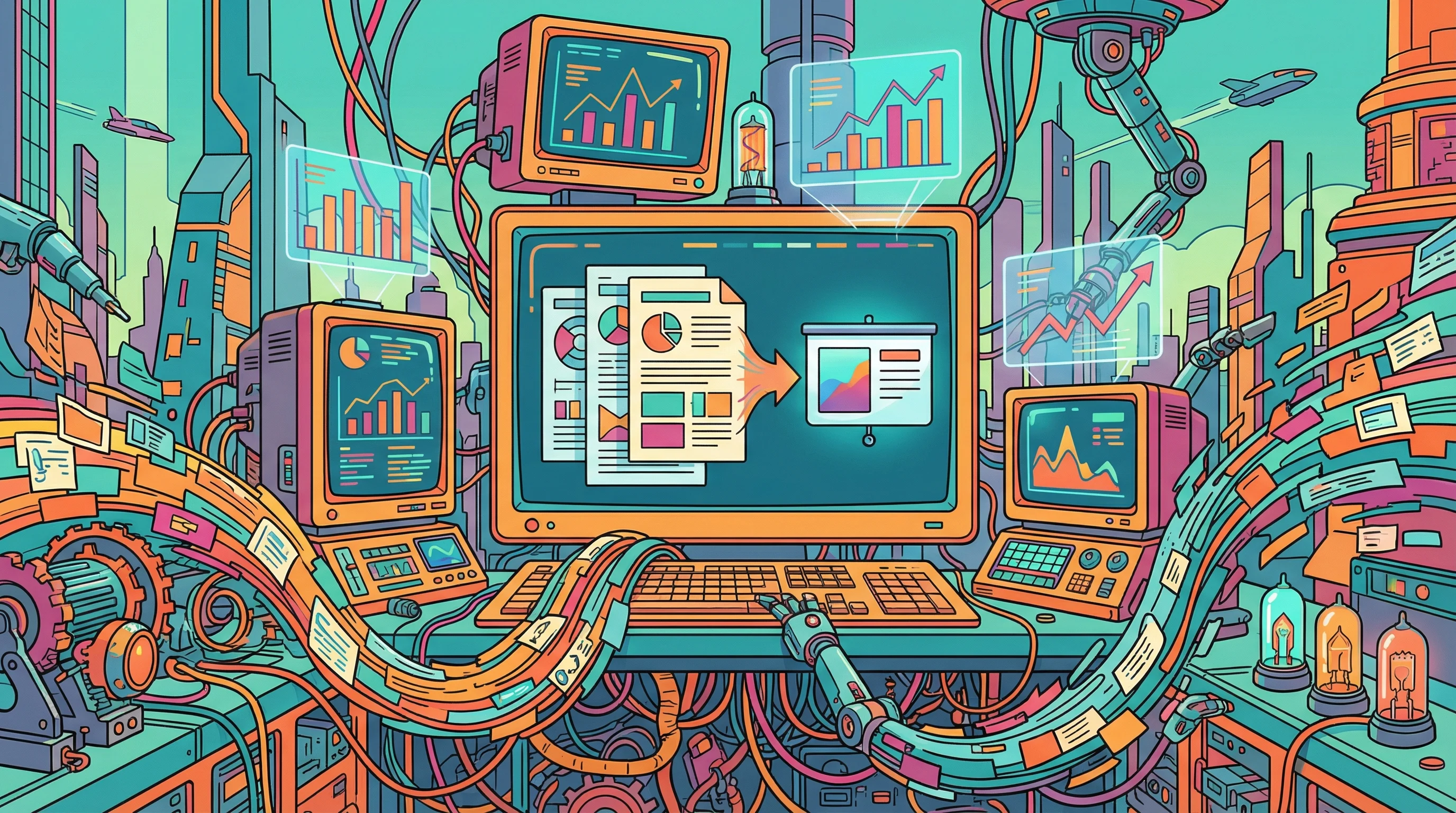
Current agent capabilities span the VC workflow. "Seamlessly" would be overstating things.
Deck creation runs through Claude Skills or tools like FactSet's Pitch Creator, launched this January. The platform claims to reduce investment banking pitchbook creation from hours to minutes, which seems plausible if you've ever watched an analyst build one manually. Founder sourcing leverages platforms like Harmonic's Scout agent, offering natural language queries for market maps and team analysis. One Scout user claimed "We found 4 of our last 9 deals on Harmonic"—a testimonial that's either impressive or damning, depending on whether you think that hit rate is good.
Outreach and scheduling? Gmail and Calendar integrations handle that. Due diligence gets assists from StackAI's no-code agent platform (the company raised a $16 million Series A in 2025) and Affinity's Deal Assist, which automates note-taking and research for private capital firms.
The fund formation stack has automated substantially, perhaps more than the front-end investment work. AngelList Venture provides end-to-end infrastructure for funds, SPVs, and rolling vehicles. Allocations markets itself as an "AI-powered SPV platform" claiming to create special purpose vehicles "in minutes" with automated KYC, AML compliance, and Blue Sky filings. SPV.co launched this March with similar promises.
These tools work. Sort of. With oversight, usually the human kind.
Reality, Meet Hype
The Finance Agent Benchmark, released last May, showed the best AI models achieving just 46.8% accuracy on SEC-filing-based financial tasks. That's well below human performance on complex analysis, and not in a "needs a bit more training" way. Security researchers have identified vulnerabilities in MCP servers, including tool poisoning and malicious code execution risks—problems that sound abstract until they're not.
Gartner, ever the industry buzzkill, warned of "agentwashing" and predicted many poorly governed enterprise agent projects would face cancellation by 2027. They're probably not wrong.
Regulatory scrutiny is tightening, predictably. FINRA Notice 24-09 reminded broker-dealers last June that technology-neutral rules apply to GenAI—meaning you can't automate your way out of compliance obligations. The EU AI Act's general-purpose AI obligations took effect August 2, requiring transparency on training data and copyright policies, with systemic risk classifications tied to compute thresholds. American regulators are watching.
Some issuers have pushed back against automation-enabled opacity. OpenAI and Anthropic both increased restrictions on SPVs and secondary transfers in elite funding rounds, the Financial Times reported last August. The target? The layered structures that AI-assisted fund formation platforms make trivially easy to create. Turns out companies don't love it when their cap tables become incomprehensible.
Data access remains legally fuzzy, at best. That viral demo's claim of scraping "12k founders from LinkedIn" raises obvious terms-of-service and privacy questions. Enterprise MCP connectors with proper permissions and audit logs offer safer alternatives. But web scraping remains common in agent demos, probably because it's easier than doing things the right way.
The Bifurcation Coming

Gartner predicts 40% of enterprise applications will include task-specific AI agents by 2026, up from less than 5% last year. In venture capital specifically, the market is splitting apart.
Global VC funding hit $469 billion in 2025, with AI capturing 48%—that's $226 billion, according to CB Insights. Sounds healthy until you look at the other side of the equation. The number of active U.S. VC managers fell roughly 25% from 2021 to 2024, dropping from 8,315 to 6,175, per Financial Times data. Small funds are getting squeezed out. The survivors are increasingly data-native, building tech stacks that would have seemed absurd a decade ago.
McKinsey's 2025 survey found 62% of organizations experimenting with AI agents, though only 39% report EBIT impact at the enterprise level. That gap suggests what researchers are calling a "centaur phase"—human-agent collaboration that improves operational efficiency without yet replacing judgment-intensive work.
Salesforce CEO Marc Benioff called it "the agentic enterprise" at Dreamforce 2025, because of course he did. Sequoia Capital, more usefully, dubbed them "Goldilocks Agents"—not too simple, not too complex, but custom cognitive architectures matched to specific workflows. For venture capital, that likely means agents handle repetitive research and scheduling while humans retain pattern recognition around founder quality, market timing, competitive dynamics. The stuff that still matters.
Maybe.
The Pitch Problem
The viral demo of an AI-launched VC fund worked as satire because it contained uncomfortable truth. The technology to automate large portions of venture workflows exists today. What remains unclear is whether automation creates competitive advantage or becomes table stakes—and whether the judgment that separates great investors from mediocre ones can be codified at all.
Some things probably can't be automated away. Conviction in a contrarian thesis. The gut sense that a founder will outperform their pedigree. The ability to convince other investors to follow your lead in a hot round. Then again, people said the same thing about chess and Go and protein folding.
Human decision-makers aren't going anywhere yet. But they're increasingly working alongside agents that can draft better decks, find more founders, and schedule faster than any analyst ever could. The fund-raising pitch of 2026 might not be "we use AI."
It might be explaining why you still need humans at all.


