

The ultrasound screen shows the vein clearly enough. It's right there—a dark oval on a grainy gray field. But translating that flat image into three-dimensional reality, guiding a needle through layers of tissue to hit the target on the first try, remains surprisingly difficult. For residents and newer clinicians attempting central line placement, that difficulty shows up in the data: access failures that remain common enough to drive demand for better guidance tools. Each miss means another stick, more patient discomfort, minutes ticking away in an already overwhelmed emergency department.
A San Francisco-based startup called Lumius Imaging believes it has an answer, though whether it's the answer won't be clear for some time yet.
The company emerged from Y Combinator's Spring 2026 cohort with a real-time 3D ultrasound system that launched in late April. The proposition sounds almost too simple: show clinicians an actual volumetric view of what's beneath the skin, eliminate the mental gymnastics of 2D-to-3D translation, and do it at a price point that doesn't require a capital expenditure committee and six months of deliberation.
An Old Physics Problem, a New Commercial Attempt
The underlying technology—Diffractive Acoustic Tomography, or DAT—isn't exactly new. Co-founders Tri Vu, Luca Menozzi, and Chenhang Li developed the approach during their doctoral work at Duke's Biomedical Engineering department. They published results in Nature Communications in January 2025. The technique uses a slit-based diffraction method with off-the-shelf linear ultrasound arrays. In other words: take a standard 2D probe, apply some clever physics and signal processing, and you get volumetric imaging without the expensive custom hardware.
What Lumius claims to have built is a system delivering what it calls "true 4D"—isotropic resolution across a 4x4x4 centimeter field of view, in real time. The device can supposedly identify vessels, nerves, and muscle tissue automatically, then guide the operator through the procedure with AI-assisted prompts.
There are two form factors planned: a plugin module that retrofits existing ultrasound systems, and a standalone compact probe. Neither has FDA clearance yet. Every page on Lumius's website carries the requisite disclaimer about not being evaluated for medical use—a reminder that for all the technical promise, this is still a pre-market product.
Starting with the Simplest Hard Problem

Lumius is beginning with central line placement, a procedure performed millions of times each year in hospitals worldwide. It's a smart wedge. Narrow enough to master, common enough to matter, and plagued by enough variability in operator skill that better guidance could plausibly make a difference.
The company's Launch YC post references clinical literature on access failures, particularly among less experienced operators. Current ultrasound guidance helps, certainly. But 2D imaging still demands a kind of spatial reasoning that takes time—sometimes years—to develop instinctively.
The longer-term vision is broader: deep vein thrombosis detection, tumor diagnosis, biopsy guidance. For now, though, the focus remains on proving the system works where speed and accuracy aren't just quality metrics—they're patient outcomes. Emergency departments. ICUs. Procedural suites where a missed line can cascade into complications.
The Economics Might Matter More Than the Physics
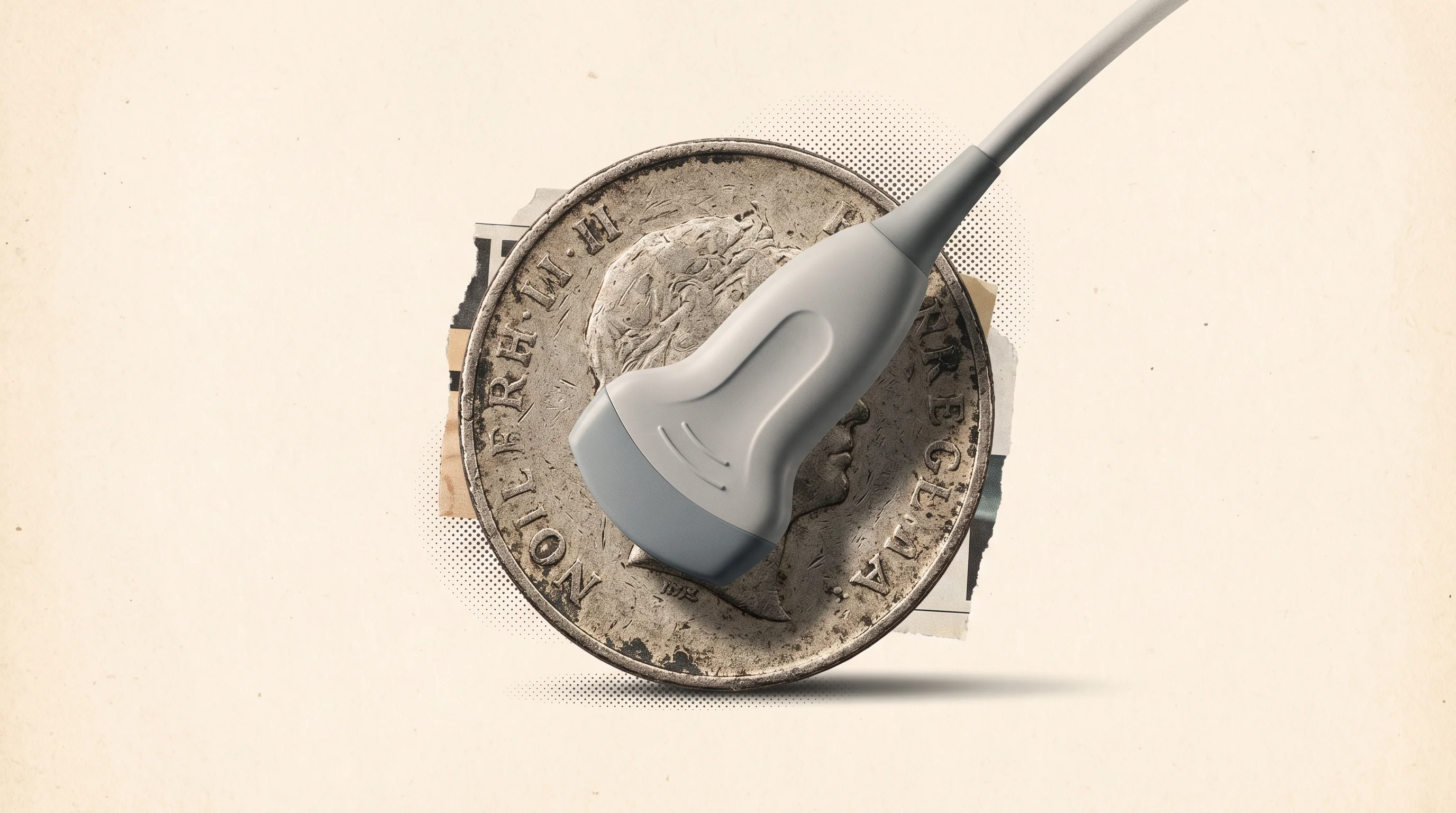
Perhaps the most striking claim in Lumius's pitch isn't about resolution or real-time imaging. It's the company's assertion that the system costs substantially less than traditional matrix-array 3D probes—a claim they frame as "50 times less," though without published pricing to verify the comparison.
The company doesn't publish specific prices, which is standard for early-stage medical device firms still figuring out go-to-market strategy. But the context tells the story. Existing volumetric ultrasound systems—the kind deployed in high-end cardiac imaging or specialized obstetric applications—routinely cost hundreds of thousands of dollars. Matrix array transducers alone can run tens of thousands.
If Lumius can deliver real-time 3D imaging at a meaningfully lower price point, it potentially opens the technology to settings that would never justify a dedicated volumetric system. Community hospitals. Outpatient procedure centers. Point-of-care applications in resource-constrained environments. The DAT approach, built on commodity components rather than expensive custom arrays, seems designed to make that economics shift possible.
Whether the claimed cost advantage translates to affordable enough for widespread adoption is another question.
Three PhDs and a Translational Pipeline
All three co-founders came out of Duke's photoacoustic imaging lab, working under advisor Junjie Yao. The team picked up early support from Duke's Coulter Translational Partnership in August 2025, then a North Carolina Biotechnology Center grant in February 2025. By April 2026, they were in Y Combinator.
The team is small—four people, according to the YC profile—but deeply credentialed. Vu, Menozzi, and Li all hold PhDs in biomedical engineering from Duke University, with backgrounds spanning ultrasound, photoacoustics, and wearable diagnostics. Clinical advisors include Jeffrey Lawson and Keith Hemmert, both physicians with procedural experience.
Duke still holds the underlying patents. A PCT filing published in April 2025 describes handheld 3D-DAT probe embodiments and methods for isotropic imaging. Lumius appears to be licensing or spinning out the technology under some arrangement with the university. The specifics aren't public, which is typical for university-startup licensing deals still being finalized.
What Happens Next Determines Everything

Lumius is pre-regulatory approval, which means clinical adoption remains theoretical. The company will need FDA clearance before any U.S. hospital can deploy the system in actual patient care. That process typically stretches across months or years, depending on the classification pathway and the clinical data regulators demand.
The competitive landscape isn't standing still, either. Butterfly Network, Clarius, and other handheld ultrasound makers are layering in AI-driven guidance features. iSono Health launched a wearable 3D breast ultrasound platform in January 2026. PIUR Imaging offers vendor-agnostic 3D reconstruction from 2D sweeps. Lumius's advantage—if it materializes—will hinge on whether DAT delivers meaningfully superior real-time volumetric imaging at the promised price point, and whether that difference actually translates into faster, more accurate procedures when clinicians are working under real-world pressure.
For now, the company is in launch mode: pitching hospitals, gathering feedback, presumably building the clinical evidence needed for regulatory submissions. The technology is intriguing enough. The team has the credentials. Whether DAT becomes a new standard for procedural guidance or remains a promising Duke spinout with a strong Nature Communications paper depends entirely on what happens next—not in the lab, but in the clinic, where a missed vein is never just a technical problem.


