

The pitch sounds like something from a contrarian biotech playbook: What if the parasites that have tormented humanity for millennia actually hold the blueprint for treating our most stubborn immune disorders?
Adair Borges will tell you it's not contrarian at all. It's evolution.
"Parasites have been perfecting immune evasion for hundreds of millions of years," says Borges, a UCSF-trained immunologist with more than 50 publications to her name. "They don't just hide from the immune system—they reprogram it. That's precisely what we've been failing to do with drugs."
Borges is co-founder of Ditto Biosciences, a San Francisco startup fresh out of Y Combinator's Winter 2026 batch. In seven months, her team has analyzed upwards of 1 million proteins pulled from parasites, ticks, and viruses. The thesis driving Ditto—and a handful of other biotechs pursuing similar strategies—is that pharmaceutical companies have been looking in all the wrong places. Nature already solved the immunology puzzle. We just needed better tools to read the answers.
Those tools have arrived. And they're moving fast.
Mining the Dark Proteome
AlphaFold changed everything, though not in the way most headlines suggested. The deeper impact wasn't just predicting protein structures—it was making 214 million of them searchable overnight. Suddenly, the "dark proteome" of parasites and other neglected organisms became fair game for drug hunters willing to sift through genetic databases most researchers had written off as too messy, too foreign, or too risky.
Ditto isn't alone in this hunt. Holoclara, based in Pasadena, raised $16 million last June to advance worm-derived molecules for allergic and autoimmune diseases. The financing brought Peter Barton Hutt—former FDA chief counsel—onto the board, a signal that serious regulatory minds see potential here. By December, Holoclara had dosed its first healthy volunteers in Australia, testing HC002 for eosinophilic esophagitis. Data should land sometime this year.
Over in France, Par'Immune is developing P28GST, a recombinant protein lifted from schistosomes, targeting inflammatory bowel disease and psoriasis. A small Phase 2a safety study in Crohn's patients has wrapped; more trials are planned. Preclinical work showed the protein dampens the inflammatory Th1 and Th17 immune pathways while coaxing anti-inflammatory M2 macrophages into action—exactly the kind of immune rebalancing that traditional biologics struggle to achieve cleanly.
What's striking isn't just that these companies exist. It's that they're all reading from the same playbook at the same time.
The Economics of Desperation
Timing matters in biotech, and the autoimmune market—somewhere between $168 billion and $271 billion depending on who's counting—is undergoing a reckoning. Biosimilars have started carving into the blockbuster franchises that built empires. Humira biosimilars grabbed significant U.S. market share in 2024 after formulary shifts tilted in their favor. The FDA approved a record number of biosimilars that same year.
Then came the policy hammer. Medicare drug price negotiation under the Inflation Reduction Act now covers Enbrel and Stelara starting January 1, 2026, with more drugs slated for 2027. AbbVie's recent earnings beat—driven by Skyrizi and Rinvoq offsetting Humira's erosion—shows how companies are scrambling to replace legacy revenue with differentiated mechanisms. IQVIA projects immunology volume growth moderating to just 2–5% annually in the U.S. through 2028 as biosimilars cap pricing power.
The math is brutal. Incremental improvements to existing biologics no longer command premium pricing. Pharma needs novel mechanisms—or it needs to get comfortable with shrinking margins.
This environment creates space, perhaps more than the founders expected, for platforms mining unusual sources. Parasite proteins qualify as unusual. Whether they can clear the commercial and regulatory bars that have buried countless exotic biologics is another question entirely.
What Parasites Know That We Don't
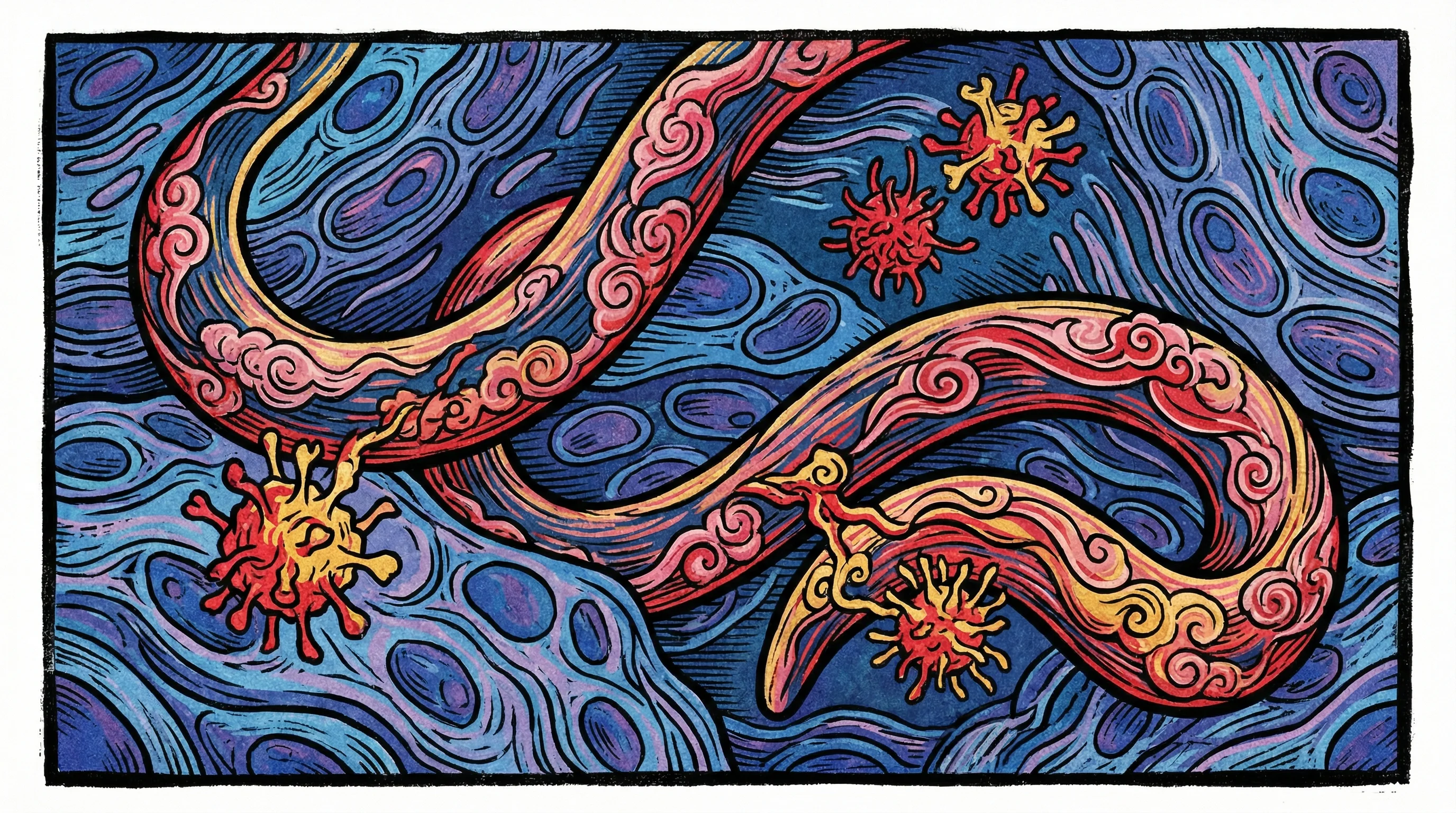
The science, at least, is compelling. Helminths—parasitic worms—don't just survive inside human hosts. They thrive for years, sometimes decades, without getting evicted by the immune system. They accomplish this through molecular diplomacy: secreted proteins that shift host immunity toward regulatory T cells and Th2 responses, dialing down the Th1 and Th17 pathways implicated in diseases like rheumatoid arthritis, Crohn's, and psoriasis.
Ticks pull a different trick. They inject proteins called evasins that bind and neutralize multiple chemokines simultaneously—a kind of network-level anti-inflammatory effect that single-target antibodies can't replicate. Academic literature is littered with examples: helminth secretions attenuating colitis in mice, schistosome antigens modulating autoimmune balance, tick peptides showing promise in preclinical fibrosis models.
None of this is hypothetical. Researchers tried dosing multiple sclerosis and Crohn's patients with actual live worms a decade ago. The trials showed safety but modest, inconsistent results—enough to validate the biology, not enough to justify swallowing parasites as therapy. The lesson was clear: isolate the active molecules, optimize them, and leave the worms in the lab.
Dennis Sun, Borges' co-founder (Harvard and UC Berkeley training), puts it plainly: "Evolution ran a billion experiments we'll never have time to run ourselves. Our job is to figure out which ones worked and why."
The AI Advantage—and Its Limits
Ditto claims it has identified thousands of parasite proteins predicted to bind clinically validated human targets with affinities in the 1–2 nanomolar range. That's tight binding—on paper. The company is also building what it calls a "tissue biobank" to map human immune memory against parasite antigens, aiming to de-risk immunogenicity before clinical trials. Early experiments reportedly show promising target engagement.
Those are company claims, not peer-reviewed data. Early-stage biotech is always heavy on promise, light on validation. But the computational infrastructure underpinning these claims is real. A 2025 arXiv preprint showcased deep learning tools annotating the "dark proteome" of Wuchereria bancrofti, the filarial worm behind elephantiasis. ESMFold's metagenomic atlas now covers more than 600 million protein sequences. The bottleneck isn't access to data—it's knowing what to do with it.
Ditto's bet is that AI can triage vast, uncharacterized protein spaces faster than traditional high-throughput screening. Maybe. The precedent for nature-inspired drugs is solid if you look beyond parasites: artemisinin from sweet wormwood (Nobel Prize, 2015), ziconotide from cone snail venom, captopril descended from snake venom peptides, exenatide from Gila monster saliva—spawning the entire GLP-1 class that's now reshaping obesity treatment.
Parasites could be the next reservoir. Or they could be a well-funded dead end. The history of drug discovery is littered with both.
The Immunogenicity Problem No One Wants to Talk About
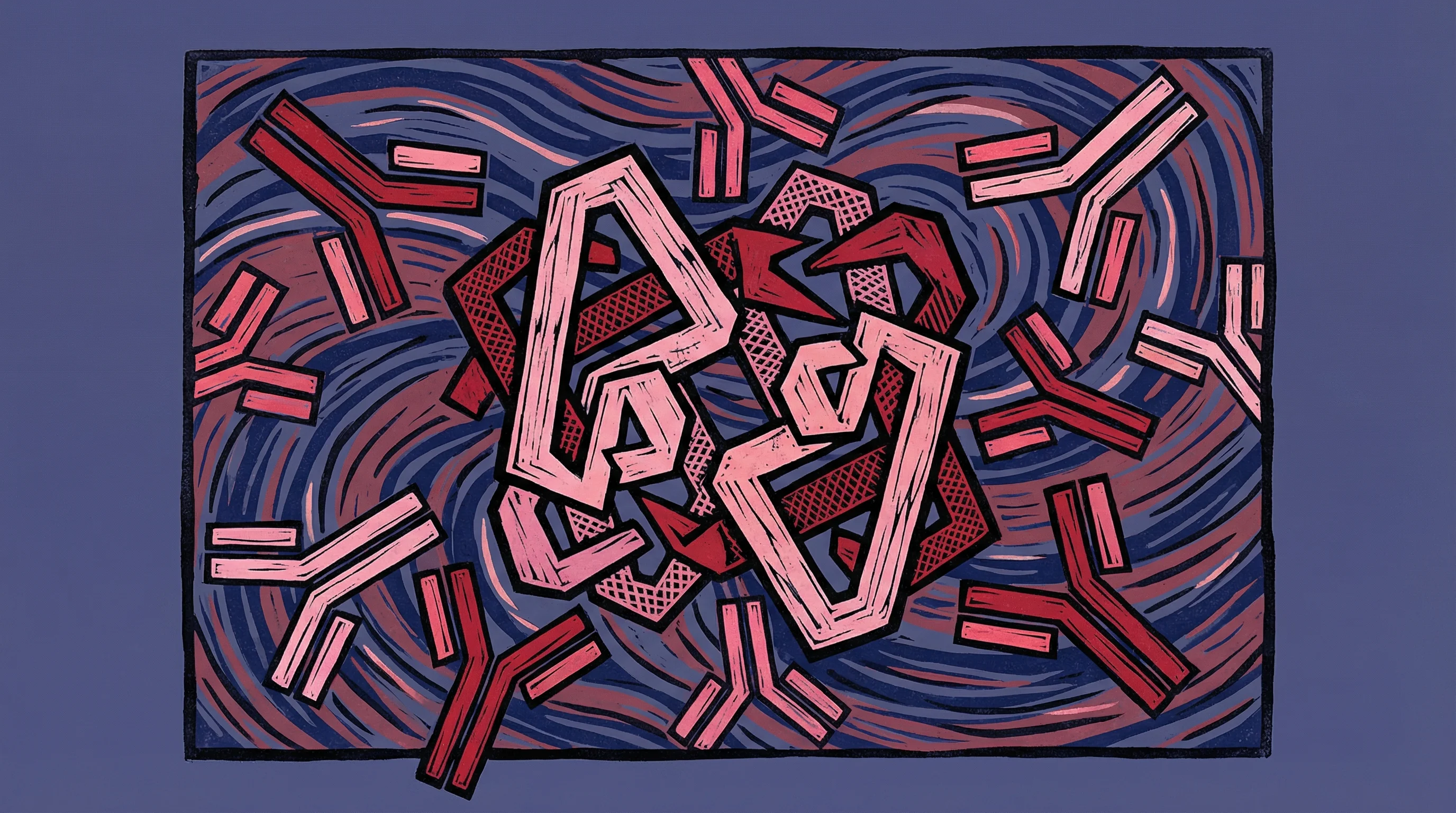
Here's the uncomfortable reality: a protein optimized by evolution for one immune context might provoke neutralizing antibodies—or worse, hypersensitivity reactions—in another. Immunogenicity isn't an academic concern. It's why the FDA demands risk-based assessments for any novel therapeutic protein and why countless exotic biologics have died in Phase 2.
Par'Immune's P28GST program demonstrates that GMP-scale recombinant production of parasite proteins is feasible. That's progress. But feasibility isn't the same as safety, and safety isn't the same as efficacy. Delivery modality compounds the challenge. Injectable biologics face different hurdles than oral small molecules, which Holoclara is pursuing to sidestep some of the immunogenicity risk.
Manufacturing scale, regulatory precedent, payer receptivity—all weigh on whether any of these molecules reach patients. The autoimmune space is notoriously difficult. Bristol Myers Squibb's $13 billion Celgene acquisition hinged partly on ozanimod, which has struggled to gain traction. Roche walked away from an anti-BDCA2 antibody after disappointing lupus data. The graveyard is crowded.
The Question No One Can Answer Yet
Still, the convergence feels real. Pricing pressure from biosimilars and government negotiation creates headroom—maybe necessity—for differentiated mechanisms. AlphaFold and related tools have democratized protein structure prediction, lowering barriers to mining neglected biological spaces. And academic literature keeps documenting preclinical signals that parasite-derived molecules can modulate human immunity in therapeutically useful ways.
Whether Ditto, Holoclara, or Par'Immune reaches commercial scale remains uncertain. Borges and her co-founder Emily Weiss (a PhD with stints at Illumina and DuPont) are betting that evolution's R&D budget—millions of years of selective pressure—beats even the deepest pharma pockets.
The counterargument is equally straightforward: if parasite proteins were easy to turn into drugs, someone would have done it already. The fact that we're only now seeing serious capital flow into this space reflects both the immaturity of the science and the degree of difficulty involved in translating exotic biology into FDA-approved therapies.
The question isn't whether nature holds answers. The question is whether these startups can engineer parasite biology into drugs that meet regulatory, manufacturing, and commercial standards—and do it before their runway ends.
If they can, the organisms humanity has fought for centuries may finally contribute something more constructive than misery. If they can't, well, the autoimmune market will keep waiting for its next breakthrough, and parasites will go back to being just parasites.
Either way, it's a story worth following. Evolution rarely gets outplayed. But it's never faced AlphaFold before.


