

Mosaic emerged from Y Combinator's summer 2026 cohort with a precise diagnosis of what goes wrong when companies try to scale AI coding tools. The startup, which lists two-to-ten employees on its LinkedIn page as of August 2026 and operates under the corporate name Emergent Computing, released Ocean this month: a shared memory layer that treats developer teams and their AI agents as participants in a single persistent environment. The core insight is deceptively simple. Once an organization runs multiple agents across different workflows, the individual session becomes less important than the context those agents share.
"Two agents with identical context are the same agent," the company wrote in a blog post published in June. Ocean mounts as a team-scoped, read-only drive at ~/.ocean on each developer's machine. Ephemeral agents write back to a central repository, and teammates can resume work exactly where any session left off. The company describes the architecture as a "hive-mind" model. Installation runs through Homebrew, and the command-line interface includes utilities like ocean doctor, ocean status, and ocean mount. Mosaic says it collects no product telemetry and adds only instruction files without touching user-owned configurations.
Pricing sits at $200 per seat monthly for teams of up to 20 members, with a free Hobby tier for individuals. Those figures come from the company's pricing page, last accessed August 11.
Coding Tools Reach Critical Mass
AI-assisted coding crossed into mainstream adoption over the past year, though the numbers vary by which company is counting. GitHub Copilot hit 26 million users by October 2025, according to Microsoft CEO Satya Nadella during the company's fiscal 2026 first-quarter earnings call. Microsoft's broader 365 Copilot suite reached 20 million paid seats by May, per the third-quarter transcript. Advanced Micro Devices alone runs tens of thousands of developers on GitHub Copilot, Nadella said, accepting hundreds of thousands of code suggestions each month. Professional services giant PwC deployed more than 200,000 Copilot seats, according to Microsoft's fiscal 2026 first-quarter earnings call.
GitHub moved to usage-based billing on June 1, 2026, introducing what it calls AI Credits to replace fixed seat licenses. The company sent April usage reports on May 12 to help customers plan budgets under the new model.
But the market has fragmented fast. Cursor released Shared Canvases in May, offering read-only team views of developer workspaces. Claude Code added team session sharing alongside organization-level controls. Replit introduced Agent 4 in March, with an emphasis on parallel execution that the company likened to "a great team" handing off tasks. GitHub announced Agent HQ last October: a control plane for launching and managing coding agents from OpenAI, Anthropic, Google, Cognition, xAI, and open-source or in-house models. The company also ships Copilot Spaces, which allow teams to share scoped knowledge with collaborators.
Other startups approached the coordination problem from different angles. Based offers a shared filesystem and terminal where "memory compounds across conversations," not locked to a single agent or provider, according to its website in August. Coshell built a cloud "drive" with conflict detection for overlapping edits. AQ provides a multiplayer coding interface where teams run Claude Code together in one live session. MobSession lets an entire team steer one AI coding agent from a shared link.
Why Shared State Suddenly Matters
Three forces converged in 2026 to make shared infrastructure for AI agents something more than a nice-to-have feature.
Agents moved beyond solo developer workflows. Gartner's Japan-specific data reported that 17 percent of organizations have adopted AI agents, with more than 60 percent expecting to adopt within two years. A Stack Overflow survey from 2025 found 84 percent of developers either use or plan to use AI tools. Nadella told investors that GitHub logged over 500 million pull requests merged in the past year, with AI coding agents driving record usage levels.
The session model began breaking under load. Mosaic argued in its June blog post that agents should function as ephemeral probes reading from and writing to a persistent context store. "The actors are disposable," the company wrote. "The store is what persists." Without durable shared memory, teams risk running parallel agents that duplicate work or collide in the same files. LangChain forum users flagged race conditions in May when multiple agents edited identical repositories or database tables outside graph state, prompting calls for explicit concurrency controls and conflict resolution.
Enterprises started demanding tighter governance. Microsoft shifted to token budgets and consolidated on in-house tools, TechRadar Pro reported in August. The National Institute of Standards and Technology launched an AI Agent Standards Initiative on February 17 to develop standards for interoperable and secure agent ecosystems. The European Union's AI Act transparency rules took effect August 2, with high-risk provisions phased through 2028. A March academic paper warned of scheduling contention, context degradation, and poisoning risks in multi-agent systems, advocating for operating-system-style resource managers.
Anthropic's Model Context Protocol, open-sourced in November 2024, has been widely adopted by early implementers including Block, Zed, Replit, Codeium, and Sourcegraph. "Open technologies like the Model Context Protocol are the bridges that connect AI to real-world applications, ensuring innovation is accessible, transparent, and rooted in collaboration," Anthropic said when it released the protocol.
What Ocean Actually Does
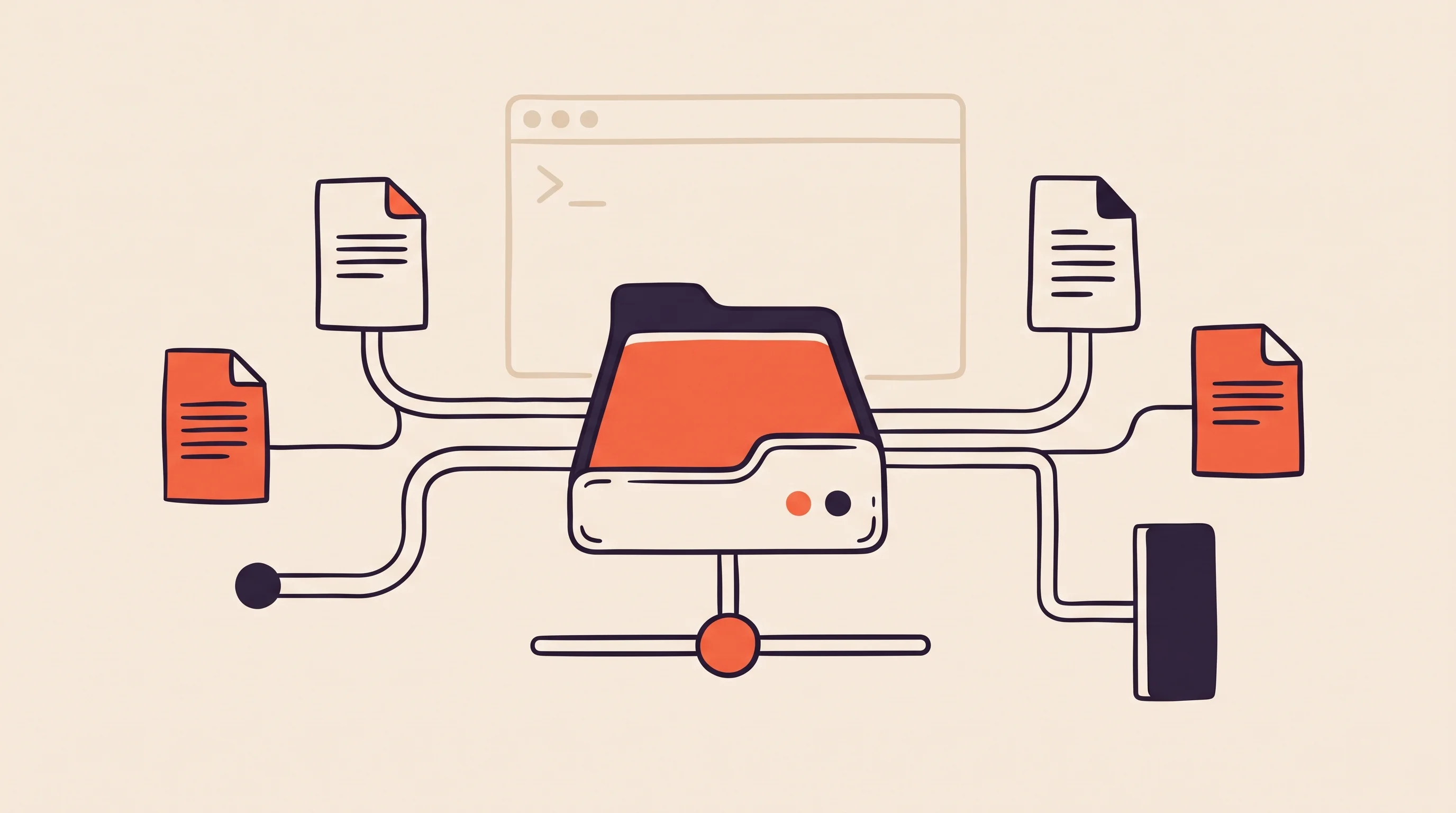
Ocean positions itself as connective tissue beneath existing agents and integrated development environments. A developer runs a Homebrew command (brew tap emergent-inc), and a background LaunchAgent mounts a read-only team drive. Agents read shared context and write back skill files or session data that teammates see in real time. Mosaic's homepage advertises Figma-style live cursors, "true pair programming" between humans and agents, and sub-second multi-agent sandboxing. The company claims it can "securely bridge your organization's custom agents with external partner agents" with policy verification, though how well that works in practice remains to be seen.
The architecture resembles approaches in open-source frameworks. LangGraph, part of the LangChain ecosystem, offers graph-based multi-agent orchestration with shared mutable state, memory persistence, and checkpointing, per documentation updated this year. Microsoft's AutoGen framework provides memory abstractions and team structures. OpenHands, an open platform for software agents, introduced an Enterprise Agent Control Plane on May 6 with reusable workflows, scheduling, retries, state management, and audit logs.
A June academic paper proposed governed shared memory for large-language-model multi-agent systems to manage coordination risks. A January paper introduced what researchers called a Repository Intelligence Graph, a deterministic architecture map to help agents navigate codebases. "Write contention becomes a first-class architectural problem rather than an afterthought," Mosaic wrote in June.
GitHub treats agent coordination as infrastructure. Agent HQ extends GitHub's branches, pull requests, issues, and actions to coding agents, with built-in controls, observability, and governance, Nadella said. Code Ocean's Aqua agent uses the Model Context Protocol to perform platform actions with permissions, session management, and context awareness, according to recently updated documentation.
Unanswered Questions

Performance benchmarks leave room for improvement. SWE-bench testing updates through SWE-bench Live have exposed agent limitations across operating systems and tooling. The best resolve rate on the hardest tasks sits around 41 percent as of August 10, per an arXiv preprint. That gap suggests differentiation may come from multi-agent coordination and shared-state infrastructure rather than raw model intelligence alone.
McKinsey argued in reports published between April and June that enterprises capturing real value from generative AI pair technology with operating-model redesign. Agentic workflows compress timelines from weeks to days or hours, the consulting firm said, but return on investment requires governance and workflow change, not just tools. A May meta-analysis found that coding assistants increase productivity with effect sizes that depend heavily on context, underscoring the need for precise shared understanding.
Standards bodies are scrambling to keep pace. NIST's AI Risk Management Framework added a generative AI profile in 2024 and is developing profiles specifically for agents. The Model Context Protocol ecosystem grew to 1,899 open-source servers by 2025, though a security assessment noted maintainability concerns. A January paper introduced CooperBench, arguing that social and coordination intelligence matter as much as task competence in team coding scenarios.
Mosaic's timing reflects an inflection point, or at least the company's bet that one has arrived. GitHub moved to consumption pricing. Microsoft consolidated usage governance. Gartner advised investment in AI engineering frameworks. The old agency model of one developer, one agent, one session no longer maps to how teams actually work when five agents might touch a repository in an hour.
Shared memory with transactional guarantees, versioning, and conflict resolution starts to look less like a feature and more like infrastructure.
"When it comes to coding, GitHub Copilot is the most popular AI pair programmer," Nadella said last October. Agent HQ, he added, serves as "the organizing layer for all coding agents." Mosaic is wagering the organizing layer runs deeper than a session manager. It sits at the level of the context store itself. Whether Ocean becomes the standard or one experiment among many, the underlying question seems settled. Agents stopped being solo tools somewhere in the past year. The architecture is still catching up.


