

A small San Francisco startup thinks it can solve one of the technology industry's least glamorous problems: who, exactly, will swap out millions of server components when the humans run out.
Proprio Robotics, which was part of Y Combinator's S26 batch, is building robots designed to handle the tedious physical labor inside data centers — inserting fans, hot-swapping disks, extracting RAM modules, the kind of fine-motor dexterity that has frustrated automation engineers for decades. The company, founded by Anirudh Pai and Raghav Punnam, enters a market where demand looks undeniable but execution remains treacherous. Drop a high-end GPU or puncture a liquid-cooling line, and the business case evaporates.
"We're building the physical automation layer for data centers," Pai wrote on LinkedIn in July, sketching out a vision that includes everything from switch recabling to heatsink removal. It's a narrow niche, arguably the right one, wedged between inspection robots already patrolling some facilities and the theoretical "lights-out" data centers that operators discuss in conference rooms but rarely deploy in practice.
The timing reflects converging pressures. Tech giants poured more than $400 billion into data center capital expenditures in 2025, according to the International Energy Agency, with spending projected to jump another 75% in 2026. Goldman Sachs expects U.S. data center power demand to grow from 31 gigawatts in 2025 to 41 gigawatts in 2026 and reach 66 gigawatts by 2027. McKinsey has floated a $7 trillion figure for global investment across the data center ecosystem through the end of the decade, though such projections tend to assume constraints that don't yet exist will somehow get solved.
Labor is one of those constraints. The Uptime Institute's annual survey, released in late July, found more than half of data center operators reporting recruiting difficulties even as rack densities climb past 30 kilowatts — the kind of equipment that demands skills like blind-mate connector troubleshooting and precision GPU cabling. Training takes months. Mistakes are expensive.
A Market Taking Shape, Slowly
Physical robotics inside data centers isn't new, just uncommon. Google has tested industrial arms for hard drive destruction since at least 2018. Microsoft Research runs prototypes for modular robotics aimed at self-maintaining facilities. NAVER, the South Korean tech company, operates a fleet of robots at its 270-megawatt GAK Sejong campus, which opened in late 2023, according to Data Center Dynamics. Boston Dynamics' Spot robots patrol some facilities run by Novva Data Centers, checking temperatures and looking for anomalies.
None of these efforts have scaled past pilot projects or specific use cases. The technology exists; the business model remains elusive.
CBRE's Global Data Center Trends report from July found vacancy rates at or near record lows across major markets, with North American absorption hitting 2,497.6 megawatts in 2025, up 38% year-over-year. Vacancy in North America fell to 1.4% by year-end 2025. Supply is tight, power constraints are shaping site selection, and operators face what the report described as "unprecedented demand drivers" tied to artificial intelligence infrastructure.
Yet data center managers, burned by decades of vendors overpromising automation, remain cautious. Forrester, in a blog post from August 2025, framed robotics as "a strategic lever for scalable, resilient infrastructure" but noted the near-term focus is augmenting staff, not replacing them. Uptime Institute's survey echoed that sentiment: operators trust AI for predictive maintenance but stay wary of autonomous control systems anywhere near mission-critical hardware.
The regulatory backdrop is shifting. The Federal Energy Regulatory Commission launched what it called an "aggressive, targeted action" on June 18 to speed large-load interconnections, directing regional grid operators to justify or reform connection rules within 30 days. Virginia's State Corporation Commission has shifted more grid-upgrade costs toward data centers over the past year. The European Union proposed the Cloud and AI Development Act in June, aiming to triple EU data center capacity in five to seven years while mandating energy-efficiency integration, according to European Commission documents.
These are not tailwinds for unfettered expansion. They're signals that the era of data centers plugging into the grid wherever they please may be ending.
The Dexterity Problem
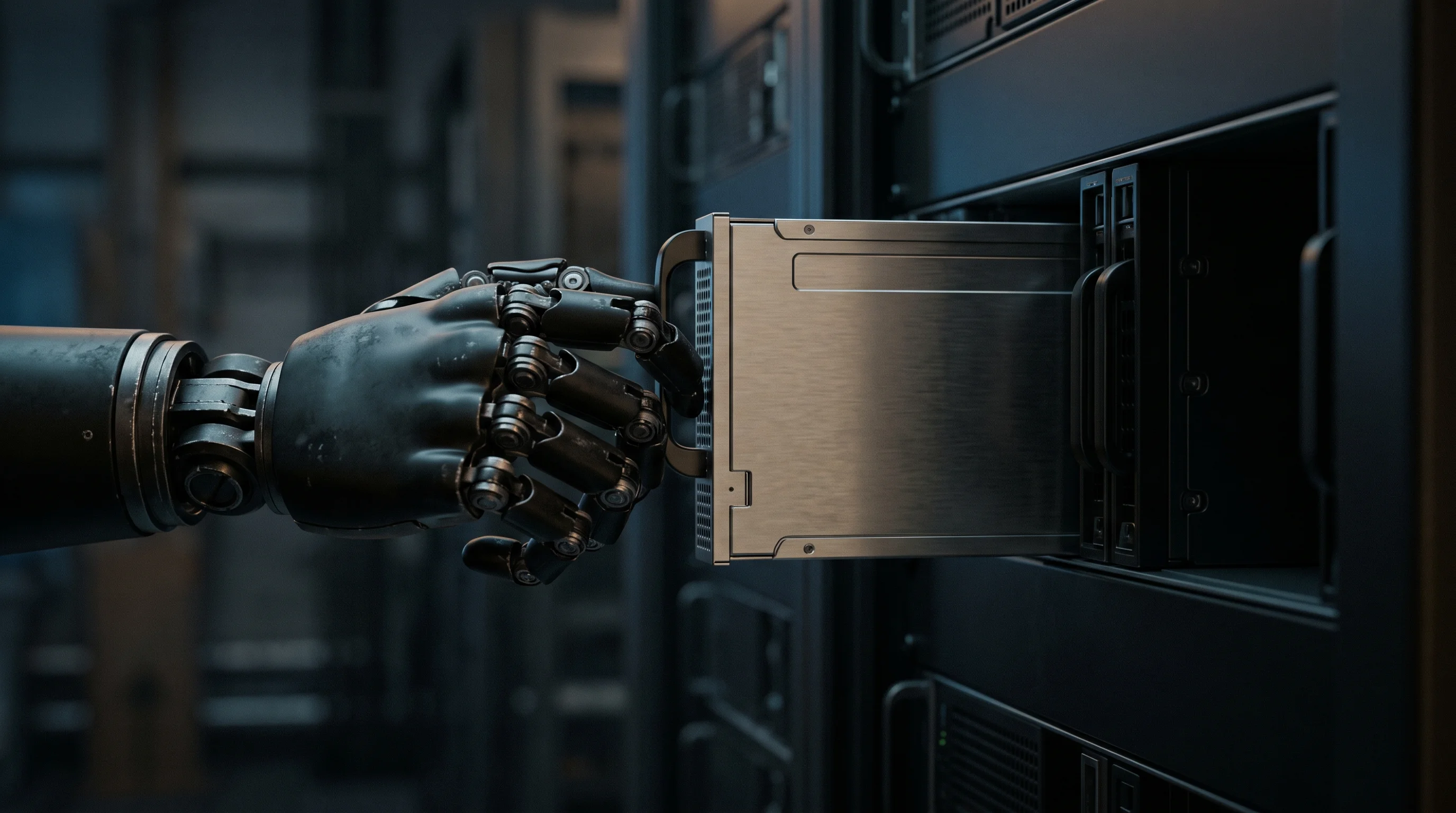
Proprio occupies a specific slice of the automation challenge: high-dexterity manipulation inside the server rack. The company, which lists fewer than 10 employees on LinkedIn and has disclosed no funding, shows video on its website of robots performing server disassembly. That task aligns with circular-economy programs Microsoft and Google have built at facilities they call Circular Centers, where retired servers get processed for reuse and recycling. Microsoft reported a 90.9% reuse and recycling rate in fiscal 2024 in a blog post from April 2025.
Component harvesting at scale presents an obvious use case. Extract RAM, remove GPUs, recover disks, repeat thousands of times without fatigue or repetitive-strain injuries. If a hyperscaler retrofits one Circular Center with robots and hits cost parity with manual labor, procurement conversations will spread across the industry within months.
The technical hurdles are real. A peer-reviewed study published in Industrial Robot Journal in May documented large-language-model-enhanced mobile manipulation trials in data center operations, achieving what researchers described as substantial efficiency gains. But efficiency in a controlled trial is not the same as reliability at five-nines service level agreements, the standard that governs every piece of equipment inside a revenue-generating facility.
Proprio isn't alone in chasing this market. Boost Robotics, which emerged from Y Combinator's 2025 batch, pitches "robot remote hands" for inspection, reboots, and component swaps, with founders from Carnegie Mellon's Robotics Institute. RAY Robotics markets container-sized, robot-operated data center modules designed to launch at stranded-power sites within a year. Grenzebach DCS offers autonomous mobile robotics for next-generation facilities.
SoftBank has developed what it calls a "cableless" server rack featuring bus bars, blind-mate liquid connections, and optical connectors designed to accommodate robotic installation and removal, according to Data Center Dynamics. The company plans testing at its Tomakomai data center, scheduled to open in 2027. Design-for-robotics initiatives like this one reduce the fine-motor complexity that has kept robots out of hardware paths, potentially compressing adoption timelines.
Earlier automation efforts in data centers targeted narrower problems with some success. Wave2Wave Solution Corporation and FiberSmart Robotics pioneered robotic optical cross-connects for automated fiber patching as early as 2015, deploying systems that handled up to 2,000 fibers, according to industry case studies. Those systems addressed layer-zero switching, far simpler than rack-level manipulation, but demonstrated that operators would adopt robotics when reliability met their standards.
Power, Density, and the Human Factor

The immediate crisis facing data center operators isn't whether robots can swap RAM modules. It's whether they can find enough power and skilled labor to deploy AI infrastructure at the pace demand requires.
Omdia's Data Center Thermal Management Tracker noted the thermal management market reached $7.7 billion in 2023, with liquid cooling approaching or exceeding $1 billion by 2025 as AI densities accelerate adoption. The IEA, in analysis published in June, warned that liquid cooling introduces new maintenance burdens: leak detection, predictive diagnostics for coolant flow, specialized handling protocols. These are tasks that require either highly trained technicians or, conceivably, highly reliable robots.
Goldman Sachs expects U.S. data center occupancy to peak above 95% in late 2026. CBRE's report found global supply reaching 16 gigawatts in the first quarter across the 16 largest markets, up 25% year-over-year. The gap between projected demand and available supply, powered and staffed, is widening.
NVIDIA, Schneider Electric, and partners released Omniverse-based digital twin blueprints in March allowing operators to simulate power requirements from grid to chip level and rehearse robotic workflows before deploying hardware. This kind of digital sandbox reduces the operational risk of testing automation sequences that might otherwise cause downtime, an approach Microsoft's modular robotics research has explored in parallel.
The challenge operators face privately, and discuss less publicly, is labor. The Uptime Institute survey described "continued recruiting and retention pressures" while deploying equipment that requires months of training. Liquid-coolant handling, precision cabling for high-density AI clusters, troubleshooting thermal anomalies in racks pushing 30 kilowatts or more — these aren't skills abundant in the labor market.
Forrester's caution about augmentation rather than replacement reflects this reality. Robots that hand technicians the right tool at the right time, or perform the repetitive grunt work while humans handle diagnosis and oversight, may arrive faster than fully autonomous systems. That's a smaller market opportunity but a more realistic one in the near term.
What Comes Next
Robotics adoption in data centers will likely follow the path every other automation wave has taken in critical infrastructure: slowly, then suddenly. Inspection and patrol robots, already deployed at facilities run by NAVER, Novva, and Digital Edge, will expand before high-dexterity manipulation becomes standard. The business case for a robot that walks the floor with a thermal camera is straightforward. The business case for a robot swapping GPU modules in a live production rack is harder.
Proprio and its cohort are betting that the $7 trillion McKinsey projects won't get built with the same labor force that erected the $400 billion in capacity standing today. That's probably correct. Whether robots rack the next million servers, harvest components from retiring hardware, or simply free up human technicians for higher-value work remains an open question.
The constraints are as much cultural as technical. Data center operators have long memories of automation vendors who overpromised. Any robot that damages equipment or causes unplanned downtime will set commercial adoption back, perhaps significantly. Reliability standards in this industry are unforgiving, and the robots will need to earn trust one task at a time.
Power constraints, regulatory pressure, labor shortages, and exponential demand growth — these forces are pushing operators toward automation faster than many expected. The physical automation layer that Proprio describes is emerging, driven less by technological possibility than by operational necessity. The question is no longer whether robots will handle data center grunt work. It's how quickly operators will trust them to do it.


