On August 10, a San Francisco startup you've never heard of posted to Y Combinator's internal launch board with a pitch that robotics researchers have chased for years: software that can pilot any robot body, anywhere, without custom tweaking. Neuromorphic, a three-person team from the accelerator's Summer 2026 batch, claims its system has already logged more than 1,500 tasks running around the clock in an unnamed wet lab.
That's the pitch, anyway. The company declined to name a customer or disclose funding.
But the timing tells you something about where the money is flowing. Embodiment-agnostic robotics—the idea that one AI brain can control different hardware platforms—has vaulted from academic conferences to valuations that would make a SaaS founder weep. Skild AI's $1.4 billion Series C on January 14 valued the Pittsburgh startup north of $14 billion. SoftBank, Nvidia, Macquarie, 1789 Capital, and Bezos Expeditions all wrote checks, Bloomberg Law reported. Skild CEO Deepak Pathak has spent the months since repeating a mantra across media appearances: "any robot, any task, one brain."
Physical Intelligence, another generalist-policy startup, raised $600 million at a $5.6 billion valuation last November. As of March, Sacra research reported the company was in talks for another $1 billion at an $11 billion valuation.
Nvidia released Isaac GR00T N1.6 on January 5, positioning the open vision-language-action model as a step toward what the company's newsroom called "reasoning generalist-specialist robots." Google DeepMind shipped Gemini Robotics 1.5 in September, offering multi-embodiment control through the Gemini API. ABI Research forecast in July that foundation-model robotics could unlock a $150 billion market by 2036, led by industrial and warehouse deployments before the technology reaches living rooms.
The technical scaffolding beneath all this hype has matured faster than most expected. OpenVLA, an open-source vision-language-action model trained on 970,000 trajectories and published in June 2024, demonstrated cross-embodiment generalization and beat RT-2-X on select benchmarks, according to the arXiv paper. UniVLA, presented at RSS 2025, topped OpenVLA on manipulation and navigation tasks with less compute and data. RING, a 2025 indoor-navigation policy published on OpenReview, showed strong performance across multiple real platforms.
Lab automation, oddly enough, has become the proving ground. Opentrons and HighRes announced what they called "the first AI agent-to-agent lab automation workflow" on February 5. Benchling Automation launched a hardware-agnostic platform in May, partnering with Automata, Hamilton, HighRes, and Opentrons, PR Newswire reported. ABB and Roche announced a collaboration in July to bring autonomous mobile robots and mobile manipulators to diagnostics labs, orchestrated by ABB's software, Automate reported.
Even standards bodies are moving. SiLA 2 expanded its AI working group in January 2026, while OPC UA Robotics and OPC UA LADS specifications provide the interoperability layer that embodiment-agnostic controllers need, according to SiLA materials.
The factory floor offers the clearest signal of where this goes next. BMW deployed Figure 02 humanoids in a 2025 pilot that supported production of more than 30,000 X3 vehicles over ten months. In June, the automaker announced Figure 03 for logistics sequencing at its Spartanburg plant. "Plant Spartanburg is the birthplace of humanoid robotics in BMW Manufacturing's operational day-to-day activities," said Ulrich Wieland, vice president of production control and logistics, in the company's press release. Figure CEO Brett Adcock added: "Humanoids are no longer lab experiments—they can be a valuable asset in establishing a flexible, reliable manufacturing workforce."
Agility Robotics signed a commercial agreement with Toyota Motor Manufacturing Canada in February and opened a Fremont facility in July. 1X commissioned a NEO factory in Hayward in April, planning consumer shipments later this year. Pre-orders for 10,000 units sold out in five days, according to a GlobeNewswire release.
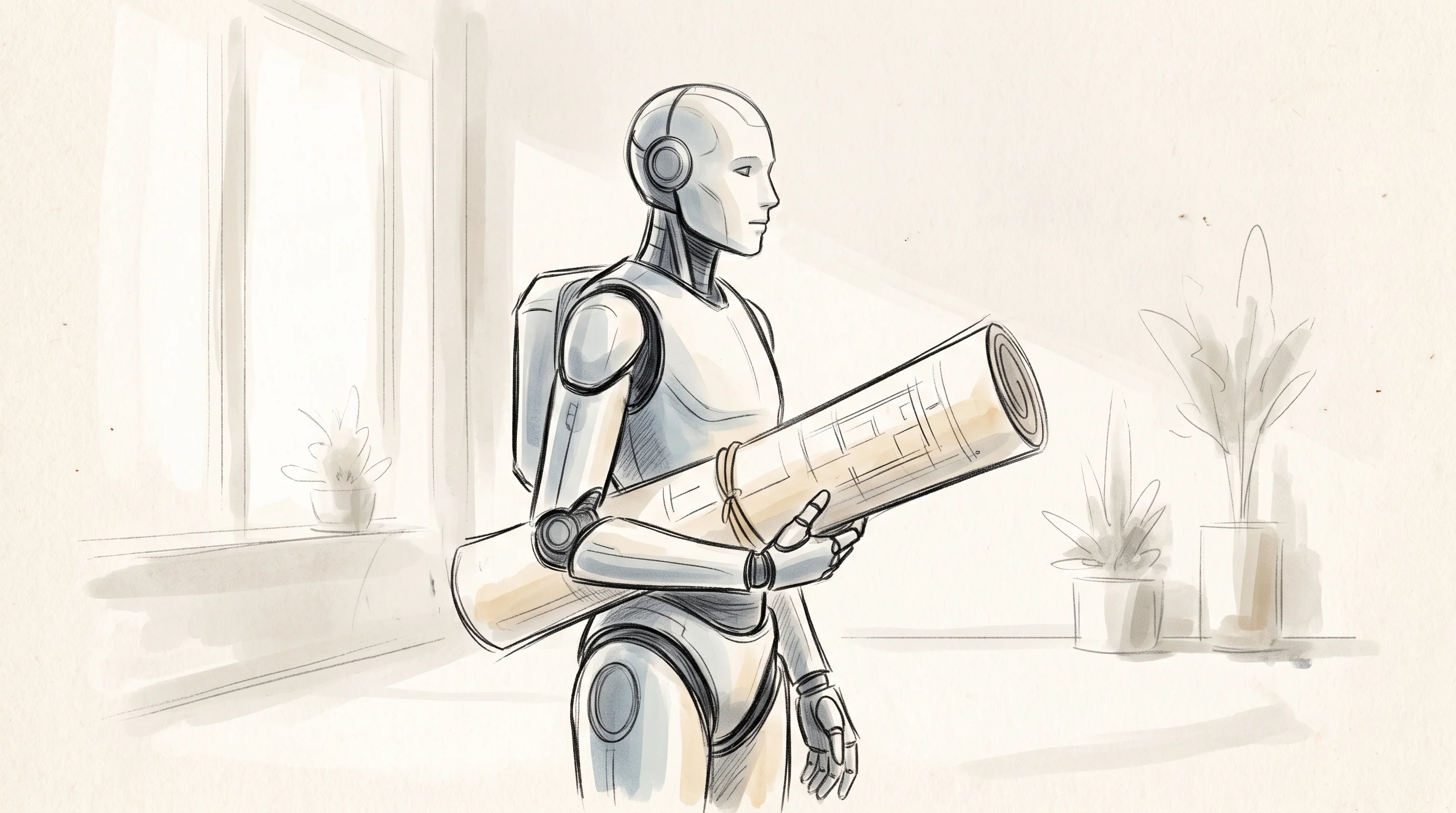
Which brings us back to Neuromorphic. The startup packages sensors, compute, and software into what it describes as a modular brain that attaches to different robot bodies. An onboard large language model orchestrator composes reusable skills for navigation, manipulation, inspection, and tool use. Sensor-based safety loops run in parallel. Operators control the system through Slack, email, or phone. (Slack announced a Model Context Protocol server and Real-time Search API for secure agent integrations in February 2026, according to the Slack Developers blog.)
The founding team brings credentials that matter in this domain. Vatan Aksoy Tezer maintained MoveIt and deployed more than 1,000 robots in Japan and Singapore. Co-founder Cem did robotics research at Cambridge. Ege has research experience at Bilkent and NTU and participated in HackMIT 2024, according to the Launch YC page. The startup is a member of Nvidia Inception, its website shows.
What's missing is what usually separates demo videos from deployments. Independent evaluation ecosystems are starting to emerge. YC's Summer 2026 batch includes Instance, which focuses on robot evaluations, and Robocurve, which builds benchmarks, according to the accelerator's manufacturing and robotics list updated in August. ARC VLA offers benchmark services for vision-language-action policies.
Regulatory timelines are tightening, too. The EU AI Act's high-risk provisions for stand-alone use cases apply from December 2027, with rules for AI embedded in robotics products following in August 2028, according to the European Council. UL 3300, the ANSI/CAN/UL service robot safety standard, saw revisions in April 2025.
Cross-embodiment reliability metrics remain scarce outside select pilots like BMW and Toyota, according to materials from ARC and Instance. Neuromorphic's 1,500-task claim is founder-reported, as per their Launch YC page on August 10, with no external customer named for verification. The company declined to disclose funding.
Perhaps that changes in the months ahead. Or perhaps Neuromorphic joins the long list of robotics startups that discovered pilot deployments and production deployments live on different planets. For now, the team is building in a market where billion-dollar valuations arrive faster than most factories can install the robots those valuations are supposed to control.