

Last month, a startup you've probably never heard of claims it cranked out 325,000 home designs. Not over a year. Not since launch. In thirty days.
The company, Drafted, operates with nine people. It just closed a $16 million seed round led by Buckley Ventures, with backing from Y Combinator, Pinterest's Ben Silbermann, and—perhaps unexpectedly—OneRepublic's Ryan Tedder. The pitch: multimodal generative models that can spit out residential floor plans and exterior renderings in minutes, packaged as downloadable PDFs or CAD files ready for the next step in the building process.
For an industry accustomed to measuring design work in months and billing in increments that make most homeowners wince, those numbers represent more than early traction. They hint at economics that may be shifting beneath the profession's feet, perhaps faster than many practitioners realize.
When the Software Ate the Blueprint
Residential architecture has always occupied uncomfortable territory—part artisan craft, part engineering puzzle, part negotiation between dreams and building codes. A custom home demands months of iteration: reconciling what clients imagine with what zoning allows, what physics permits, and what budgets can bear. For decades this happened through hand sketches that gave way to CAD, which eventually yielded to parametric modeling. The work remained expert-driven, labor-intensive, and expensive enough that the vast majority of homeowners simply never considered hiring an architect.
AI's arrival in this space followed a familiar pattern: gradual, then sudden.
Autodesk has been steadily building out its Forma platform—born from the 2020 acquisition of Norway's Spacemaker—adding AI-powered site analysis and generative building modules throughout the year. Startups like TestFit, Snaptrude, and Finch 3D have rolled out feasibility tools aimed mostly at multi-family developers. UpCodes introduced an AI-native plan review system on June 3, trained on what the company says are 11 million code sections. Eight days later, Kestrel Labs announced its own AI compliance platform, embedded directly inside Revit.
But Drafted is playing a different game. While most tools target practicing architects or commercial developers, Drafted positions itself squarely at homeowners and builders—people who might never have engaged a professional designer in the first place. The company markets "free house-plan PDFs" alongside its web application, framing generative AI as a consumer service that happens to produce construction-ready documents.
That approach carries echoes of CEO Nick Donahue's previous venture. Atmos, a custom-home design and build marketplace, had raised roughly $20 million and employed 40 people at its peak. The company generated around $7 million in revenue and completed 50 homes before shutting down in March 2025. In a December interview with TechCrunch, Donahue described Atmos as having "became an extremely operational business"—construction crews, permitting headaches, all the friction of actually building things—that struggled when interest rates spiked and the housing market cooled.
Drafted represents the software-only reset. No job sites, no contractor coordination, just models and the infrastructure to deliver them at scale.
The Money Follows the Models
The broader AI-in-construction market tells a story of capital chasing compression—the compression of timelines, iteration costs, and the traditional gatekeeping around who gets to design.
Fortune Business Insights pegged the market at $4.86 billion in 2025, projecting it would hit $6.02 billion in 2026, with a compound annual growth rate of nearly 25% driving it toward $35.53 billion by 2034. Generative design software specifically—spanning industries but with a significant architecture, engineering, and construction share—was valued at $377.8 million in 2025 and is forecast to reach $1.586 billion by 2033.
Survey data suggests architects are warming to these tools, though unevenly and with the wariness of a profession that has seen software promises before.
The UK's Royal Institute of British Architects reported that 59% of practices used AI in 2024, up from 41% the year prior. A study by Chaos and Architizer found that 74% of architects and designers plan to increase AI usage in the near term. Yet an Autodesk survey from spring 2025 found that only 13% of respondents currently incorporate machine learning or large language models into daily workflows—though 67% expect to within five years.
That gap between intention and implementation is telling. The enthusiasm is concentrated in early-stage work: concepting, site analysis, daylighting studies, massing exploration. These are the tasks where AI tools have gained the most visible traction, where firms report using generative design to expand option sets for clients and accelerate feasibility studies without high risk.
Florida's Baker Barrios Architects, featured in Autodesk case studies, described using Forma to improve client interaction and explore more design alternatives. Lake|Flato applied GIS-driven site optimization to improve livability and sustainability outcomes. The value proposition is clear when the stakes are still low.
But deeper into the design process—production documentation, detailing, coordination across trades—adoption slows considerably. The reasons are practical: the stakes of error climb, and the interoperability between AI outputs and traditional BIM platforms remains, generously, imperfect.
The 325,000-Design Question
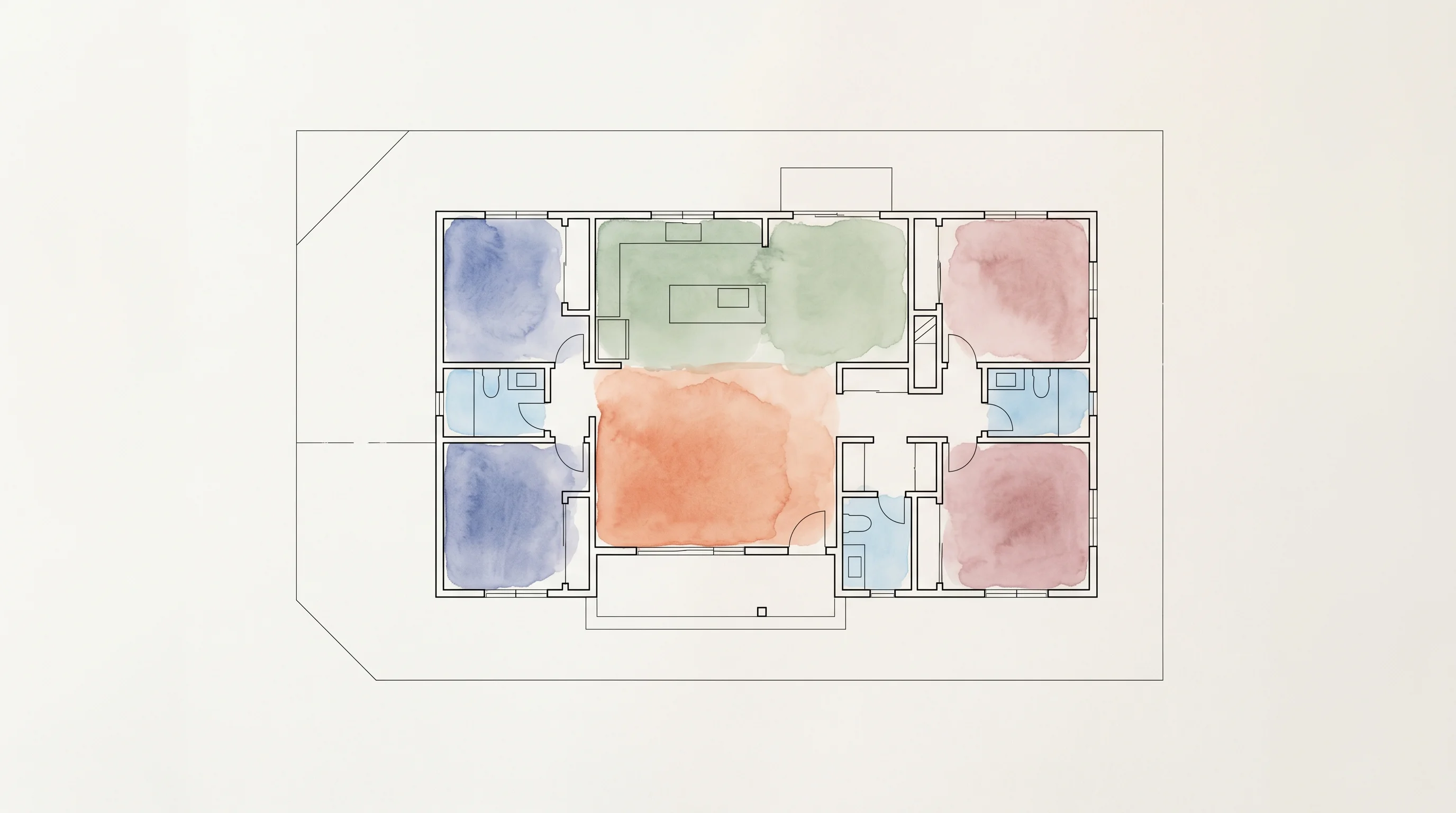
Drafted's pitch centers on solving what it frames as the "harder part" of AI home design: generating usable floor-plan concepts from constraints and spatial inputs rather than just pretty renderings. The company emphasizes sketches, site parameters, and program requirements as inputs, producing layouts that can theoretically feed into traditional modeling tools like Chief Architect. The framing is deliberate: an "AI planning layer" that precedes production work rather than replacing it.
Whether 120,000 users generating 325,000 designs in a month—a company-reported metric that warrants the usual skepticism applied to startup claims—translates to professional adoption remains an open question. Those numbers suggest consumer traction or prosumer experimentation more than enterprise deployment. Drafted's team of nine, with alumni from Stanford, Autodesk, Brown, Adobe, WeWork, and Donahue's Atmos, gives it credibility. Scale is another matter.
And Drafted is hardly alone in chasing the residential AI opportunity, which is looking increasingly crowded.
Core AI launched HomeGPT in June, a consumer-facing home-design app that the company said attracted 130,000 active users shortly after launch. Maket, another prosumer tool, recently added a "Floorplan Recognizer" feature converting uploaded plans into editable layouts; a company blog post claimed AI could deliver 70 to 75% of schematic design work. Snaptrude, targeting professional workflows, has built what it calls an "AI stack" sequencing from brief to site to program to sizing to floor-by-floor layouts, with iterative reprompting for refinement.
Then there are the compliance plays—arguably where the near-term money is. UpCodes' Plan Review analyzes drawings against code requirements across more than 6,000 jurisdictions. Kestrel Labs embeds its compliance engine inside Revit, promising error reduction before submission. Primepoint, which closed a $10 million seed round in April, is building an intelligence platform designed to read and understand construction drawings at a granular level. These tools address a different bottleneck entirely: the risk and cost of plan rejections, resubmissions, and change orders that plague the industry.
The competition isn't just startups scrambling for seed rounds. Autodesk is methodically expanding Forma's building-design capabilities and tightening integration with Construction Cloud. A January blog post from Autodesk's Carl Christensen outlined a roadmap connecting site design, building design, data management, and downstream collaboration tools. Autodesk's reach into firms through Revit, AutoCAD, and BIM 360 gives it distribution advantages no seed-stage company can match, no matter how clever the model.
When the Regulators Notice
The regulatory landscape is beginning to stir, if slowly.
Mississippi's State Board of Architecture updated its rules effective June 8, clarifying that architects "shall not delegate critical decision-making responsibilities to automated systems... or AI." The rule requires disclaimers on unsealed work that includes AI-derived content. It's a narrow intervention—Mississippi is not exactly the epicenter of architectural innovation—but it signals that state licensing boards are paying attention.
Nationally, the American Institute of Architects published guidance on responsible AI use in October 2025, emphasizing transparency and human oversight in language carefully calibrated to sound supportive without being prescriptive. The National Council of Architectural Registration Boards signaled in its fiscal 2025 annual report that competency standards and exam content are being revisited to account for AI's role, though timelines remain vague.
For firms serving European clients, the EU AI Act—which entered into force in August 2024—begins general applicability August 2, adding another layer of compliance considerations.
What Happens Next (and Who Loses)

The question facing the profession is not whether AI will reshape residential design workflows. That much seems settled. The real uncertainty is how deeply the reshaping goes, and how fast.
Cross-industry research from McKinsey and BCG emphasizes that scaling AI requires more than access to models. It demands operating-model redesigns, integration investments, and cultural shifts that often exceed the cost of the tools themselves—sometimes by an order of magnitude. In architecture, engineering, and construction, where project-based work, distributed teams, and contractor handoffs complicate any kind of standardization, those organizational frictions may prove more stubborn than the technical ones.
What seems clearer is that the earliest measurable value will come from pre-design acceleration and compliance pre-checks—tasks where speed and error reduction deliver immediate, quantifiable returns. Drafted's bet is that a market exists willing to pay for that acceleration even if it sits outside traditional architectural practice. If 120,000 people did generate floor plans in a month, some meaningful fraction were almost certainly homeowners and builders who would never have hired an architect anyway.
Which raises uncomfortable questions for the profession, particularly for small practices built around custom residential work. If design becomes a commodity service—accessible to anyone with a browser and a prompt—what happens to the architect whose business model depended on being the only person who could translate vague client desires into buildable plans?
The tools may expand the overall market. They will almost certainly compress margins. And in an industry where 59% of UK practices already use AI and three-quarters of architects plan to increase usage, the firms that resist may find themselves competing on nostalgia rather than efficiency. That's rarely a winning strategy.
Drafted has $16 million and a team of nine to prove the thesis works. The next twelve months will reveal whether consumer traction converts to professional adoption, and whether AI-generated floor plans hold up under the scrutiny of code officials, contractors, and homeowners actually living with the results.
The technology is past the speculative phase. The workflows are being rewritten now, in real time, whether the profession is ready or not.


