

In a converted industrial space south of Lisbon, Olivia Page is betting that mushroom roots can do what decades of energy codes and corporate sustainability pledges have failed to accomplish: fundamentally change what we stuff inside walls.
Her company, Mykor, grows insulation from mycelium—the thread-like underground network that mushrooms sprout from. Feed it agricultural waste or construction timber destined for the incinerator, and within weeks you get a panel that the company claims removes 48 kilograms of CO2 per square meter. Not low-carbon. Carbon-negative.
It sounds like the kind of pitch venture capitalists hear over oat milk lattes in Shoreditch or SoMa. Except this time, the policy architecture that could actually make it viable is snapping into place faster than the product itself.
Buildings account for roughly 37% of global energy-related CO2 emissions—policy wonks often round it to 40%—yet the materials that insulate them haven't fundamentally changed since Eisenhower was president. Fiberglass, mineral wool, foam boards. Effective, yes. Predictable. But also energy-intensive to produce and, at best, carbon-neutral when you account for their full lifecycle.
That status quo is about to face its first serious stress test. Between 2028 and 2030, the European Union will begin requiring whole-life carbon accounting for new buildings under its revised Energy Performance of Buildings Directive. California expanded its Buy Clean Act last September to cover insulation broadly, not just mineral wool. Federal procurement guidelines are pushing Environmental Product Declarations across construction materials, creating what one industry veteran called "the most significant demand signal for embodied carbon transparency since LEED launched."
Mykor closed a £960,000 seed round last July—modest by tech standards, bringing total capital including grants to roughly £3 million. But the timing may matter more than the check size. Not because mycelium insulation is new (researchers have been experimenting with fungal composites for years), but because regulators are finally writing rules that could force the market's hand.
When Policy Meets Performance
The global insulation market sits somewhere between $65 billion and $74 billion this year, depending on which analyst's methodology you trust. Projected growth rates range from a sluggish 2.8% to a more optimistic 6.9% annually through 2035—the wide variance reflecting genuine confusion over how to categorize sustainable segments versus legacy products.
One forecast pegs sustainable building insulation alone at $59.7 billion in 2024, growing to $93.9 billion by 2032. Bio-based materials—cellulose, wood fiber, hemp, and nascent mycelium products—currently represent perhaps $2.27 billion of that, but are expected to grow at 8% annually. Still a rounding error, statistically speaking.
Conventional materials dominate for good reason. Mineral wool, fiberglass, and foam products like extruded polystyrene deliver predictable thermal performance, decades of code compliance history, and supply chains that builders actually trust. Recent innovations have chipped away at their carbon footprint: Owens Corning's FOAMULAR NGX uses hydrofluoroolefin blowing agents that cut global warming potential by roughly 90% compared to the hydrofluorocarbons they replaced. BASF followed suit. ROCKWOOL published decarbonization targets for its direct emissions.
But these are tactical improvements. The materials still require significant energy to produce—extruded polystyrene carries an embodied energy of around 83.5 megajoules per kilogram in some lifecycle assessments—and while HFO blowing agents reduce atmospheric warming, the products themselves sequester no carbon.
They're getting cleaner. They're not pulling carbon out of the air.
That's the wedge bio-based entrants are driving at.
The Regulatory Accelerant
If you want to understand why investors suddenly care about insulation feedstocks, start with Brussels.
The EU's Energy Performance of Buildings Directive recast entered force last May and lays out a timeline that should worry every foam manufacturer: starting January 2028, new buildings over 1,000 square meters must calculate and disclose life-cycle global warming potential in energy performance certificates. All new buildings follow by January 2030. Member states must publish roadmaps for GWP limits by 2027, with zero-emission standards for new construction by 2030.
Not suggestions. Requirements.
In the U.S., the picture is messier—federalism tends to produce that—but the directional pull is similar. The General Services Administration launched a Buy Clean pilot in 2023 under the Inflation Reduction Act, initially covering asphalt, concrete, glass, and steel. Insulation didn't make the list, but the program triggered a scramble for Environmental Product Declarations as manufacturers realized embodied carbon documentation was becoming procurement currency.
California moved faster. Governor Newsom signed SB 1207 last September, expanding Buy Clean California from "mineral wool board insulation" to "insulation" as a category. The Department of General Services now has to identify subcategories and update GWP limits for mineral wool by January 1, 2025. Washington State and New York have enacted parallel frameworks for concrete and steel.
Energy codes are tightening in parallel. ASHRAE 90.1-2022 introduced envelope backstop requirements and thermal bridging accounting—technical language that translates to higher demand for continuous insulation systems that minimize heat loss at junctions. LEED v4.1 emphasizes EPDs and embodied-carbon optimization in its materials credits.
The combined effect? Transparency and low embodied carbon shift from feel-good marketing to competitive necessity. One construction procurement officer told me bluntly: "In three years, if you don't have an EPD and a credible decarbonization story, you're not even getting through the RFP."
Industry observers expect similar dynamics when states begin setting GWP thresholds for insulation specifically. It creates a floor that conventional products will need to meet—and an opening for bio-based materials to differentiate.
Scaling the Unscalable

Mykor operates a pilot factory in Montemor-o-Novo, Portugal, with R&D in Bristol and commercial operations in Lisbon. The company takes biomass residues—construction timber waste, agricultural byproducts—and transforms them into insulation systems using proprietary biotech processes and, it claims, over 75% solar electricity.
Its MykoSIP panels and MykoBead loose infill are vapor-permeable, free of volatile organic compounds, and according to a UK Green Building Council profile, use 90% less water and 40% less electricity than polystyrene in production. Performance data from research institutions suggests mycelium composites can achieve thermal conductivity in the 0.029 to 0.043 W/m·K range—roughly competitive with mineral wool and some foam products, though exact figures depend on density and additives.
The company's trajectory reflects the broader challenge of commercializing bio-based materials. Early work included a 2021 collaboration with Multiplex, the construction contractor, which trialed sending waste timber from London tower projects to Mykor for upcycling. A proof-of-concept phase that generated data points, not revenue.
Structured funding followed: a pre-seed round in May 2023 led by Sustainable Ventures and Green Angel Syndicate, then the July 2024 seed round that brought in Moonstone Fund, Rumbo Ventures, Core Angels, and Pera Innovation. Mykor also participated in the Holcim MAQER Ventures Accelerator—notable because it signals interest from a global materials incumbent hedging its portfolio.
According to an Innovate UK case study published in April, Mykor has secured over £950,000 in grant funding, employs 17 full-time staff, and has off-take agreements worth £337 million. That last figure invites skepticism—off-take agreements are expressions of intent, not guaranteed purchase orders, and the construction industry has a long history of enthusiastic MOUs that never convert to actual shipments. But it does indicate market appetite, however conditional.
CEO Page has stated the company's near-term focus is achieving CE marking, reducing production cycles from weeks to days, and meeting fire safety and lifecycle regulations. That's the gauntlet: fire ratings that satisfy code officials, third-party EPDs under EN 15804+A2 or ISO standards, product approvals in key markets, and manufacturing costs that compete with mineral wool on a per-R-value basis—or at least close the gap enough that embodied-carbon savings justify a premium.
Fire performance remains a development area for mycelium materials broadly. Early tests by Ecovative, a U.S. pioneer in mycelium composites, achieved ASTM E84 Class C ratings. Italian manufacturer Mogu's acoustic panels carry Euroclass B-s1,d0 certification. Moisture management is another focus—mycelium's natural hygroscopic properties can benefit vapor permeability but require careful detailing or hydrophobic treatments to prevent mold growth in certain climates.
None of this is insurmountable. It's just expensive and time-consuming, which is why most bio-based insulation startups run out of cash before they reach commercial scale.
The Competition Isn't Standing Still
Mykor isn't operating in a vacuum. Wood fiber insulation is scaling rapidly. Germany's Steico—now majority-owned by Kingspan, a detail that tells you incumbents are paying attention—is expanding production in Poland. TimberHP, a U.S.-based wood fiber manufacturer, emerged from Chapter 11 restructuring earlier this year and launched its TimberBoard product in November, targeting builder demand in the Northeast and Pacific Northwest.
Hempitecture opened a 33,000-square-foot Idaho plant in 2023, positioning itself for western U.S. markets where architect specifications increasingly favor natural materials. Cellulose insulation, made from recycled newsprint, continues to hold a low-embodied-carbon position with manufacturers like Greenfiber emphasizing net carbon storage. Cork board insulation from Portugal's Amorim carries ACERMI certification at 0.040 W/m·K and markets itself as carbon-negative.
Even in emerging markets, experimentation is accelerating. In Kenya, MycoTile produces roughly 3,000 square meters of mycelium panels per month from local agricultural waste, targeting affordable housing with units costing around $208 for 15 square meters of panels. The project demonstrates that mycelium's feedstock flexibility and low-tech scalability may have applications beyond European retrofits and California passive houses.
Meanwhile, the incumbents aren't conceding ground. The HFO blowing agent transition across XPS and polyisocyanurate products is largely complete, and major manufacturers now tout EPDs and LEED contribution as baseline expectations rather than differentiators. ROCKWOOL and others are investing in recycled content and low-carbon energy for production facilities.
The competitive bar isn't static. It's rising.
The 24-Month Test
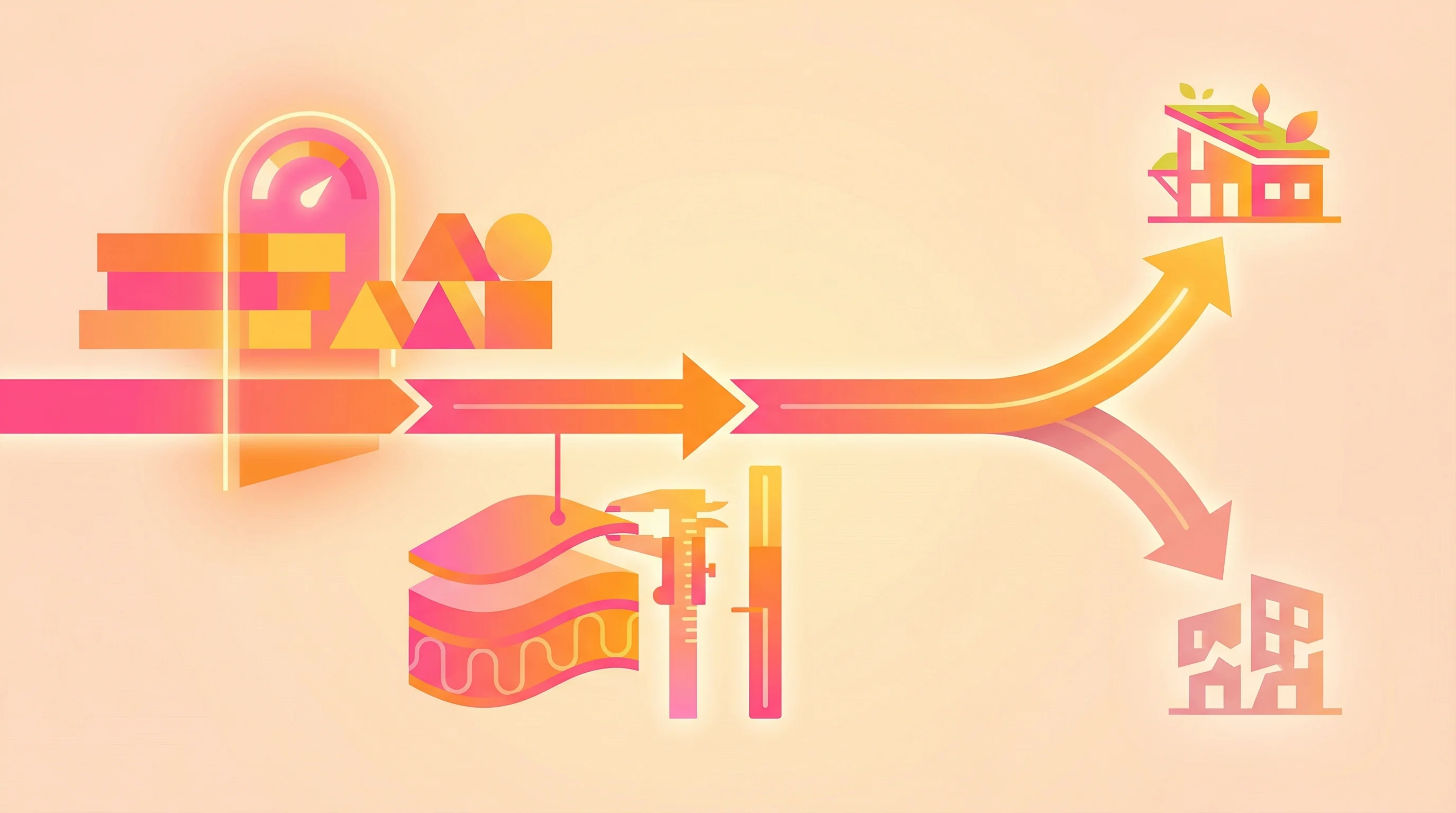
What could actually move the needle?
Regulatory mandates with enforcement mechanisms. If the EU follows through on GWP limits for building materials—and early signals suggest they will—and California sets insulation thresholds that favor biogenic carbon storage, the market bifurcates. Projects subject to those rules need low-GWP products, period. Projects outside those jurisdictions may still follow if developers see reputational advantages, or if lenders and insurers begin pricing climate risk into building portfolios.
There's precedent. When California's Title 24 energy code tightened envelope requirements in the early 2010s, it didn't just change building practices in California—it shifted national product development because manufacturers weren't going to maintain separate supply chains for one state.
Strategic interest from construction majors suggests this isn't entirely speculative. Holcim's venture arm backing Mykor, Kingspan's stake in Steico, early off-take agreements from large contractors—these are hedges on a low-carbon future, placed by companies that move slowly but with significant capital when they do move.
The question is timing and scale. Mycelium insulation remains pre-commercial for most envelope applications. Research shows promise; production hasn't yet proven cost parity at volume. Wood fiber and cellulose have head starts on certification and supply chain integration, which is why they're positioned to capture near-term market share among bio-based options.
For policy makers and investors, the insulation market offers a useful case study in how mandates can accelerate material substitution. Unlike steel or concrete, where production pathways are capital-intensive and locked into decades-old infrastructure, insulation manufacturing is relatively modular. A new entrant can establish a pilot line, secure product approvals, and scale regionally without requiring billions in capex.
That makes it a faster-moving testing ground for embodied-carbon policy design.
The risk is fragmentation. If every jurisdiction sets different GWP limits, testing protocols, and disclosure timelines, manufacturers face a compliance labyrinth that favors large players with regulatory departments and legal teams. Harmonization—or at least mutual recognition of EPDs and test methods between the EU and U.S.—would lower barriers for startups while still driving carbon reductions.
Whether that happens depends on choices being made right now, as these policies move from aspiration to rulemaking.
Buildings as Carbon Sinks?

Mykor's mycelium panels and the broader cohort of bio-based insulation materials represent something more than a sustainability niche. They're a wager that the next decade of construction will look fundamentally different from the last—shaped less by incremental efficiency gains and more by hard limits on what materials can be used.
That 40% of emissions tied to buildings? It could become a 40% opportunity, if regulators set rules with teeth and manufacturers can deliver performance at cost.
The optimistic scenario: policy pull overcomes inertia, certification pathways streamline, and bio-based materials capture meaningful market share by 2030. Buildings start sequestering carbon instead of merely reducing it.
The realistic scenario: incumbents adapt faster than expected, capturing most compliance-driven demand with lower-carbon versions of conventional products, while bio-based materials carve out high-end niches and wait for the next regulatory ratchet.
The pessimistic scenario: fragmented rules, delayed enforcement, and cost gaps kill momentum. Mycelium insulation joins the long list of promising green technologies that couldn't cross the valley between pilot and scale.
Page and her team in Portugal are betting the first scenario plays out. They've got 24 months, maybe less, to prove the technology can move from interesting to indispensable. In an industry that moves at glacial speed, that's not much runway.
Then again, regulatory deadlines have a way of concentrating minds. And money.


