

The premise sounds almost absurdly simple: Shine a laser at a satellite. Recharge its batteries. Go home.
But ORiS Space, a Turin-based startup spun out of Politecnico di Torino, just closed €5 million in late July on that exact proposition—€4.5 million in equity led by Earlybird and co-led by Pitchdrive, with contributions from Galaxia, Vento, and Piemonte Next Fund, plus a half-million-euro regional grant. The pre-seed round, announced July 21, 2026, positions the young company as Europe's entry in what's quietly becoming a strategic race: who gets to build the first orbital gas station.
Or power station, more accurately. Because low Earth orbit doesn't run on fuel anymore—it runs on electricity. And there's starting to be a lot of demand.
When Orbit Gets Crowded, Power Gets Scarce
Consider the numbers. BryceTech's 2025 launch review, published in April, found that 98 percent of spacecraft launched last year weighed less than 1,200 kilograms. The smallsat explosion everyone saw coming has arrived—but miniaturization hasn't solved the power problem. If anything, it's made things worse.
NASA's 2026 State-of-the-Art report flags energy storage and power management as "critical enabling areas" for the next generation of small spacecraft, especially those venturing beyond LEO or supporting lunar operations. Translation: batteries are a bottleneck.
The economics tell the rest of the story. Allianz Research pegged LEO services at roughly $16 billion last year and projects the market will hit $120 billion by 2030, driven by enterprise and industrial demand. Deloitte expects more than 15 million LEO broadband subscribers by year's end. Amazon's Project Kuiper had deployed over 200 satellites through March and planned more than 20 missions in "year two" of operations. Starlink's scale is, by now, public knowledge.
What all those satellites need—constantly, reliably—is power. Especially during eclipse periods when they swing into Earth's shadow. Especially during high-demand maneuvers. The orbital real estate may be valuable, but keeping thousands of spacecraft operational requires rethinking how energy gets distributed up there.
Enter wireless power beaming. Which isn't exactly new, though the execution keeps improving.
A Concept That Refuses to Die
Japan's JAXA ran microwave transmission demos over a decade ago. Caltech's SSPD-1 mission demonstrated on-orbit power transfer in 2023. The idea has persisted, in part because it solves a real problem, and in part because the technology finally seems ready. What changed recently is the density of potential customers and the maturation of laser systems that can deliver kilowatts at range—without requiring satellites to be rebuilt from scratch.
That last point matters. ORiS and its competitors promise their systems work with standard photovoltaic arrays already installed on client satellites. No retrofit. No redesign. Just point and beam.
Whether that holds up in practice is what the next year will determine.
ORiS isn't operating in isolation. Star Catcher Industries, a U.S. company, raised $65 million in a Series A back in May to build what it describes as "the first power grid in space." Like ORiS, Star Catcher uses optical beaming and claims compatibility with existing solar panels. Aviation Week reported the company planned an orbital demonstration sometime this year. Volta Space Technologies, backed by NASA STTR and Canadian Space Agency funding as of mid-2026, is developing a lunar "LightPort" receiver and secured a slot on the same ARAQYS-D3 mission ORiS is targeting for Q1 2027.
That mission—run by Dcubed, a German-American venture—is shaping up to be something of a showdown. Multiple power-beaming partners will fly on a single SpaceX rideshare, all testing their systems simultaneously. Dcubed's ARAQYS platform features an in-space-manufactured 2-kilowatt solar array, essentially a testbed for distributed energy infrastructure. ORiS booked its spot and, according to the company, aims to deliver its flight model by the end of July.
There's a terrestrial precedent that's worth noting. PowerLight Technologies partnered with Kraus Hamdani Aerospace to demonstrate sustained flight of an unmanned aircraft recharged mid-air by laser beam—nearly one kilowatt delivered at altitudes up to 5,000 feet—at Shaw Air Force Base in April. The U.S. Naval Research Laboratory showcased a dual-use laser system in June that switches between wireless power beaming and counter-UAS operations. These aren't speculative lab experiments. They're funded by Operational Energy initiatives and flagged as expeditionary capabilities.
Which brings up the other angle: defense.
The Dual-Use Proposition
ORiS is part of NATO's Defence Innovation Accelerator, DIANA, which launched its 2026 program in February. Co-founder Anna Mauro described the company's "optical combiner"—technology that merges multiple laser beams at kilowatt levels—in an April 2025 NATO profile. The pitch is straightforward and strategic: power drones on the battlefield, power satellites in peacetime.
DIANA's Energy & Power challenge explicitly seeks technologies that enhance resilience and sovereignty. A memorandum of understanding with Telespazio Germany, signed in November 2025, suggests operational interest from European satellite service providers who understand that energy autonomy in orbit might matter as much as launch sovereignty.
And perhaps more than the founders initially expected, the military applications are driving interest. When energy becomes infrastructure, infrastructure becomes strategic. A satellite that can recharge from a third-party beam stays on station longer, responds faster to tasking, reduces the mass-to-orbit cost equation. That's commercially attractive. It's also, unmistakably, a defense capability.
Proving the Physics
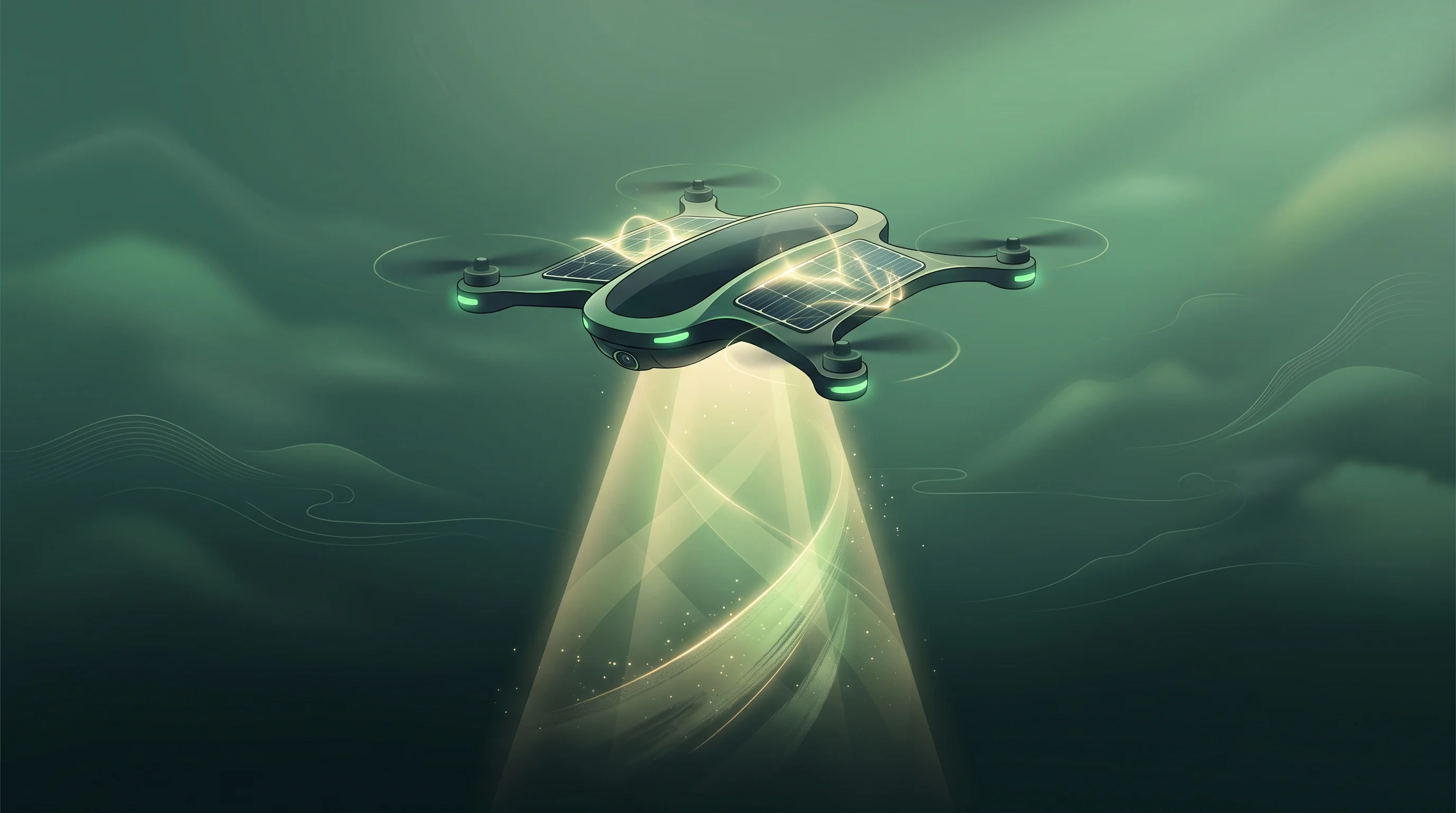
The recurring claim across ORiS, Star Catcher, and others is elegant in its simplicity: satellites don't need new hardware. They use their existing solar panels to convert the incoming laser light into electricity. ORiS demonstrated this principle with its LOONA drone, which hovered at over 100 meters powered entirely by beamed energy—proof of concept for tracking, pointing, and delivery at range.
CEO Andrea Villa framed the July funding milestone this way: "Our first step is to make energy in orbit a commodity, available at any time, just as we are used to here on Earth."
Bold words. Whether they scale depends on wavelength matching, photovoltaic spectral response, and atmospheric or vacuum losses that won't be fully validated until the 2027 orbital demos. Academic work published in June suggests realistic LEO space-based solar power constellations might deliver 50 to 100 kilowatts per ground site with a 20-satellite Walker configuration at 450 kilometers altitude. That's microwave, not laser, but it frames expectations: power delivery in orbit is measured in kilowatts per node initially, not megawatts.
Still, the Satellite Industry Association noted in its 2026 report that U.S. firms manufactured 83 percent of commercially procured satellites launched in 2025. If American and European operators adopt power-as-a-service models to extend mission life or boost throughput during peak periods, first-mover advantage goes to whoever flies first and proves the economics work.
The Regulatory Maze (Less Complicated Than It Sounds)
Outdoor laser operations face scrutiny, naturally. In the U.S., FAA Advisory Circular 70-1B and Order JO 7400.2 govern airspace coordination; ANSI Z136.6 sets safety standards. Export controls classify high-power lasers under EAR Category 6 and cross-reference ITAR's USML Category XII. Europe has its own frameworks. NATO's involvement suggests defense applications will accelerate rather than hinder development—provided dual-use companies can navigate overlapping jurisdictions.
Spectrum, interestingly, is less of an issue for optical systems than for microwave competitors. (Emrod ran an Airbus demo back in September 2022; Reach Labs demonstrated RF power beaming to UAVs in June 2026.) Lasers don't require ITU frequency allocations. They do require line-of-sight and precision tracking. That's an engineering challenge, not a regulatory one, which plays to ORiS's advantage. The company is hiring engineers and expanding lab and cleanroom facilities with its fresh capital.
The Moment of Truth Arrives Soon
The Q1 2027 ARAQYS-D3 mission is the inflection point. Multiple companies will beam power in orbit simultaneously. If the demonstrations succeed, expect capital to follow quickly. If they reveal efficiency losses, thermal management issues, or pointing problems—and there's always the possibility they will—the market will recalibrate just as fast.
Either way, the data will be public. That matters. The next wave of investment will be informed by real orbital performance, not lab results.
Longer term, the LEO build-out creates structural demand. Allianz Research highlights geopolitical fragmentation in its analysis—U.S. and Chinese constellations dominating, European sovereign systems playing catch-up. Power infrastructure could become a strategic asset, not merely a service. An operational edge, in other words, for whoever controls it.
ORiS's $5.7 million round is modest by space standards. Star Catcher's $65 million Series A dwarfs it. But pre-seed rounds signal intent more than scale. The company's path runs through technical milestones—flight model delivery by end of July, orbital demo in Q1 2027—and customer validation via the Telespazio partnership and DIANA cohort access.
If the ARAQYS mission goes well, Series A will follow. If it doesn't, ORiS will join a long list of space ventures with compelling ideas that didn't survive contact with orbital reality.
For now, though, the race is underway. Orbital energy infrastructure—once relegated to science fiction—has become a capital allocation decision. Investors betting on dual-use deep tech, satellite operators planning constellation expansions, and defense stakeholders eyeing resilient space logistics all have a stake in whether wireless power beaming works at scale.
The answer arrives next year. One laser beam at a time.


