

Ten times faster. That's what RamAIn, a two-person startup barely a year old, is saying about its AI agents compared to the computer-use tools released by Google, OpenAI, and Anthropic. It's the kind of assertion that makes enterprise software buyers either lean forward with interest or reach for the door.
The San Francisco company emerged from Y Combinator's Winter 2026 batch in early February with a pitch that resonates immediately for anyone who's watched employees waste afternoons copying data between systems that simply won't integrate. Their AI agents manipulate desktop applications and web portals through simulated mouse clicks and keystrokes—handling the grunt work that APIs were supposed to eliminate but never quite did.
Legacy systems, it turns out, remain spectacularly bad at talking to each other.
Speed Through Specialization
Where RamAIn diverges from the big players is architecture. Most computer-use agents follow a predictable rhythm: capture a screenshot, feed it to a vision model, decide what to do, execute, repeat. It works, after a fashion. But it's slow.
RamAIn's approach pre-trains agents on specific interfaces—teaching them UI patterns and interface structures upfront rather than forcing them to decipher each screen from scratch. The result, they claim, is dramatically faster decision-making. Whether "10x faster" survives contact with production environments is another matter entirely. No independent benchmarks exist yet. No third-party reviews have surfaced. Just the company's word, which is how these things usually start.
The timing is aggressive. Anthropic released its computer-use beta in October 2024. OpenAI's "Operator" preview dropped in January 2025, Google followed with Gemini 2.5 Computer Use Preview shortly after. RamAIn is effectively declaring itself faster than companies with exponentially more resources before most potential customers have even kicked the tires.
Bold? Certainly. Provable? We'll see.
The Pain Points Are Real
The use cases RamAIn is targeting will sound depressingly familiar to back-office managers. Vendor onboarding forms in procurement systems. Multi-carrier quote submissions for insurance brokers. Prior authorization workflows in healthcare that somehow still require humans to click through five separate portals. Accounts payable, accounts receivable, retail pricing updates, pharmacy claims, logistics load booking—the list reads like a catalog of work nobody wants to do but everybody needs done.
According to founder posts, the company's design partner program has already produced three implementations in under five weeks. One involves assistive form-filling for complex insurance underwriting—60-plus fields across five pages. Another pulls data from legacy dashboards into vendor portals, creating what they call "visual data pipelines." A third handles multi-site pricing extraction, presumably scraping information that exists nowhere as structured data.
The deployment pitch: a few days to train and roll out across a team's applications. The system supposedly "self-heals" when it encounters unexpected pop-ups or UI changes, which matters because enterprise software is constantly throwing curveballs. There's a human-in-the-loop feature for moments of ambiguity, plus full audit trails—because letting AI click around production systems without accountability is how you end up explaining things to auditors.
Crowded Territory
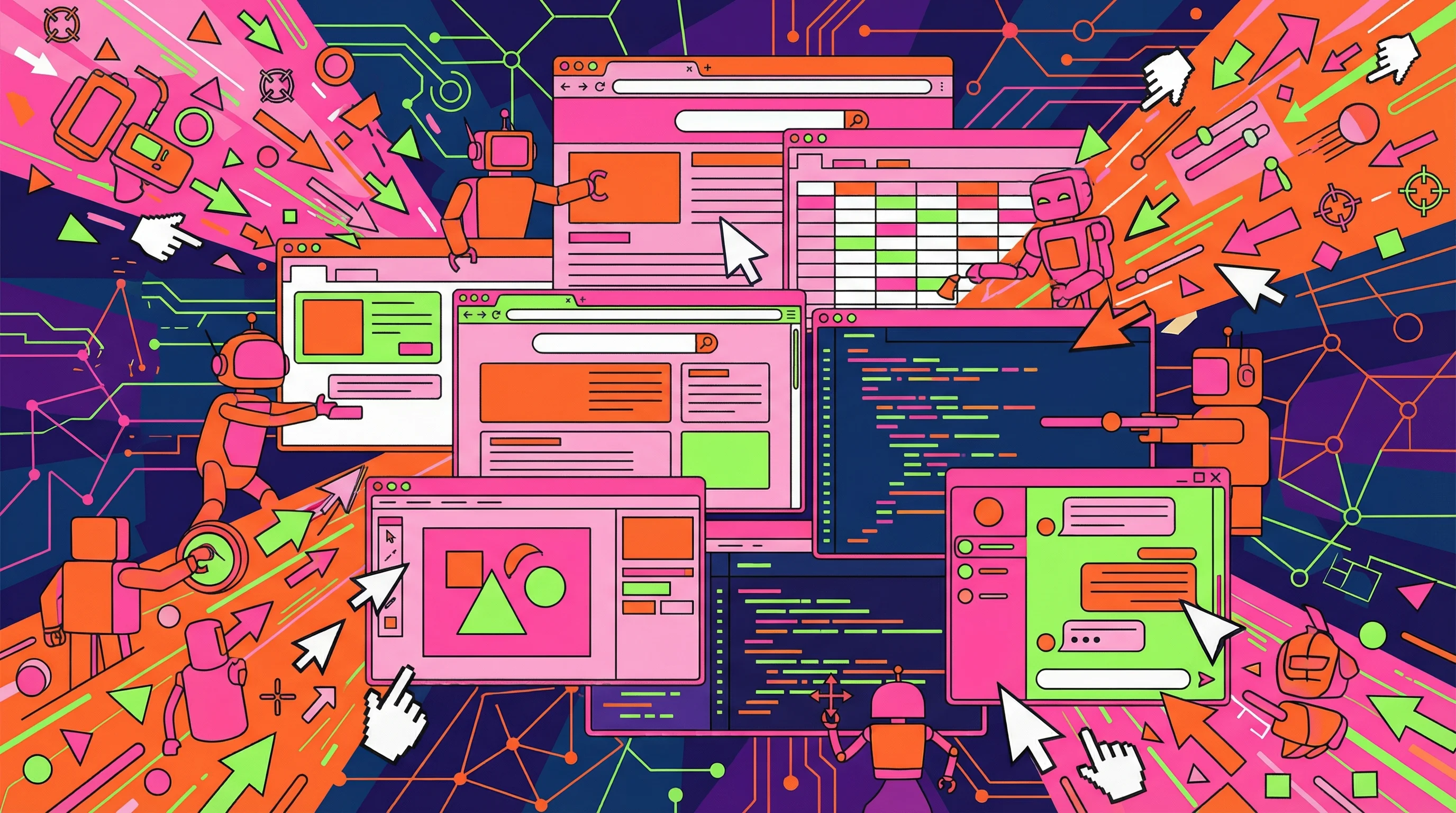
This market got competitive fast. Until October 2024, computer-use agents were mostly theoretical. Then Anthropic opened the floodgates, and suddenly everyone had a product. Microsoft embedded computer-use capabilities into Copilot Studio in 2025, enabling agents to operate websites and desktop apps when proper integrations don't exist. UiPath, the incumbent with actual enterprise relationships and mature governance controls, shipped its "Healing Agent" in May 2025 and unveiled "ScreenPlay" at its FUSION conference—blending natural language with UI automation in ways that blur the line between RPA and agentic AI.
Which raises the obvious question: what does a two-person startup have that established vendors don't?
Speed and simplicity, supposedly. The promise that you can train agents in days rather than weeks. That these agents won't break every time a software vendor updates their UI, unlike traditional RPA scripts that rely on brittle selectors and break constantly. Maybe that's enough. Maybe enterprises are tired enough of vendor lock-in and bloated implementations that they'll take a chance on something lighter and faster.
Or maybe they'll wait for proof beyond a Y Combinator launch post.
Who's Building This
Shourya Vir Jain, the CEO, studied electrical engineering at IIT Delhi before spending time at McKinsey. He previously founded Genoshi, an AI studio he bootstrapped to six figures—not life-changing money, but enough to suggest he can ship product. Vansh Ramani, the CTO, also came through IIT Delhi's computer science program with research stints at Carnegie Mellon's Machine Learning Department and the University of Copenhagen.
Ramani's credentials include graph condensation research accepted to ICLR 2025 and a nearest-neighbor search project called "Panorama." His Y Combinator bio claims Panorama was merged into Facebook's FAISS library, though that specific assertion hasn't been independently verified on the FAISS repository pages. It's the kind of detail that matters less than the underlying competence it suggests.
They're working out of San Francisco with Tyler Bosmeny as their Y Combinator partner. The company was founded in 2025, making this launch roughly a year into existence. Fast, even by startup standards.
The Offer
RamAIn is actively courting design partners with a 30% discount on implementation and a 100% refund guarantee if the agents can't automate a given workflow. The first 100 users on the waitlist get free access, according to founder posts on LinkedIn. There's also mention of a "voice-powered automation platform" that would let non-technical users build workflows in 60 seconds, though details remain thin.
What's missing: security posture beyond vague assurances, deployment models (on-premises versus managed cloud), detailed governance controls, and pricing beyond the introductory offers. The official site is ramain.ai, though public materials remain sparse ahead of Y Combinator's Demo Day on March 24, 2026. For a product targeting enterprise IT leaders accustomed to exhaustive vendor evaluations, that's a lot of unanswered questions.
The Bet
This is a familiar wager for enterprise buyers. You're trading the unknown risks of working with a startup—will they be around in two years? can they scale? will support evaporate after the honeymoon?—for the potential upside of genuinely faster automation and lighter technical debt.
Whether RamAIn's agents actually run 10x faster than offerings from companies with exponentially more resources is the kind of claim that gets tested fast once real workflows start running. Benchmarks in a lab mean nothing. Production environments, with their chaos and edge cases and systems held together with duct tape and prayers, tell the truth.
For now, RamAIn has momentum, Y Combinator's stamp, and a pitch that resonates. What they don't have yet is proof at scale. That gap—between a compelling demo and a product enterprises can bet their operations on—is where startups either break through or fade quietly into the long list of companies that almost made it.
The 10x claim will either age beautifully or become a cautionary tale. Sometimes the only way to find out is to watch.


