

When Jensen Huang needed to illustrate the future of manufacturing during his keynote at NVIDIA's developer conference earlier this year, he turned to a company most people had never heard of. Sancho Robotics—a Palo Alto-based startup—provided the demo: a general-purpose robot smoothly loading materials into a biomanufacturing station, orchestrating the kind of handoff that typically requires a human worker.
The moment was validation most startups spend years chasing. By mid-July, Sancho had emerged from stealth with $7 million in seed funding, co-led by Fusion Fund and Catapult Ventures. But the real story isn't the money or the marquee appearance. It's the bet the company is making on what it calls a "physical API"—software that treats robots as connective tissue, bridging the gaps between the specialized machines that populate modern factories.
It's an elegant pitch, perhaps more conceptually neat than the messy reality of factory floors would suggest. And it arrived in the same period when Walden Robotics launched with $300 million, a reminder of just how much capital is suddenly flowing toward physical AI in industrial settings.
The Orchestration Problem
Sancho's founders, Chao Cao and Jack Yang—both holding Ph.D.s from Carnegie Mellon's robotics program—describe their work as solving "the last mile" of manufacturing automation. The phrase is deliberate. Most factories already have islands of automation: CNC machines, injection molders, inspection stations running with minimal human oversight. What they lack is the connective layer that handles loading, unloading, and material transfer between those stations.
That's still human work in most facilities. Expensive, sometimes error-prone human work.
"Sancho's focus on solving high-value real-world problems sets them apart," Rouz Jazayeri, managing partner at Catapult Ventures, said in the company's announcement. Charlotte Xia of Fusion Fund emphasized the orchestration angle: the goal is to make "the whole line work more seamlessly" by programming robots to navigate the handoffs that specialized equipment can't manage alone.
The technical challenges are considerable. Sancho's open job postings—seeking founding engineers in mobile manipulation and autonomy systems—read like a wish list of hard robotics problems. Contact-rich tasks. Robust control strategies that work outside the lab. Perception systems that balance precision with the dust, vibration, and inconsistent lighting of real production environments.
These aren't trivial asks.
From DARPA Tunnels to Assembly Lines
Cao's background offers some clues about how the team plans to tackle those challenges. He previously led autonomy development for Carnegie Mellon's entry in the DARPA Subterranean Challenge, a competition that sent robots into unpredictable underground environments—mines, tunnels, cave systems. Later, he worked as a research scientist at the Boston Dynamics AI Institute, where the focus was on making robots that could handle dynamic, unstructured tasks.
Now that same autonomy expertise is being redirected toward factory coordination. The parallels are there: both domains require robots to operate in spaces not designed for them, adapting to variations and recovering from unexpected conditions.
The team remains small. As of mid-2026, LinkedIn lists the company at somewhere between two and ten employees. But the caliber of early hiring—and the investor backing—suggests Sancho is building for something larger. Fusion Fund's posts referenced "participation from an incredible group of investors, founders, and operators," though the company hasn't publicly disclosed participants beyond the two co-leads.
That kind of vagueness is typical for seed rounds. Or it might mean the round came together quickly, momentum building faster than expected.
A Demo That Mattered
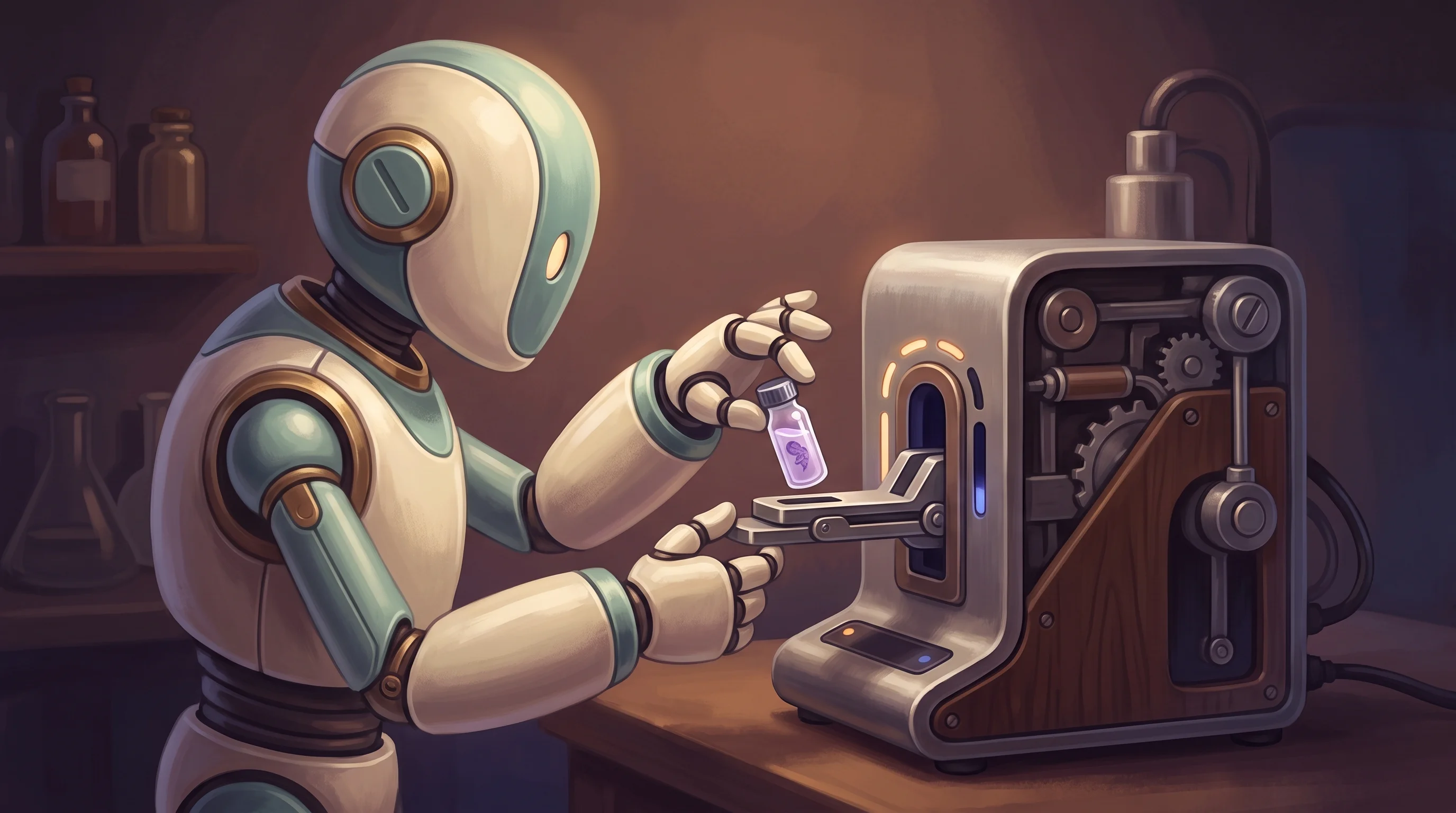
The collaboration with Multiply Labs, a Bay Area company specializing in robotic biomanufacturing, gave Sancho the proof point it needed. A YouTube video—titled simply "Humanoid Robot Loads a Biomanufacturing Robot"—shows the kind of workflow the startup is targeting. It's not flashy. But it demonstrates something harder than flashiness: a general-purpose robot executing multi-step material transfers between specialized stations, the kind of task that doesn't lend itself to traditional automation.
Multiply Labs was already using NVIDIA's Omniverse and Isaac Sim for digital twin simulations, according to an earlier NVIDIA blog post. Sancho's orchestration layer appears to sit on top of that infrastructure, directing physical robots through processes mapped out in simulation first.
Xia's LinkedIn activity from around the time of the GTC keynote linked to behind-the-scenes footage and flagged the appearance as a milestone—the kind of public validation that matters when you're still months from announcing your company exists.
Betting on the Orchestration Layer
The $7 million will fund team expansion and deployments beyond biomanufacturing. Sancho's website positions the technology as infrastructure for "advanced manufacturing" broadly, language deliberately open-ended. The job postings emphasize field testing and production robustness, signals that the company is moving from concept validation to commercial implementation.
Whether that timeline holds is another question.
The funding environment, at least, is favorable. In recent months, Standard Bots raised $200 million at a billion-dollar valuation. RobCo secured $100 million for autonomous industrial robotics. Hellbender landed $12.5 million for edge computer vision hardware. The capital flooding into physical AI suggests investors believe the sector is approaching an inflection point—or at least that the narrative is compelling enough to bet on.
Sancho's wager is that the orchestration layer—the software making disparate machines work as a system—will prove as valuable as the robots themselves. Maybe more valuable, if it turns out factories need better coordination software more than they need new hardware.
It's a theory. A well-funded one.
What Comes Next

For now, Sancho is hiring researchers and engineers in Palo Alto, building out the technical foundations for what it's calling the world's first physical API. The framing is ambitious, the kind of claim that invites scrutiny. It also invites a question: will manufacturers, often conservative in their technology adoption, embrace the abstraction of treating robots as API endpoints?
The answer will determine whether $7 million is just the opening chapter—or most of the story.


