

The satellite in geostationary orbit today draws perhaps 20 kilowatts from its solar wings. The one scheduled to launch next year may need 60. And if the orbital data center evangelists are right—a big if—the platform going up the year after could require ten times that.
Those numbers suggest a potential inflection point for space power infrastructure. And it's prompting a wholesale rethink of how deployable solar arrays actually deploy.
Enter Beyond Reach Labs, a Pittsburgh startup just admitted to Y Combinator's Winter 2026 batch, which is betting the industry's appetite for power will outpace its traditional approach to folding and unfolding structures. The company's pitch: space solar arrays that expand from dining-table to football-field dimensions using origami-inspired geometry. They claim expansion ratios an order of magnitude beyond current systems—an audacious assertion from a team that includes Mitchell Fogelson, who spent his Carnegie Mellon PhD developing kilometer-scale deployables under NASA funding, and Pele Collins, who led Dragon parachute engineering at SpaceX for six or seven years.
Whether the origami gambit works remains to be seen. But the challenge it aims to address is drawing serious attention.
The Power Curve Bends Upward
The demand for orbital electricity is bending upward across every major segment. NASA's Lunar Gateway Power and Propulsion Element powered on its 60-kilowatt-class ROSA (Roll-Out Solar Array) wings during 2025 testing—a tenfold jump from typical smallsat arrays and double the power level of many current GEO telecommunications platforms. Airbus's Eurostar Neo and Thales Alenia Space's INSPIRE satellite buses now advertise 25 to 30 kilowatts of payload power as standard capability. Not stretch goals. Standard.
The ROSA architecture itself has become something of an industry workhorse through sheer repetition. Six upgraded arrays augmented the International Space Station's power between 2021 and 2023. A fourth pair was delivered in January 2025. The design powered NASA's DART planetary defense impactor in 2022, made its first commercial GEO appearance on Maxar's Ovzon-3 satellite in January 2024, and landed contracts for Thales's next-generation telecom line and Axiom Space's first commercial station module in 2025. Each iteration pushed the envelope further: Ovzon-3 deployed two 5-kilowatt wings; Gateway's arrays are twelve times that power level.
Market forecasters see the addressable opportunity expanding accordingly. GlobalGrowthInsights pegs the space solar panel and array market at $460 million in 2025, reaching $3.3 billion by 2035. FutureMarketReport offers a more aggressive baseline—$1.45 billion in 2024—but arrives at a similar terminal figure of $3.66 billion by 2032. The divergence in starting points reflects some definitional ambiguity around what counts as "array" versus broader power systems, but the directional arrow is consistent: up and to the right.
Three Converging Pressures
Three trends are stressing traditional deployable designs, and they're converging faster than the industry anticipated.
The first is scale. Commercial space stations and cislunar infrastructure require sustained high-power operation—not the intermittent demands of a telecommunications relay. Axiom's announcement that Redwire would supply ROSA wings for its AxPPTM power module marks a symbolic handoff from ISS heritage to commercial architecture, with target launch dates around 2027.
The second driver comes from next-generation telecommunications and direct-to-device connectivity constellations. AST SpaceMobile's BlueWalker-3 deployed a 64-square-meter array/antenna combination in November 2022—large enough to become one of the brightest objects in the night sky and trigger formal concern from the International Astronomical Union. The incident underscored a reality often overlooked in engineering circles: very large deployables carry externalities beyond performance specs. Optical brightness, radio-frequency interference, and end-of-life disposal all scale with aperture.
The third catalyst, more speculative but potentially transformative, involves so-called orbital compute platforms. Industry coverage from late 2025 described companies planning GPU-equipped data centers in LEO, citing continuous solar exposure and thermal rejection advantages. Whether these concepts mature into paying customers remains uncertain—the business case is still nebulous at best—but proponents claim power requirements approaching 100 kilowatts per platform. That's a step-function beyond anything flying today outside of crewed stations.
The Supply Side Scrambles
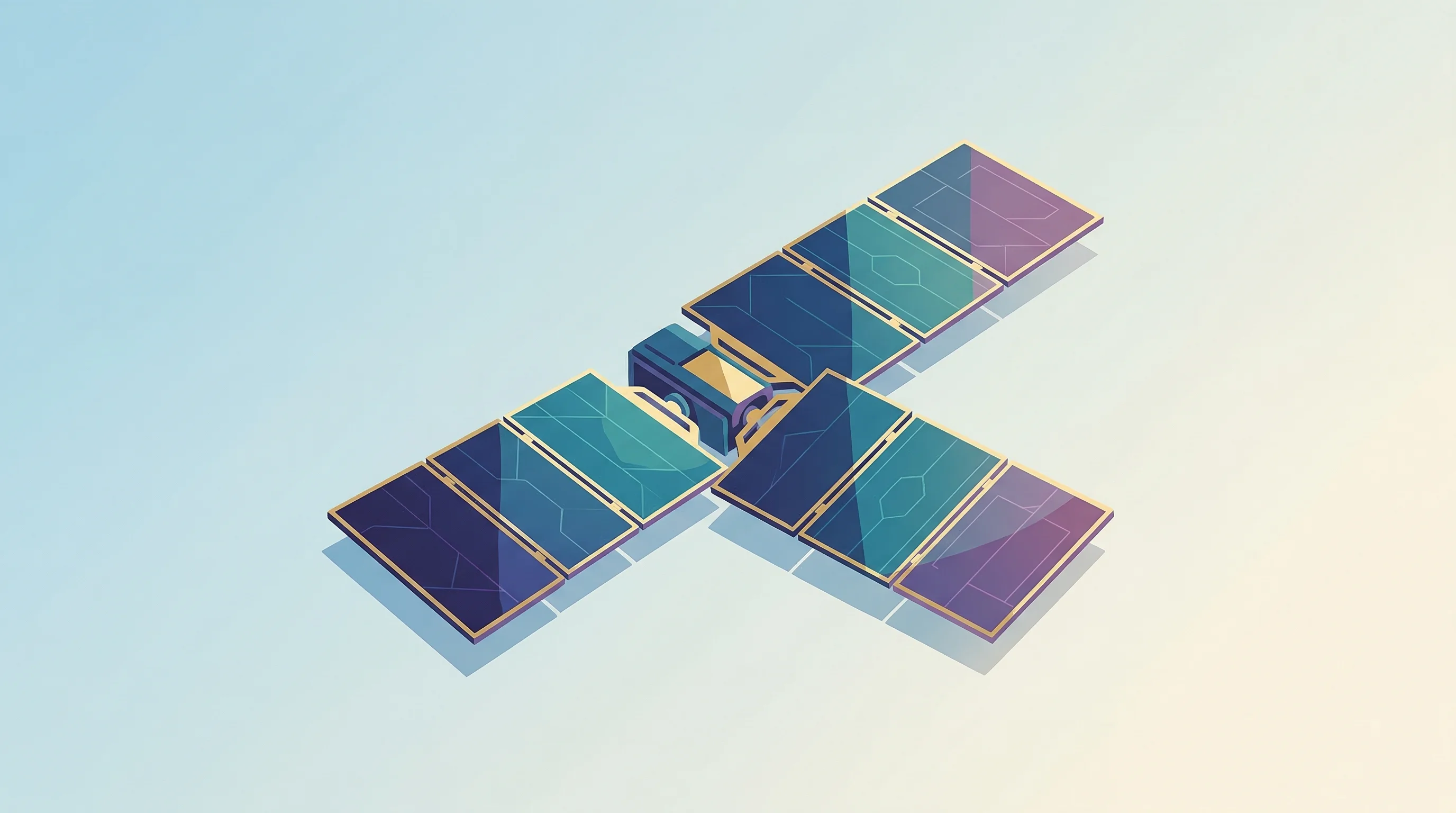
Incumbent array manufacturers are scaling up capacity, though not always smoothly. Rocket Lab's SolAero division—acquired in January 2022—received preliminary CHIPS Act terms for up to $23.9 million in June 2024 to expand production of space-grade compound semiconductor solar cells, one of only a handful of domestic sources. In March 2025, SolAero won a contract to power Airbus's next-generation OneWeb constellation and unveiled STARRAY, a modular smallsat array product. The company has reported strong revenue growth across its space systems business, though specific figures for arrays remain opaque within broader launch and systems revenue.
Venture-backed startups are pursuing alternative cell and module architectures with varying degrees of traction. mPower Technology closed over $21 million in Series B funding in May 2025 for its DragonSCALES thin micro-cell modules and inaugurated an automated 1-megawatt production line in November 2025, with plans to double capacity by mid-2026. Solestial, which develops radiation-tolerant silicon cells for LEO, attracted investment from Mitsubishi Electric's ME Innovation Fund in May 2025. MicroLink Devices received UK government funding in December 2025 to advance flexible III-V cell materials under the SALMAT program.
Each represents a bet that reducing cell thickness, enabling new form factors, or improving radiation tolerance can unlock cost or performance advantages that rigid crystalline cells cannot. The jury's still out on which approaches gain commercial traction.
The Geometry Problem
Beyond Reach Labs enters this landscape with a fundamentally different value proposition: it's not the cells that need reimagining, but the structure holding them.
The company's technical roots trace to Fogelson's NASA NIAC-linked research at Carnegie Mellon, which produced two related concepts—Pop-Up Extending Trusses (PETS) and Hierarchical High-Expansion-Ratio Deployable Structures (HERDS). A paper on HERDS, presented at the IEEE Aerospace Conference in March 2024, describes mechanisms that integrate Kresling origami patterns with pop-up scissor linkages to achieve high expansion ratios while maintaining load-bearing stiffness. Dense technical reading, but the practical upshot is straightforward: fold the structure tighter, unfold it larger.
In practical terms, the company claims its designs can reach expansion ratios an order of magnitude beyond current deployables while fitting within similar launch volumes. Where a ROSA wing might unfurl from a compact roll to several meters, Beyond Reach Labs envisions structures that extend from a dense stack to tens or hundreds of meters. Perhaps more ambitiously, the application set includes not only orbital arrays but also deployable radiators and, in what borders on science fiction for now, lunar vertical solar array towers—tall masts designed to capture near-continuous sunlight at the Moon's south pole.
The company was founded in 2023 and accepted into Innovation Works' Robotics Factory Accelerate Program in August 2025, which provides up to $100,000 in pre-seed investment per cohort company. Team size remains small, likely in the low single digits given the early stage. Whether the origami-inspired geometry translates from NASA chamber tests to flight hardware remains an open question, but the technical pedigree and alignment with NASA's own lunar VSAT tower program suggest the approach warrants attention.
The Integration Challenge Ahead
The path from 20 kilowatts to 200 is not just a scaling problem. It's a systems integration labyrinth involving thermal management, power distribution, attitude control, and increasingly, environmental compliance.
The FCC's five-year post-mission deorbit rule, adopted in September 2022 and phased into new authorizations through 2024-2025, directly impacts deployable sizing. Larger arrays increase drag area, which helps deorbit but complicates stowage volume—a classic trade-off with no elegant solution. The BlueWalker-3 brightness controversy has likewise heightened scrutiny on reflective surfaces, potentially requiring mitigation coatings or operational constraints that add mass or cost.
NASA's cancellation of the OSAM-1 on-orbit servicing demonstration in March 2024 illustrates another constraint: public funding for very large, first-of-kind in-space assembly missions faces relentless budget and schedule pressure. That shifts the onus to commercial actors to close the business case for hundred-kilowatt platforms—a chicken-and-egg dynamic where array suppliers need credible anchor customers and platform developers need proven power systems. Neither wants to move first.
Unfolding in a Vacuum
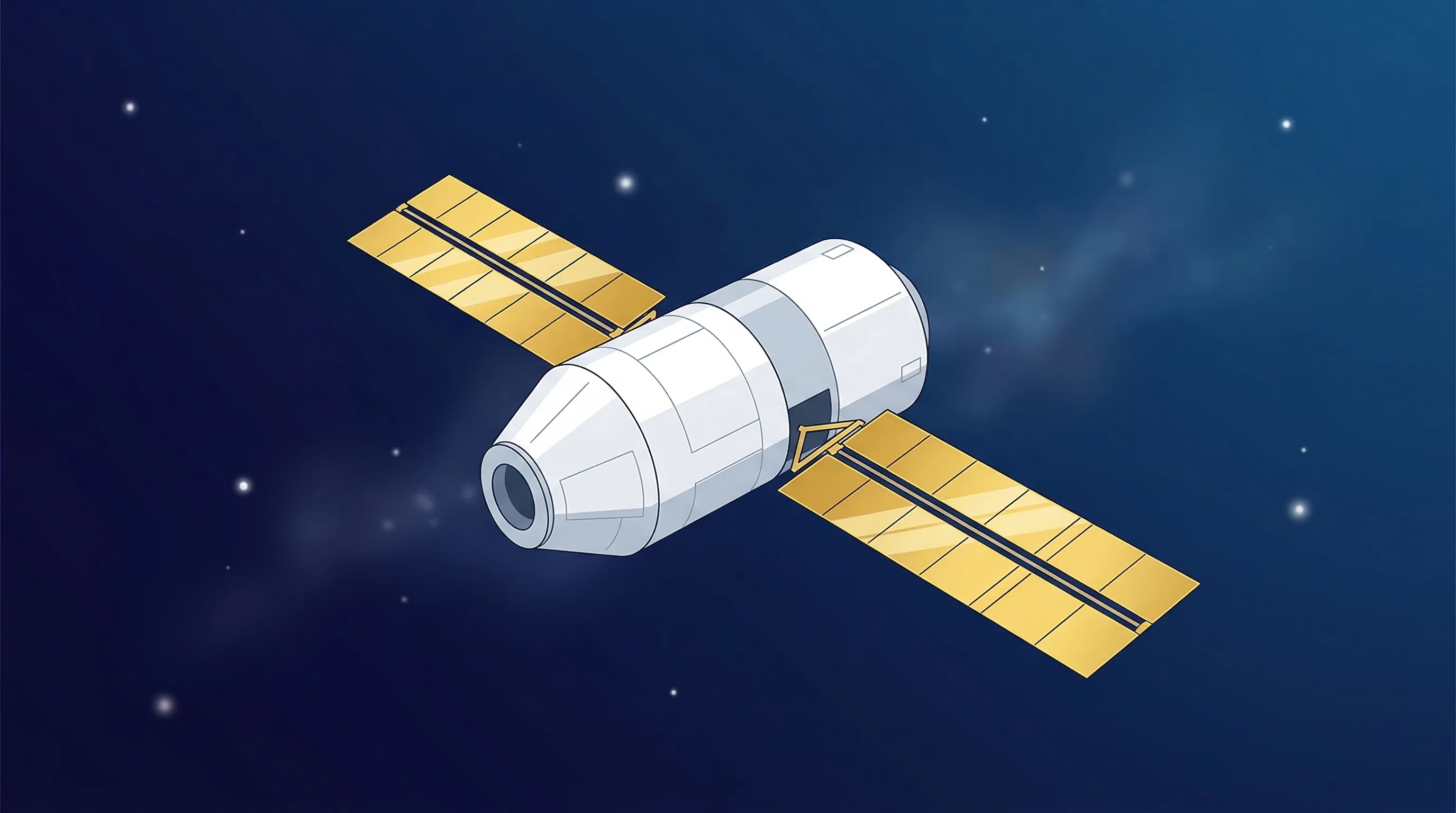
Still, the trajectory appears set, even if the timeline remains uncertain. Lunar Gateway is in final testing. Axiom's station module has a power contract. Rocket Lab is expanding cell production with federal support. And if orbital compute or other high-power applications gain even partial traction, the industry will need solutions that don't just scale ROSA wings wider but rethink how structures pack, deploy, and survive for years or decades in harsh radiation and thermal environments.
Whether Beyond Reach Labs' origami geometry becomes part of that answer depends on milestones still ahead: ground testing, flight qualification, and ultimately, a customer willing to bet a mission on a dining table unfolding into a football field in the vacuum of space. The physics may check out. The funding may materialize. But the hardest part—convincing a risk-averse industry to try something genuinely new—remains ahead.
For now, at least, someone's willing to try folding the problem differently.


