

On an average day, the International Space Station pulls about 215 kilowatts from its solar arrays—roughly what you'd need to keep the lights on in forty suburban homes. Not much, really. Until you start thinking about what's on the drawing boards.
Orbital data centers that never sleep. Lunar outposts enduring fourteen-day nights. Power relay satellites forming a web across cislunar space. The kind of infrastructure that makes today's spacecraft look positively Edwardian—like asking a pocket watch to run a server farm.
The gap between these ambitions and the reality of current power generation in orbit has opened a door that few saw coming. While the industry obsesses over launch costs and booster landings, a quieter revolution is taking shape in how satellites actually keep the lights on once they reach space. The companies positioning themselves to fill this gap aren't merely refining old blueprints. They're reconsidering the basic physics of deploying massive structures where gravity doesn't exist to help—or hinder.
What Got Us Here
Space solar arrays have followed a fairly predictable path over the decades. Rigid panels evolved into accordion-style folds, which eventually gave way to roll-out designs that unfurl with the satisfying precision of a measuring tape. Redwire Space's Roll-Out Solar Arrays became something of an industry standard after six wings boosted the ISS's power output by about 30 percent between 2021 and 2023. Each iROSA wing delivers around 20 kilowatts. Useful, certainly. Revolutionary? Not quite.
The market has responded the way markets tend to: standardization, productization, incremental gains. Rocket Lab rolled out its STARRAY line this past April, offering off-the-shelf configurations designed to collapse lead times. Airbus ordered north of 200 Sparkwing arrays for MDA's production line supporting the Telesat Lightspeed constellation. Redwire unveiled ELSA in early March—a modular design promising 50 percent more power density through volume optimization and mass manufacturing.
These represent solid engineering work, no question. They're also fundamentally insufficient for what's coming. When Axiom Space contracted with Redwire last September for arrays on its commercial station module, the underlying assumptions didn't change: launch compact, deploy carefully, work within unforgiving mass budgets. The architecture scales, but linearly. Maybe.
The Geometry Trap
Here's the thing: solar cell efficiency isn't really the problem anymore. SolAero's IMM-β cells under qualification hit roughly 33.3 percent efficiency at beginning of life. Spectrolab's triple-junction cells exceed 32 percent. These are respectable numbers, edging toward theoretical limits for their architectures.
The real bottleneck is geometric. You need a football field's worth of collecting area packed into a volume the size of a dining table, then somehow coaxed into shape in orbit without exotic mechanisms, structural headaches, or crushing mass penalties. It's a packing problem more than a physics problem.
Beyond Reach Labs—a two-person startup that came through Y Combinator's Winter 2026 batch—claims it's cracked this particular nut with what it describes as a "patented deployable geometry." Founder Mitchell Fogelson holds a PhD from Carnegie Mellon focused on deployable space structures. His co-founder, Pele Collins, spent years leading parachute engineering across more than thirty Dragon missions at SpaceX. Their pitch? Arrays that self-expand from compact launch configurations to football-field scale, delivering ten times more usable power without adding launch mass or volume.
The company says it has letters of intent totaling over $175 million and is planning a first in-space demonstration for late in the second quarter of 2027. In March, EMF Space—a startup developing GEO satellites for space-based solar power—apparently selected Beyond Reach Labs as its preferred supplier for large-scale arrays, though this emerged mainly through LinkedIn announcements rather than formal press releases. (Make of that what you will.)
Skepticism is warranted here. Space history is crowded with elegant deployment concepts that looked brilliant in simulation and disastrous in vacuum. But Beyond Reach Labs has secured backing from NASA, the NASA Innovative Advanced Concepts program, the National Science Foundation, and Y Combinator. The company frames power and heat rejection as twin constraints for orbital data centers and next-generation space stations, targeting systems north of 100 kilowatts that simply won't fit within existing paradigms.
Whether the geometry actually works at scale remains to be demonstrated.
Silicon's Unexpected Return
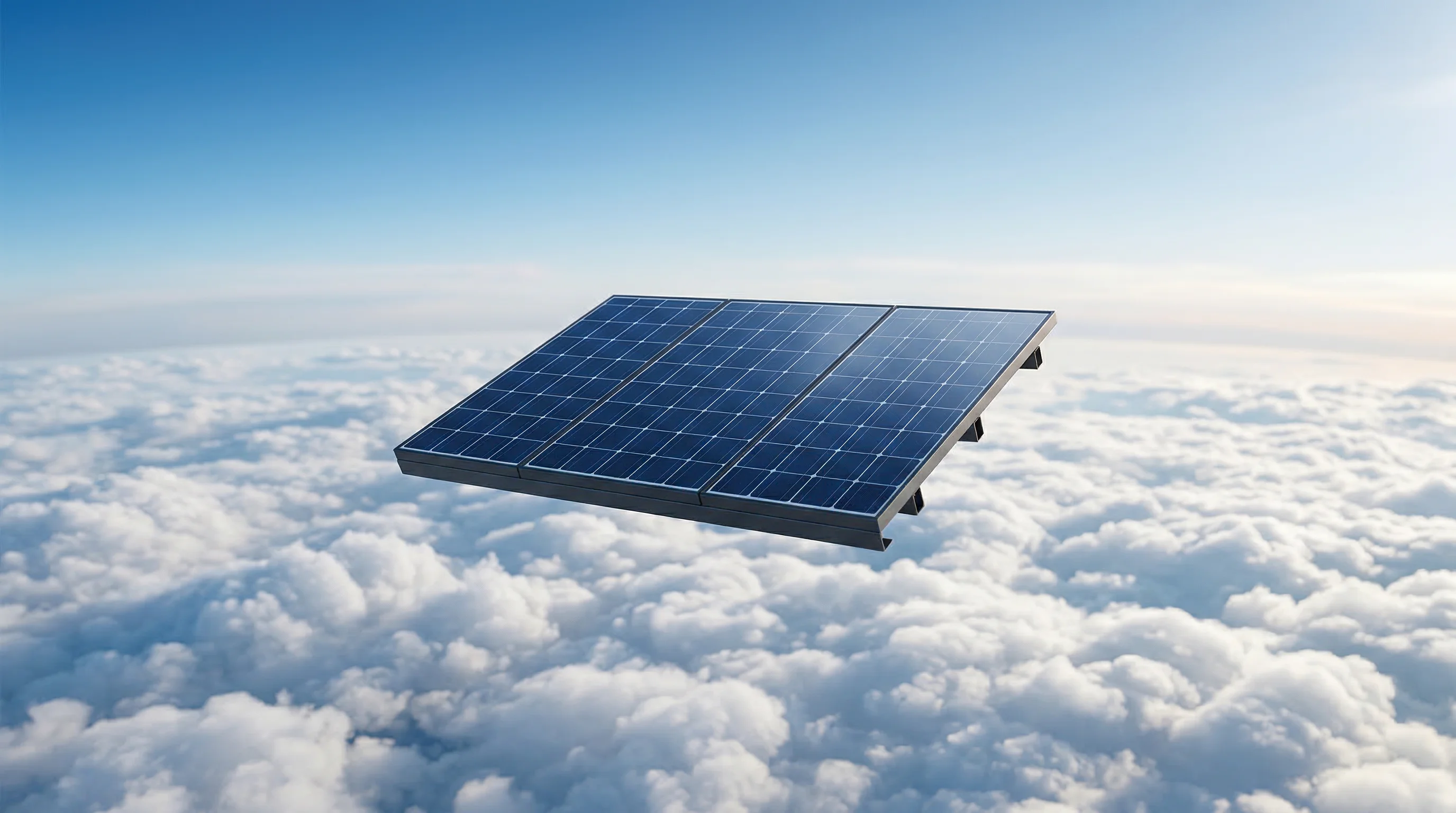
A parallel shift is quietly rewriting the economics of space solar cells. For years, multi-junction gallium arsenide cells dominated orbital applications because their 30-plus-percent efficiency justified the cost and limited supply. But silicon—the workhorse of rooftop solar arrays from Phoenix to Hamburg—is staging a comeback beyond Earth's atmosphere.
Solestial raised $17 million in Series A funding in May 2025 and is scaling a facility in Tempe, Arizona, to produce "self-curing" silicon heterojunction cells designed for space. The company secured a SpaceWERX award last July to demonstrate a 1-kilowatt wing buildable in a single month—a timeline that would have seemed faintly absurd for traditional III-V arrays. mPower Technology markets its DragonSCALES silicon modules explicitly for space-based solar power and constellation applications.
The trade-off is straightforward enough. III-V cells deliver peak performance but come with long lead times, high costs, and supply chain vulnerabilities that make procurement officers nervous. China's export controls on gallium and germanium, along with multiple analyses over the past year flagging the country's dominant market share and episodic price swings, have heightened these concerns. Silicon sacrifices a few percentage points of efficiency in exchange for terrestrial-scale manufacturing capacity and material abundance.
For applications like space-based solar power—where sheer collecting area matters more than squeezing every photon—that trade begins to make sense. For others, perhaps less so. The market is starting to split along these lines.
Flight Demonstrations Coming Fast
Several companies are converging on demonstrations slated for 2026 and 2027, creating something resembling a natural experiment in deployable architectures.
Aetherflux raised $50 million in Series A funding on April 2, 2025, and is targeting an end-to-end space-to-ground laser power demonstration before the year ends. Founder Baiju Bhatt envisions portable ground stations five to ten meters across receiving power beamed from low Earth orbit. The company is flying on an Apex bus, which at least removes spacecraft integration as a variable.
Araqys, part of the Dcubed group, has published a roadmap showing in-space 3D-printed array demonstrations across 2026 and 2027. Its D3 mission, scheduled for the first quarter of 2027, aims to demonstrate a 2-kilowatt array with integrated power beaming capability. Whether additive manufacturing in microgravity can achieve the precision and reliability required for power generation remains, to put it charitably, an open question.
Atomic-6 secured Air Force Research Laboratory SBIR Phase II funding last May for "pop-out redeployable arrays" with flight demonstrations in February 2026 and the first quarter of 2027. The company also holds a NASA STTR for vertical solar towers on the Moon—a concept designed to address terrain shadowing at the lunar south pole, where crater rims offer near-continuous sunlight while valleys plunge into weeks of darkness.
Japan's OHISAMA mission represents perhaps the most ambitious government-backed space-based solar power demonstration to date. In December 2024, Japan Space Systems demonstrated wireless power transmission at 5.8 gigahertz between ground and airborne platforms. The country has maintained roadmaps toward operational SBSP by the mid-to-late 2030s for years now, outlasting multiple waves of Western skepticism and budget cycles.
What Happens Next

By late next year, things should clarify considerably. Multiple in-orbit demonstrations will either validate these novel deployment concepts or expose unforeseen failure modes. The UK government released a feasibility study on February 19 concluding that space-based solar power could become competitive by around 2040 with appropriate policy support, including possible participation in Contracts for Difference mechanisms. It's a cautiously hedged projection, but notable for coming from a national government rather than a pitch deck.
Regulatory and supply chain realities will constrain how fast this market can actually scale. The FCC's five-year deorbit rule for LEO satellites—adopted in 2022 and fully effective for all new authorizations since late September 2024—adds lifecycle compliance burdens for very large structures. Laser power beaming remains subject to FAA oversight and ANSI safety standards. Microwave beaming demonstrations at 5.8 gigahertz still require ITU spectrum coordination for operational deployment.
The gallium and germanium supply chain deserves continued monitoring. Diversification efforts are underway, but they're lagging demand growth. If III-V cell production becomes a genuine bottleneck for high-performance arrays, silicon's resurgence accelerates by default rather than design.
The more fundamental question, though, is whether orbital power demand justifies the investment in the first place. Axiom Space secured up to $5.5 million from the Texas Space Commission in May 2025 for orbital data center capabilities. Lonestar Data Holdings launched a lunar data storage payload in February 2025. These are real programs with real funding, not speculative concept studies. Data centers consumed roughly 4 percent of U.S. electricity in 2023, with growth scenarios suggesting near-doubling by 2030 as AI workloads intensify. Rack power densities already range from 20 to 240 kilowatts. Moving some fraction of that compute to orbit—where radiative cooling and abundant solar energy coexist—starts to make a certain kind of economic sense.
It's still early. DARPA's POWER program set a wireless power beaming record last June, transmitting 800-plus watts across 5.3 miles via laser relays. Impressive work, but orders of magnitude short of gigawatt-scale visions. Caltech's SSPD-1 mission concluded its on-orbit demonstrations in 2024 with useful lessons but no clear path to commercialization.
What's different now is the convergence of launch cadence, capital availability, and demonstrated customer demand. Beyond Reach Labs targeting a late Q2 2027 demonstration isn't operating in isolation. It's part of a broader recognition that power—not launch capacity—may become the binding constraint on humanity's expansion beyond Earth. The companies that solve deployment at scale, whether through origami mathematics, in-space manufacturing, or geometries not yet publicly disclosed, will define the architecture of the next decade in orbit.
The inflection point won't arrive when the first gigawatt array unfurls in space. It'll come when the cost per kilowatt in orbit drops below the cost of building and cooling an equivalent data center on Earth. We're not there yet—not remotely close, in fact.
But for the first time, the engineering path forward looks less like science fiction and more like a tractable problem with known unknowns and addressable challenges. That shift, subtle as it may seem, changes the conversation. Someday becomes soon. And soon, in aerospace terms, means real money starts moving in earnest.


