

The pitch couldn't have been simpler. Four engineers walk into a Zurich innovation park with a plan to build Europe's first commercial rotating detonation rocket engine—no massive government contracts, no nine-figure war chest. Just 3.8 million euros in pre-seed funding and less than three months to prove it could be done.
By May 2026, Stellar Alpina had put Engine 0 through eight hot-fire tests, sustaining up to five stable detonation waves in a test rig they'd built themselves. The company claims the milestone made them the first commercial venture in Europe to successfully fire a rotating detonation rocket engine—a technology that promises to deliver smaller, lighter, and more efficient propulsion through supersonic combustion waves that would make a conventional rocket engineer wince.
If the timeline holds, it raises some uncomfortable questions for Europe's aerospace establishment. While German rocket startups have collected hundreds of millions in public grants and private capital over recent years, this lean Swiss team operating out of Innovation Park Zurich delivered a working prototype on roughly one-tenth the typical runway. Perhaps less.
The contrast is hard to ignore.
From Student Project to Startup
The four founders—Rick Röthlisberger, Simi Y. Wespi, Victor Elliesen, and Patrick Egli—sharpened their engineering teeth on ARIS, ETH Zurich's Academic Spaceflight Initiative. The student group's PERSEUS project ran on a shoestring budget of 1,000 Swiss francs and earned exactly zero academic credits. It was, in the founders' telling, pure technical obsession.
Wespi managed PERSEUS, coordinating tests with measurement technology from Kistler that helped validate the rotating detonation concept. Elliesen led ARIS before jumping to co-found Stellar Alpina. Röthlisberger brought systems experience from a stint at Rocket Factory Augsburg, one of the German launchers now burning through grant money at what one might call a very different pace.
Early in the process, the team faced a choice: keep tinkering in the academic sandbox or take the commercial leap. They chose the latter, incorporating Stellar Alpina AG with a mandate to build compact rotating detonation engines for in-space mobility—orbital transfers, cislunar logistics, servicing missions. The sorts of things that sound like science fiction until someone actually builds the hardware.
Then the clock started.
The 82-Day Sprint
Most deep-tech startups spend their first year assembling teams, securing permits, preparing pitch decks for investors. Stellar Alpina reportedly spent those 82 days building Engine 0 and the test infrastructure to fire it. The hot-fire campaign wasn't a publicity stunt. It was an engineering sprint compressed to what one might generously call controlled chaos.
Victor Elliesen laid out the timeline in a podcast interview. The message was blunt: speed matters, capital efficiency matters, execution beats PowerPoints.
The pre-seed round came from Founderful (formerly Wingman Ventures) and LP&E, a Swiss venture firm. At 3.5 million Swiss francs—roughly 3.8 million euros—it was enough to fund the next steps: expanding test infrastructure, running additional hot-fire campaigns, developing a flight-ready engine. Not lavish, but sufficient.
Thomas H. Zurbuchen, an ETH Zurich professor and former NASA Associate Administrator for Science, endorsed the effort publicly. Venture Kick, Switzerland's startup support program, awarded Stellar Alpina funding. The wheels, it seemed, were in motion.
The German Elephant in the Room

Germany has spent the past half-decade pouring public money into New Space ventures. Isar Aerospace, based in Munich, announced a 270 million euro Series D. That followed an 11 million euro DLR Microlauncher contract and a 10 million euro EIC Horizon Prize. Rocket Factory Augsburg secured 11 million euros from a similar DLR competition. Bavaria alone committed 250 million euros to aerospace funding in a single year.
The sums dwarf Stellar Alpina's raise by an order of magnitude. Yet the Swiss startup appears to have hit its first major technical milestone—commercial RDRE hot-fire—faster and leaner than peers working with vastly larger budgets.
It's not that the German startups are inefficient, exactly. Isar and RFA are building orbital launchers, a fundamentally different beast from in-space propulsion. The missions are different, the engineering challenges are different, the capital requirements are different. But the contrast remains stark: one ecosystem funds through generous public programs; the other forces startups to demonstrate proof-of-concept before unlocking significant capital.
Globally, the funding gap widens even further. Venus Aerospace, a Texas-based RDRE startup targeting hypersonic flight, has reportedly raised close to 90 million dollars in venture funding. Academic institutions like TU Darmstadt and DLR continue pushing RDRE research with public funds. Stellar Alpina, meanwhile, is running on less than 4 million euros.
Make of that what you will.
What These Engines Actually Do

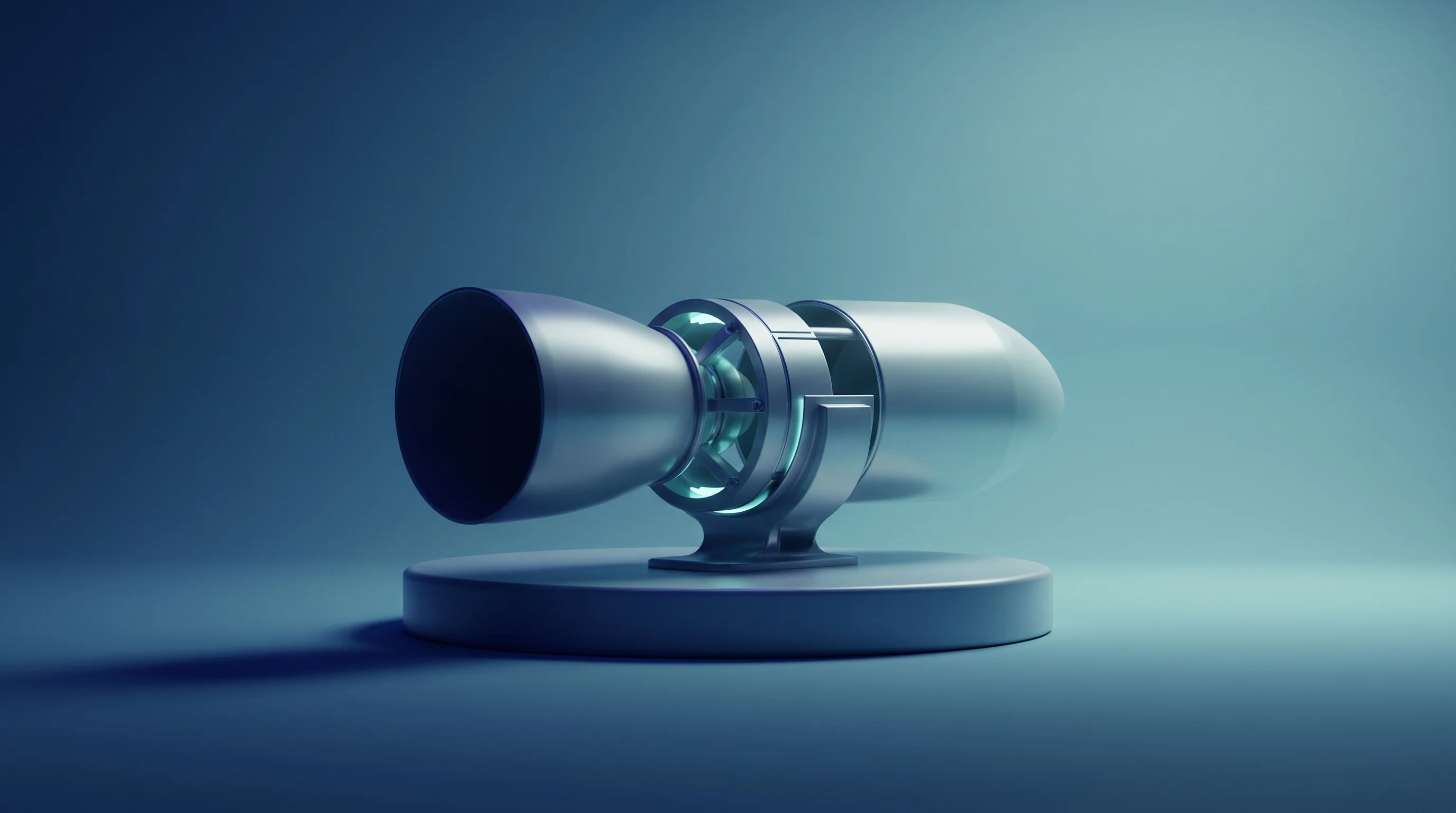
Rotating detonation engines replace conventional deflagration combustion with supersonic detonation waves that circle an annular chamber at thousands of meters per second. The pressure-gain process theoretically yields higher efficiency, smaller form factors, reduced weight—attractive properties for in-space vehicles where every kilogram extracted from the mass budget is a small victory.
The technology is notoriously difficult to tame. Sustaining stable detonation waves requires precise propellant injection, exacting chamber geometry, real-time monitoring that can react faster than human reflexes. Stellar Alpina's Engine 0 reportedly achieved up to five stable waves during its test campaign, a result the founders consider validation of their design approach.
The company's stated focus is in-space mobility: orbit-to-orbit transfers, cislunar logistics, satellite servicing. These missions demand high delta-v and reusability, both areas where RDREs could theoretically offer advantages over traditional chemical thrusters. Whether Stellar Alpina can scale from prototype to flight hardware remains, of course, the open question. Prototype to production is where most aerospace startups meet their fate.
The Swiss Deep Tech Wager
Switzerland ranks first globally for the share of venture capital flowing to deep tech—63 percent according to the Swiss Deep Tech Report 2026. The ecosystem is compact but punchy, with strong academic institutions, a longstanding culture of precision engineering, and investors apparently willing to back hard science even when the path to revenue isn't immediately obvious.
Stellar Alpina operates from Innovation Park Zurich, part of a network supported by Zürcher Kantonalbank. The location connects them to ETH Zurich, corporate partners, and a growing cluster of aerospace startups trying to carve out space in Europe's fragmented launch market. The team published an essay titled "Four Founders, No Throne," signaling their commitment to flat hierarchy and technical meritocracy. Whether that philosophy survives contact with scaling pressures is another question entirely.
Headcount remains modest—LinkedIn profiles suggest somewhere between two and ten employees—but the company has demonstrated an ability to execute with limited resources. The next phase involves scaling test operations, refining the flight engine, developing modular vehicle architectures for customer missions. Standard startup playbook, just with more fire and less margin for error.
What 3.8 Million Euros Buys
Capital efficiency is a double-edged sword, and Stellar Alpina's founders surely know it. They moved fast and proved the concept, yes. But building flight-ready hardware, securing launch contracts, and scaling production will require significantly more capital. The German launchers may burn through hundreds of millions, but they're also building factories, supply chains, regulatory frameworks—the unglamorous infrastructure that turns technology demonstrations into sustainable businesses.
Still, the Stellar Alpina story challenges some assumptions about how much money deep-tech startups actually need to hit early milestones. Eighty-two days from incorporation to hot-fire is a data point, not a universal playbook. But it's a data point that suggests Europe's aerospace future may not require billion-euro public funding programs to succeed. Or at least, not only those programs.
The four founders bet their reputations—and a few years of their lives—on the belief that lean, focused teams can compete with heavily-capitalized incumbents. Engine 0's test campaign suggests they might not be entirely delusional.
What happens next will determine whether that belief scales beyond the test stand. And whether the rest of Europe's aerospace industry is paying attention.


