

In a nondescript facility on Melbourne's outskirts, something unusual is happening inside rows of temperature-controlled racks. They're not running the usual suspects—GPUs, CPUs, the silicon workhorses of modern computing. Instead, these machines house living human neurons, cultured in dishes, connected to electrode arrays, learning to process information in ways that silicon cannot easily replicate.
It's the spring of 2026, and wetware computing—a term that once belonged to science fiction—has quietly entered commercial production.
The timing, perhaps, could not be more urgent. Data centers are devouring electricity at an alarming clip. Gartner projects the sector will consume 565 terawatt-hours this year, a 26% leap from 2025. AI-optimized servers alone are expected to account for 31% of that draw. In Ireland, data centers swallowed 23% of the nation's power grid in 2025. The International Energy Agency's 2025 figures show a 17% spike in data center electricity demand, with projections suggesting the sector could double its share of global power consumption before year's end.
Silicon's hunger has become a bottleneck. And the race for alternatives—neuromorphic chips, photonics, quantum systems—now includes an unexpected contender: biology itself.
A small cluster of startups and academic labs is betting that human neurons, grown in dishes and trained like tiny machine learning models, can outperform silicon on the metrics that increasingly matter: energy efficiency, learning speed, and eventually, raw compute power. It's a wager with profound implications, and more than a few ethical land mines.
Who's Building This, Exactly?
Four companies anchor the commercial push, each with a different angle on how to sell brain cells as infrastructure.
Cortical Labs, the Australian outfit behind that Melbourne data center, unveiled its CL1 device—a "code-deployable biological computer"—at Mobile World Congress Barcelona in March 2025. The pitch: "Wetware-as-a-Service." By last September, the company had assembled racks of CL1 units into something called Cortical Cloud, offering third-party developers API access to living neurons. It's an odd product category. But it exists.
In Switzerland, FinalSpark chose a different model. Its Neuroplatform, opened to remote users in 2024, provides API and Jupyter notebook interfaces to human brain organoid bioprocessors. By mid-2024, researchers had conducted experiments on more than 1,000 organoids, generating over 18 terabytes of data. The company was charging $500 a month for access as of August 2024, though whether that pricing still holds is anyone's guess.
The Biological Computing Co.—TBC for short—came out swinging in February with a $25 million seed round led by Primary Venture Partners. Founded by neurosurgeons Alex Ksendzovsky and Jon Pomeraniec, TBC claims to have integrated neuron-based computing into foundation models for computer vision, generative video, and AI infrastructure. The company says it has a paying customer. Independent verification? Not yet available.
Then there's Parasma, the newest entry. Backed by Y Combinator's Summer 2026 batch, the solo-founder startup published a research note in June claiming to have trained roughly 200,000 neurons—about the scale of a bee's brain—to play Doom. Founder Sean Cole is blunt about the mission: "We write the algorithms to turn brain cells into compute."
It's a small field, but it's moving fast.
Academic institutions provide the underlying scaffolding. Johns Hopkins University's Organoid Intelligence initiative, operating under the Applied Physics Laboratory's SURPASS cohort, has developed standardized platforms for stimulation, recording, and machine learning tasks. The National Science Foundation committed $14 million in August 2024 to seven projects under its BEGIN OI program, explicitly embedding ethics co-investigators in the research design—a nod to the thorny questions this work inevitably raises.
The Science Got Real, Fast
The scientific foundation was laid incrementally, then seemed to accelerate overnight. In December 2022, a paper in Neuron documented something called "DishBrain"—a culture of living neurons that learned to play Pong through a closed-loop feedback system. The work ignited debate over whether such systems exhibited anything approaching sentience. But the technical achievement was undeniable. These neurons learned goal-directed behavior faster than many deep reinforcement learning models.
A year later, Nature Electronics published work on "Brainoware," demonstrating that human brain organoids, connected in a reservoir computing architecture, could perform basic speech recognition and solve nonlinear equations. By May 2024, a preprint showed biological neurons rivaling deep RL algorithms in sample efficiency for Pong-like tasks. The trajectory from toy problems to commercial claims took less than four years—a blink in biotech terms.
The energy narrative accelerated in parallel. The IEA's 2025 special report on energy and AI established a baseline: data centers accounted for roughly 2.6% of global electricity demand, with projections that AI, data centers, and cryptocurrency could collectively double consumption by the end of this year. Gartner's June analysis underscored power availability as a binding constraint, not a distant concern. Hyperscaler emissions continued to climb even as efficiency improvements rolled out. The industry, it seemed, needed a paradigm shift.
Money followed the convergence of science and need. Cortical Labs secured $10 million from Horizons Ventures in April 2023, with additional investment from Gobi Partners announced in March of this year. TBC's $25 million seed drew from a roster including Builders VC, Refactor Capital, Wonder Ventures, and Tusk Ventures. Parasma's YC backing, while early-stage, signals institutional interest in the algorithmic layer beneath the hardware. The NSF's public investment, meanwhile, validated the technical pathway—even as ethical scrutiny intensified.
Commercial Infrastructure, Sort Of
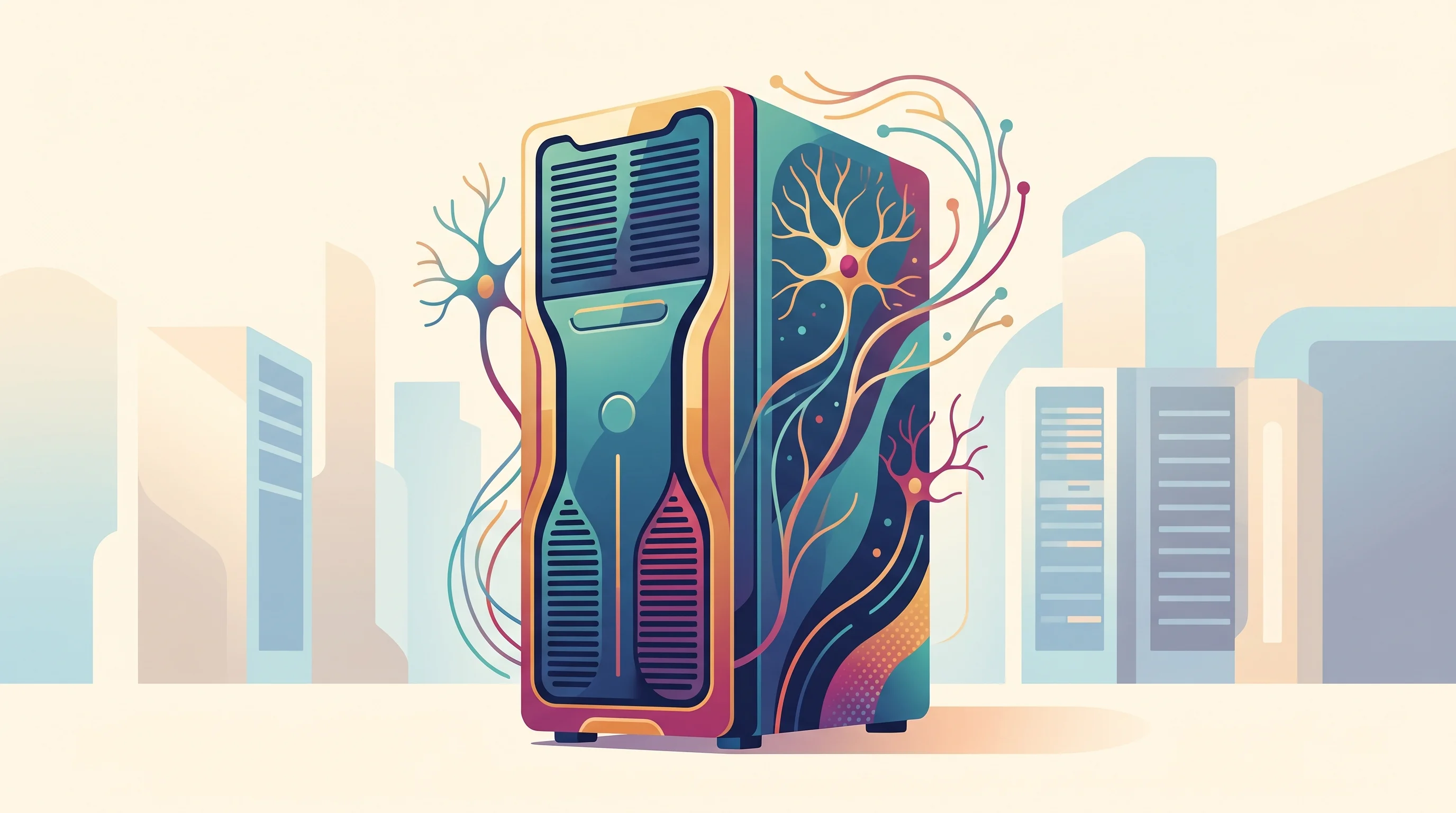
The shift from proof-of-concept to product has been uneven. But it's happening.
Cortical Labs' CL1 represents the most tangible commercialization to date: physical hardware, racks in a data center, customer demos of Doom running on cultured neurons. The company isn't positioning this as a full silicon replacement, at least not yet. CEO Hon Weng Chong has framed initial use cases around physical AI and robotics, emphasizing lower energy draw and faster learning than traditional approaches. "Synthetic Biological Intelligence," he calls it—a term that invites as many questions as it answers.
FinalSpark's model prioritized access over unit sales. The Neuroplatform's API-driven approach let researchers worldwide run experiments without building wet labs. The scale achieved—more than 1,000 organoids, over 18 terabytes of data—suggests early product-market fit for academic exploration. Whether that translates to commercial adoption at the reported $500-per-month price point, a figure now nearly two years old, remains unclear.
TBC's pitch leans into applied AI integration. The company claims to have connected neuron-based compute to foundation models for computer vision and generative video tasks, with at least one paying customer. Verification is sparse. The claim appears in press releases and investor blog posts but lacks independent benchmarking. If true, it would represent a leap from game-playing demos to production workloads. If.
Parasma's Doom experiment, detailed in a June research note, offers a window into the algorithmic layer. The system uses roughly 200,000 neurons interfaced with a "silicon critic" that scales feedback based on surprise—a reinforcement learning loop adapted for wet substrates. Stimulation involves biphasic, charge-balanced pulses at a few microamps and frequencies from a few hertz to around 100 Hz. Cole emphasizes ethical safeguards: no nociceptors, no self-model, no embodiment, and cultures orders of magnitude below thresholds for consciousness. The work has not yet undergone peer review, which is worth noting.
Infrastructure enablers have matured alongside the startups. High-density multi-electrode arrays from vendors like MaxWell Biosystems, 3Brain, and Axion BioSystems provide the input/output fidelity required for closed-loop training. Protocols for plating organoids, longitudinal recording, and API integration appeared in the scientific literature through 2025 and into this year, reducing the barrier to entry for new entrants. The ecosystem, in other words, is starting to look like an ecosystem.
The Ethics Problem Won't Go Away

The Nuffield Council on Bioethics published a governance framework for neural organoids in May, urging restraint in terminology—specifically, overuse of words like "sentience" and "organoid intelligence." The report critiques hype while acknowledging real ethical stakes as these systems grow in complexity. It's a measured document. But restraint in terminology doesn't make the underlying questions disappear.
Parasma's June ethics note confronts the issue directly. At 200,000 neurons, the company argues, cultures sit far below even invertebrate-scale nervous systems. The note details safeguards: no pain receptors, no interoception, no embodied experience, and deliberate architectural choices to avoid features associated with subjective awareness. "Our goal," Cole writes, "is to avoid creating conscious systems." The framework is proactive, certainly. But untested.
As cultures scale—and they will, if the commercial trajectory holds—those assurances will face scrutiny. What happens at 2 million neurons? Twenty million? The brain's complexity doesn't scale linearly, and neither do the ethical questions.
TBC's founders, both neurosurgeons, frame biological compute as complementary to silicon rather than a wholesale replacement. "Biology is the answer to the man-made compute crunch of the AI boom," they told Fortune in February. The framing sidesteps existential questions by positioning the technology as a tool in service of existing AI infrastructure. It's a rhetorically savvy move, though not everyone will find it satisfying.
Cortical Labs has been quieter on the ethics front, focusing public messaging on energy efficiency and learning speed. The 2022 DishBrain work sparked heated debate over whether neurons "playing Pong" constituted sentience. The company has since avoided the term, though the underlying questions persist, unanswered.
Academic voices range from cautious optimism to outright skepticism. A November 2025 STAT News piece quoted organoid scientists expressing concern over biocomputing backlash. Cold Spring Harbor's Tony Zador questioned whether organoid systems will ever achieve parity with silicon AI. Nature Reviews Bioengineering called for "mindful innovation" in a 2024 commentary, acknowledging opportunities while flagging reproducibility and standardization hurdles. Translation: proceed, but carefully.
Regulation, predictably, lags. The EU AI Act, passed in March 2024, has no explicit wetware compute category. Applicability likely flows through high-risk use cases, biometrics, or safety-critical applications—but it's interpretive, not explicit. The ISSCR Guidelines, updated in 2021 with a refresh last year, address organoids broadly but predate commercial biocomputing infrastructure. National Academies and NIH frameworks remain foundational, but they too were drafted before current commercial activity. In short: there are no clear rules yet.
What This Means for Founders (and Everyone Else)

Wetware computing is no longer purely speculative. It's infrastructure, venture-backed, and—at least in pilot form—commercially available. That doesn't mean it's ready for prime time, or even the late-night show.
Technical limitations remain severe. Current cultures sit orders of magnitude below animal brains in neuron count. Long-range integration, the kind that enables complex cognition, is absent. Organoids lack vascularization, limiting growth and lifespan. Reproducibility challenges plague the field. A January toolkit review in Nature Reviews Bioengineering highlighted ongoing struggles with standardization and data handling. The methods paper published earlier this year on goal-directed learning in cortical organoids underscores progress on protocols, but also the manual, finicky nature of the work. This is not plug-and-play technology.
Energy efficiency claims are plausible but unaudited. The brain's roughly 20-watt operating budget has long inspired neuromorphic and biohybrid computing. A February Harvard Science Review piece argues potential order-of-magnitude energy advantages if organoid intelligence scales. But scaling is an if, not a when, and current systems require life-support infrastructure—incubators, microfluidics, sensor arrays—that adds overhead. The energy story may be compelling. It's also incomplete.
Commercial readiness varies wildly. Cortical Labs appears furthest along, with physical units and data center deployments. FinalSpark has traction in academic access. TBC's claims of foundation model integration and paying customers, if verified, represent a leap. Parasma is pre-product, with algorithms and ethics frameworks but no commercial offering. Founders evaluating partnerships or integration should demand demos, SLAs, and independent benchmarks. Trust, but verify.
The investment landscape is heating up. TBC's $25 million seed is the largest disclosed round to date. Cortical Labs' funding rounds suggest sustained investor interest, though exact figures for the Gobi Partners investment announced in March remain undisclosed. YC's backing of Parasma signals belief in the algorithmic layer, perhaps independent of hardware commoditization. The NSF's $14 million BEGIN OI program provides public validation and de-risks academic collaboration. Money is flowing in. Whether returns will follow is another question.
Ethical and regulatory exposure is real. Even with safeguards, the optics of "brain cells playing video games" invite scrutiny—and not just from bioethicists. Founders in adjacent AI sectors should track how regulators respond to wetware computing as it scales. Companies building on these platforms inherit reputational risk alongside technical uncertainty. The Nuffield Council's May report offers a governance blueprint, but frameworks will evolve as the technology matures. Early adopters will, in effect, be guinea pigs.
Adjacent opportunities abound. Hardware suppliers like MaxWell Biosystems, 3Brain, and Axion are selling picks and shovels. Organoid production, microfluidics, bioreactors, and sensor integration represent infrastructure plays. Software layers—training algorithms, interface APIs, simulation tools—remain wide open. Koniku's neuron-silicon olfactory sensors, with an Airbus partnership announced back in 2020, hint at orthogonal applications in sensing rather than compute. The value chain is longer than it appears.
The next 18 months will clarify whether wetware computing is a niche research curiosity, a complement to silicon for specialized workloads, or the beginning of a paradigm shift. Data center operators watching power bills climb have reason to pay attention. AI infrastructure investors have reason to hedge. And founders in deep tech have reason to ask whether biology, not just silicon or quantum, belongs in their stack.
The cells are learning. Whether the ecosystem can scale faster than the hype cycle turns—and whether we should want it to—remains an open question.


