

The underwater internet, if you can call it that, still runs on sound waves that crawl through the ocean at roughly the speed of a chatty text message. That's the stubborn reality behind one of the more obscure corners of marine technology—and the challenge now facing Subatron, a three-person startup that just collected the final tranche of its early Swiss backing and is preparing to find out whether the offshore energy industry is ready for what it's selling.
On June 29, Zürich-based Subatron closed a CHF 150,000 convertible loan from Venture Kick, completing its early-stage capital raise. The money marks the end of a nine-month proving ground and the beginning of something harder: convincing an industry dominated by entrenched players—Teledyne, Kongsberg, EvoLogics—that a freshly incorporated Swiss operation has something worth buying. CEO Samira Baumann, alongside CTO Mathias Werder and chief business officer Alissa Wyss, incorporated the company in late April. Now comes the part where pilot deployments either validate the pitch or expose the gaps between laboratory specs and open-water physics.
The timing, at least, looks intentional. Offshore wind capacity is approaching 100 gigawatts globally, with more than 50 gigawatts under construction and installations expected to double annually starting in 2026, according to the Global Wind Energy Council's June report. Offshore oil and gas investment has topped $300 billion for two straight years. All of that infrastructure—subsea cables, pipelines, foundation structures—needs monitoring, inspection, and maintenance. Autonomous underwater vehicles are the obvious solution, but they require reliable data links in an environment where radio waves die within centimeters and fiber optics demand physical tethers that defeat the purpose of autonomy.
Which brings us back to sound.
The Acoustic Bottleneck
Underwater communication has been acoustic communication for decades, largely because nothing else propagates far enough to matter. Sound waves travel at roughly 1,500 meters per second through seawater—glacial by modern connectivity standards—and bandwidth is brutally constrained. Multipath interference from reflections off the seafloor, surface, and temperature gradients scrambles signals. The result is data rates measured in kilobits per second, not megabits, and ranges that rarely exceed a few kilometers without significant trade-offs. You can have distance or you can have bandwidth, but asking for both is asking physics to cooperate in ways it generally doesn't.
Market sizing for this industry depends heavily on definitions. IMARC Group estimates the broader underwater communication system market—hardware, software, services—at $4.9 billion in 2025. Future Market Insights projects growth from $3.42 billion last year to $8.87 billion by 2035, implying a 10 percent compound annual growth rate. Narrower estimates focusing strictly on acoustic communication run lower: BusinessMarketInsights pegs that segment at $2.59 billion in 2025, growing to $5.96 billion by 2033. The variance reflects what you're counting—acoustic-only versus full-stack systems, positioning versus data transmission—but the direction is consistent. Demand is accelerating.
The established players have carved out their territories. Teledyne Marine's Benthos line serves offshore energy and defense, with its BlueStreamX2 enhancement—announced in April 2025—doubling data rates across its ATM, CM, and UCM modem families. Kongsberg Maritime's cNODE modems, built around the CYMBAL protocol, deliver up to 6 kilobits per second for telemetry and positioning across ranges exceeding 10 kilometers. EvoLogics offers Sweep-Spread Carrier technology with support for NATO's JANUS standard and the industry's SWiG interoperability framework. Sonardyne—now part of Kraken Robotics following a consolidation that closed in late June—splits its portfolio between acoustic systems and its BlueComm optical line, which trades range (75 meters maximum) for bandwidth (2.5 to 10 megabits per second).
Optical systems like those from Hydromea promise fiber-like performance without the fiber, at least over short distances and in clear water. In March, Hydromea and Equinor demonstrated the first real-time wireless data transmission from the seabed directly to the cloud, achieving 10-megabit-class throughput via a LUMA hotspot linked into Equinor's DEEPNET infrastructure. It was a proof point. But optical links remain hostage to water clarity—turbidity, particles, dissolved organics all scatter light rapidly. For now, acoustic modems handle the bulk of long-range subsea connectivity.
Three Forces Converging
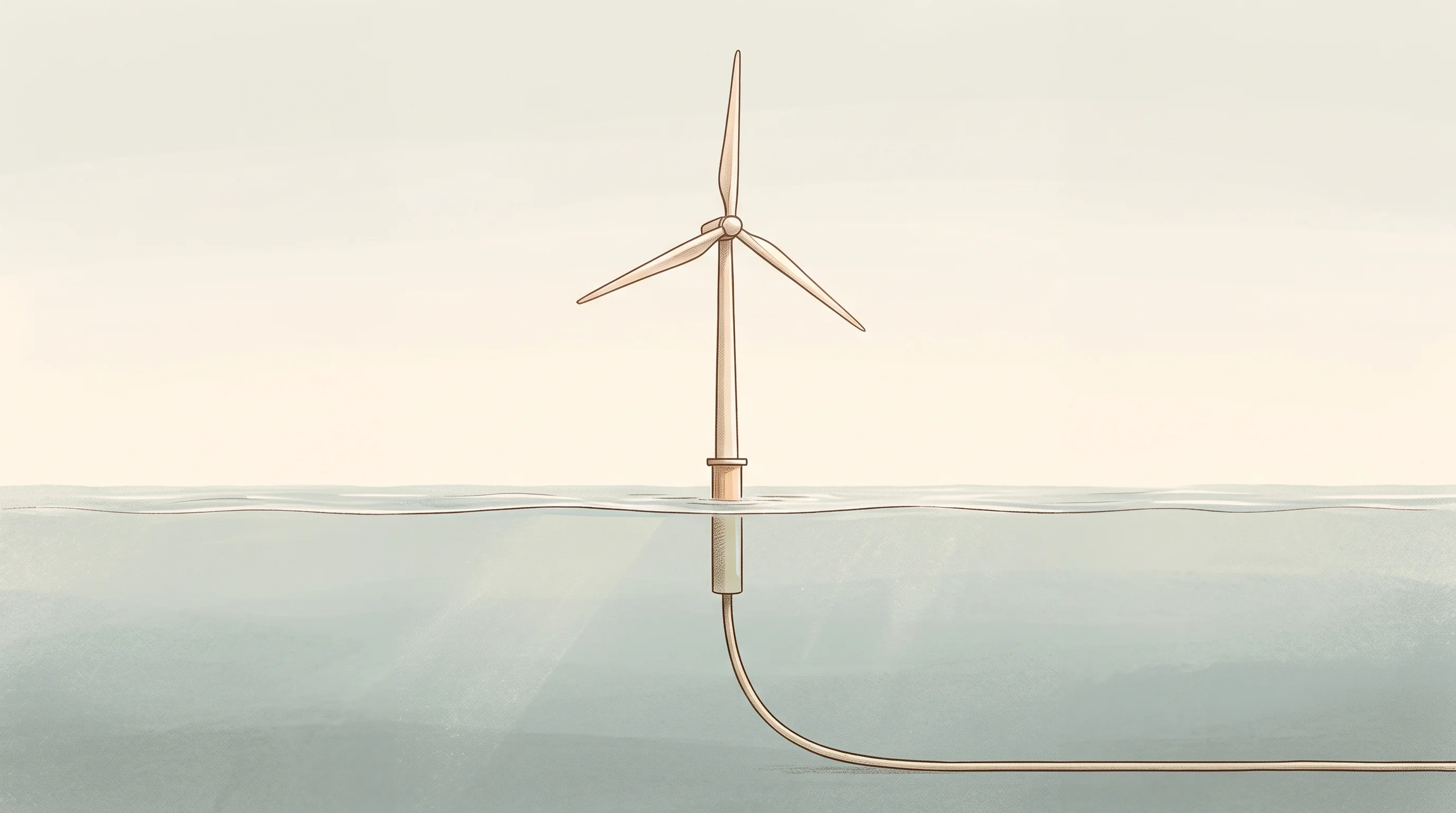
The market is being pushed beyond incremental improvement by three overlapping pressures. First, the offshore wind build-out is creating a distributed monitoring problem at scale. Wind farms require continuous surveillance of inter-array cables, foundation scour, turbine health—tasks increasingly assigned to autonomous underwater vehicles rather than crewed support vessels. Those AUVs need to phone home, ideally without surfacing every few hours to satellite-link their data.
Second, the oil and gas industry's shift toward subsea tie-backs and remote operations is intensifying demand for wireless sensor networks and real-time subsea-to-surface data paths. Westwood Global Energy Group forecasts roughly $90 billion in subsea equipment opportunities between now and 2030, with approximately 1,300 subsea trees in the pipeline. Each tree, each manifold, each piece of downhole instrumentation becomes a potential data node. Someone has to connect them.
Third, regulatory and policy momentum is converging around ocean digitalization. The European Commission's OceanEye initiative, formalized this year, aims to position the EU as a leader in ocean observation by 2035, with more than €92 million signaled across monitoring, data infrastructure, and startup support. The European Digital Twin Ocean project is already aggregating real-time oceanographic data from distributed sensor arrays, a workflow that presumes robust subsea connectivity. Meanwhile, classification societies like DNV have introduced governance frameworks for autonomous and remotely operated vessels—the AROS class notations, effective January 2025—that implicitly require reliable command-and-control links to uncrewed platforms.
Interoperability is emerging as both a technical necessity and a competitive wedge. NATO's JANUS standard, ratified in 2017, provides a baseline digital signaling protocol for discovery and handshaking between otherwise incompatible systems. The Subsea Wireless Group's SWiG standard, launched in 2022 and revised last year, extends that baseline for offshore energy use cases, defining common positioning and telemetry formats. At the WUWNet 2024 conference, vendors including Subnero, EvoLogics, WSENSE, and NORCE successfully demonstrated cross-vendor message decoding. A small step, perhaps more symbolic than transformative, but one that signals a maturing market willing to embrace open standards over proprietary lock-in.
What Subatron Is Promising
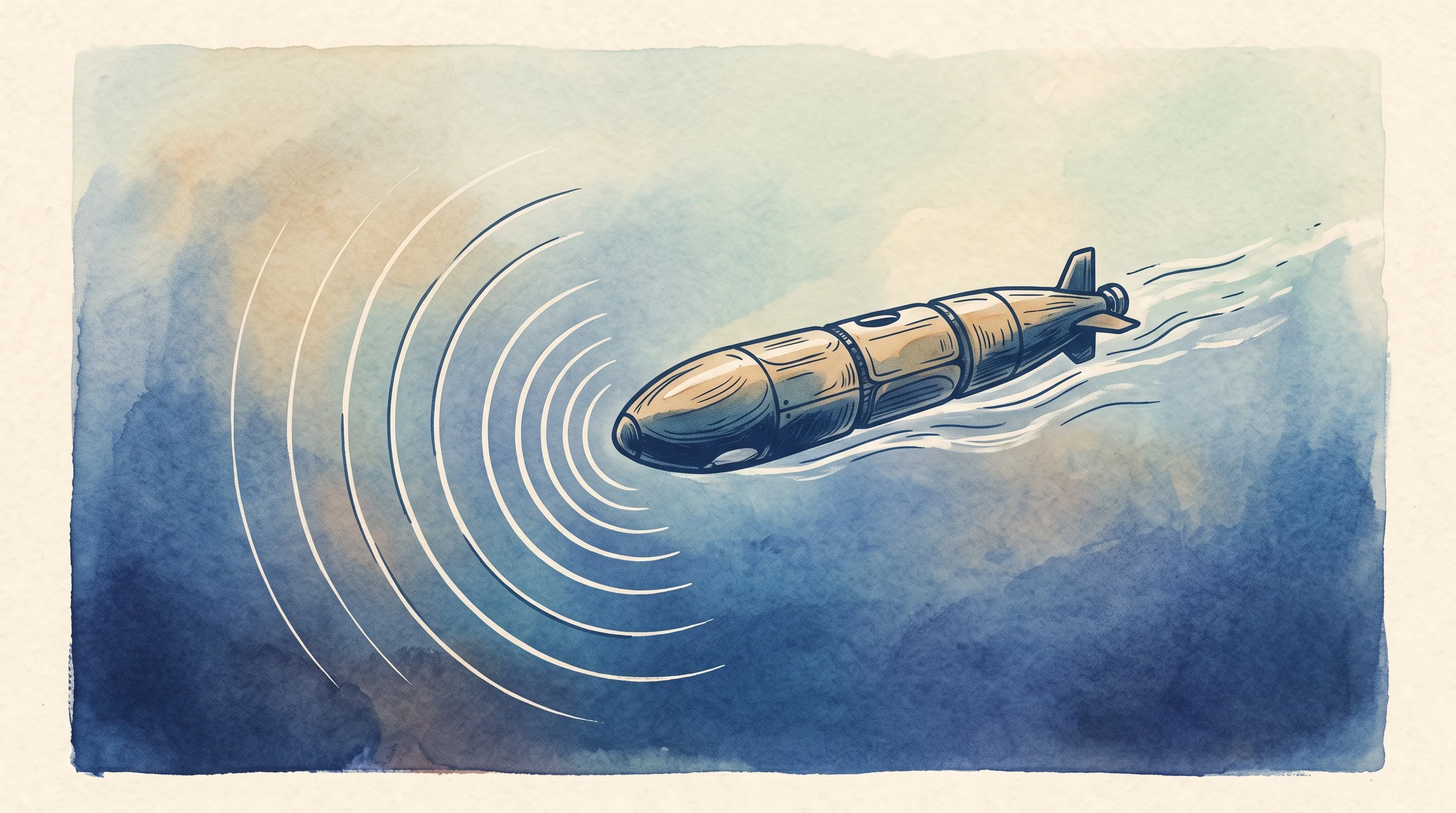
Subatron enters this landscape claiming a modular platform "built on patented transducer technology and optimized signal processing," with advertised performance of up to 2 kilometers range and 500 kilobits per second data rate. The company's website, live as of July, targets unmanned underwater vehicles, divers, sensor networks, and submarines—a broad aperture that reflects both ambition and the reality that early-stage startups rarely know which application will gain traction first.
The CHF 150,000 Stage 3 award, structured as a convertible loan, is earmarked for pilot deployments, industrialization, certification, and business development. Stage 3 winners also gain access to Venture Kick's Kickfund, which can provide up to CHF 850,000 in follow-on capital, and eligibility for the Gebert Rüf Stiftung's InnoBooster grant (up to CHF 150,000 additional). Combined, the funding envelope tops CHF 1 million—enough to reach early commercial traction if the technology delivers.
Whether Subatron's claimed specs hold up under real-world conditions is the open question. Acoustic communication performance is context-dependent—bathymetry, salinity gradients, shipping noise, biological activity all degrade link budgets in unpredictable ways. Manufacturer specifications often represent best-case scenarios under controlled test conditions. For comparison, Woods Hole Oceanographic Institution's Micro-Modem—a long-standing research and commercial reference platform—achieves roughly 1.6 kilobits per second using Phase-Shift Keying modulation at its "Rate 5" setting. Kongsberg's cNODE MiniS series delivers up to 6 kilobits per second for telemetry. Subatron's advertised 500 kilobits per second would represent a substantial leap if validated in operational deployments. The company has not published third-party benchmarks.
Elsewhere in the market, established players are iterating rapidly. Subnero unveiled a new generation of "smart" acoustic modems earlier this year, emphasizing software-defined flexibility and SWiG compliance. WSense showcased its multi-hop acoustic Internet of Underwater Things platform at Oceanology International in March, demonstrating real-time sensor data aggregation via a cloud backend. CSignum deployed its electromagnetic field signaling system at the Port of Horsens in Denmark last September, enabling continuous wireless water-quality monitoring for regulatory compliance—a use case that bypasses acoustic physics entirely by exploiting the relatively long propagation distance of low-frequency electromagnetic waves in shallow, conductive seawater.
The Kraken-Covelya transaction, which closed in late June, may prove the most consequential near-term development. Kraken Robotics acquired Sonardyne, EIVA, Forcys, Wavefront, Voyis, and Chelsea—a portfolio spanning acoustic and optical communication, ultra-short baseline positioning, synthetic aperture sonar, and subsea imaging. The consolidation concentrates capabilities across navigation, sensing, and data transmission under a single corporate umbrella, potentially accelerating integrated system development but also raising questions about vendor diversity and customer lock-in. When one company controls that much of the stack, the dynamics shift.
What Comes Next

The underwater communication market is transitioning from a niche corner of marine technology into critical infrastructure, though the timeline for that shift remains uncertain. As offshore wind installations accelerate—industry projections suggest reaching 50 gigawatts per year by 2035—the operational model will need to shift from periodic crewed inspections to continuous autonomous monitoring. That workflow depends on reliable, scalable subsea networks. The oil and gas industry's focus on subsea tie-backs and remote operations creates parallel demand, while digital twin initiatives and ocean observation mandates add policy tailwinds.
Technology diversification is likely, or at least inevitable. Acoustic systems will remain the workhorse for long-range, low-bandwidth applications, but hybrid architectures—acoustic for command-and-control, optical for high-resolution video and sonar data, electromagnetic for through-surface links—are gaining traction in multimodal platforms. Research published in the ITU Journal in March highlights AI-enhanced networking and semantic communication as emerging frontiers, where autonomous vehicles prioritize which data to transmit based on mission objectives rather than blindly streaming every sensor output. Whether that translates to commercial products or remains in the lab is another question.
Interoperability standards will either unlock the market or fragment it. JANUS and SWiG provide a baseline, but adoption is voluntary and implementation varies. If the offshore wind industry converges on common protocols—driven by operators managing multi-vendor fleets of AUVs across dozens of sites—startups with standards-compliant, modular platforms gain an edge. If proprietary ecosystems persist, established players with integrated hardware-software stacks maintain control.
Regulatory constraints are tightening, though perhaps not as quickly as environmental advocates would prefer. The International Maritime Organization's revised guidelines for underwater radiated noise, adopted in 2023 and implemented through 2024, reflect growing attention to acoustic pollution's impact on marine mammals. NOAA's 2024 Technical Guidance on acoustic thresholds for marine life sets auditory injury and temporary threshold shift limits that acoustic modem manufacturers must navigate in U.S. waters. The EU's Marine Strategy Framework Directive includes underwater noise as Descriptor 11, obligating member states to monitor and manage continuous and impulsive acoustic energy. These frameworks don't preclude acoustic communication—the energy levels involved are orders of magnitude below those from seismic surveys or pile driving—but they introduce certification and operational planning friction that adds cost and time.
For founders and investors, the opportunity is clear but the execution path is narrow. The market is expanding, demand appears validated, and incumbent technology leaves performance gaps. But subsea systems require deep domain expertise, long validation cycles, and customer relationships built over years of reliability demonstration. Subatron's journey from incorporation in April to pilot deployments will test whether a Swiss startup can compress that timeline—or whether the physics and economics of underwater communication favor those already in the water. Nine months of funding milestones is one thing. The next nine months, when customers have to decide whether the technology works and the price makes sense, will tell a different story.


