

Inside BMW's sprawling Spartanburg plant, Figure AI's humanoid robots spent 11 months in 2025 doing what humanoid robots are supposed to do—helping assemble cars. The company claims the robots contributed to the production of thirty thousand vehicles, declaring victory: bipedal machines had graduated from the research lab.
Yet here's what that milestone obscures. The robots moved. They didn't really understand what they were doing.
This gap—between impressive hardware and underwhelming intelligence—has become the defining puzzle of the humanoid robotics moment. And it's what a tiny San Francisco startup thinks it can solve, not by building better robots, but by teaching machines to feel their way through tasks the way humans do.
Intelligence Factory emerged from Y Combinator's Spring 2026 batch with five employees and a pitch that sounds almost suspiciously simple: strap instrumented gloves onto human workers, capture not just what they see and do but what they feel—pressure, texture, the give of materials under force—then retarget that embodied knowledge to any robot platform. Call it manipulation intelligence, distilled.
Whether that approach proves more than a clever hypothesis remains an open question. But the company's founding bet reflects a broader reckoning across robotics: the mechanical pieces are falling into place faster than anyone expected. The thinking part? That's another story.
A World Full of Robots, Just Not the Human-Shaped Kind
Step into a modern factory or warehouse and you'll encounter robots at nearly every turn. Just not the ones that look like people.
As of September 2024—a widely cited baseline from that period—the worldwide installed base of industrial robots stood at 4.28 million units, according to the International Federation of Robotics. North American orders climbed 6.6 percent in 2025 to 36,766 units worth $2.25 billion, with demand spreading beyond the traditional automotive stronghold into general industry. Collaborative robots—the so-called cobots designed to work alongside humans—captured 11.6 percent of first-quarter 2025 orders, significant enough that the Association for Advancing Automation began tracking them separately.
Humanoid robots represent a different proposition entirely. They're coming, advocates insist, though the installed base remains vanishingly small. ABI Research projects the global total at roughly 24,000 units in 2025, with a speculative jump to 248,000 by 2030—a compound annual growth rate somewhere between 45 and 138 percent depending how you slice it. Bank of America Institute sketches even more aggressive scenarios: 1.2 million units shipped by 2030, potentially 10 million by 2035.
These are projections built on early pilots and vendor promises, not established deployment patterns.
BMW's Spartanburg experiment with Figure AI made headlines, sure. But the automaker also announced a separate European pilot at its Leipzig plant with Hexagon Robotics, scheduled for summer 2026. Agility Robotics inked a commercial deal with Mercado Libre in December 2025 for its Digit robot. Apptronik—which raised $350 million in a Series A round in early 2025, with backing from Google and DeepMind, followed by additional funding that brought the total to roughly $403 million—has pilots running with Mercedes and logistics provider GXO. Tesla continues to talk up Optimus for internal factory use. Boston Dynamics is targeting commercialization of its Atlas robot around 2028, perhaps.
Notice a pattern? These are experiments, not scaled deployments. Warehouse automation order intake did grow seven percent in 2025, per Interact Analysis, but the parcel sector is averaging only six percent annual growth through 2030. Service robot sales increased nine percent year-over-year in 2024 to nearly 200,000 units, yet the vast majority are autonomous mobile robots and specialized machines, not humanoids.
The hardware exists. The intelligence to make it broadly useful does not.
Jensen Huang's Diagnosis
NVIDIA's CEO spent much of early 2026 hammering a single theme: "physical AI" represents the next frontier, and data is the hardest problem standing in the way.
At CES in January, Huang characterized it as the "ChatGPT moment for physical AI." By Computex in early June, he'd announced a humanoid reference design effort tied to NVIDIA's Isaac platform and Project GR00T, a foundation model for humanoid robots first unveiled in March 2024. His point, repeated in various forms: without rich, varied data capturing the full complexity of manipulation tasks, general-purpose robot intelligence remains elusive.
He's hardly alone in that assessment. The shift from narrowly programmed control systems to generalist policies—vision-language-action models that can adapt to novel scenarios—has progressed rapidly in academic labs but crawled in real-world deployment. Google DeepMind's RT-2, published in July 2023, demonstrated how to merge web-scale knowledge with robotic actions. The Octo generalist robot policy, released in May 2024, showed zero-shot transfer across different tasks. NVIDIA's GR00T aims for similar versatility. Skild AI, which hit a valuation north of $14 billion in January 2026, positions its foundation model as hardware-agnostic and deployable across varied embodiments.
Yet simulation and synthetic data only carry you so far, a reality that keeps reasserting itself. The "sim-to-real" gap—the difference between a policy that works in digital environments and one that handles messy physical reality—persists stubbornly. Scientific American noted in January 2026 that embodied AI still struggles with the long tail of real-world variation. IEEE Spectrum's Evan Ackerman argued last September that hype was outpacing robustness, a theme he returned to in April 2026: progress is steady, not exponential. Disappointing for those hoping otherwise.
Yash Sinha, Intelligence Factory's CEO, argues the missing ingredient is tactile and force feedback integrated tightly with vision. In LinkedIn posts from May 2026, he emphasized that current systems lack the "feel" humans unconsciously rely on when manipulating objects. The typical training loop—deploy a robot, collect edge-case failures, retrain, repeat—is slow and expensive. His company's instrumented gloves aim to compress months of iterative learning into hours of human demonstration, capturing rich multimodal data upfront.
Whether that proves more efficient than competing approaches is, for now, an empirical question without a clear answer.
The Race to Teach Robots to Feel
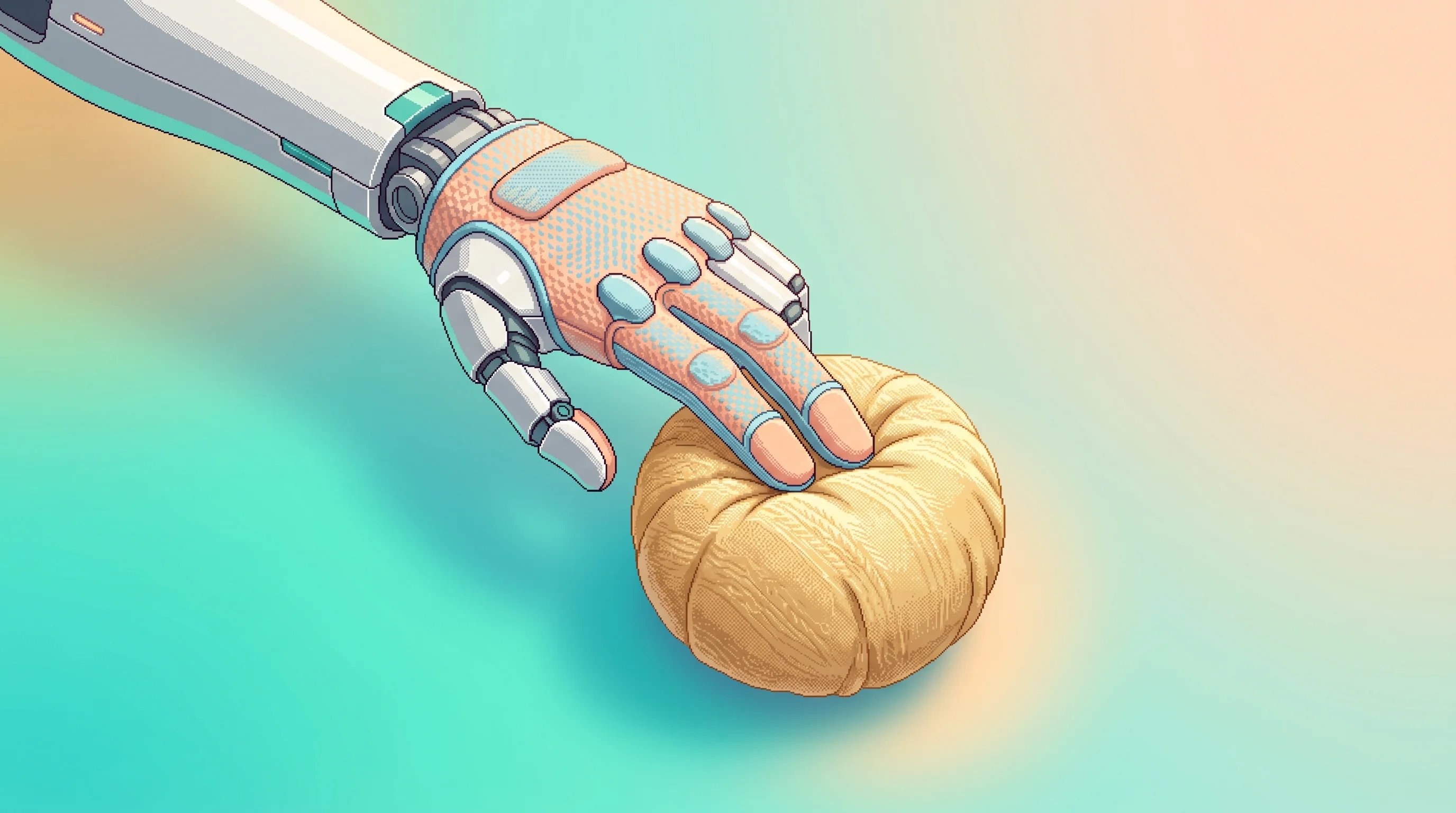
Intelligence Factory's approach aligns with emerging threads in robotics research. A May 2026 survey on multimodal tactile fusion for robot learning underscored the growing consensus that combining touch with vision and language matters. The OSMO tactile glove, showcased in December 2025, and DEXOP, a teleoperation framework highlighted at a Robotics: Science and Systems workshop in 2025, explore similar territory. Something of a convergence is happening: manipulation intelligence needs more than pixels.
Compare that philosophy to the current landscape of foundation models. Covariant launched RFM-1 in March 2024, billing it as "human-like reasoning" for warehouse robots, trained on text, images, video, actions, and sensor readings. It's deployed in picking and sorting applications today. Dexterity AI demonstrated truck-loading robots for FedEx at a 2026 investor day. Brightpick's Autopicker handles goods-to-person fulfillment for customers like NAPA and The Feed. These are specialized systems optimized for relatively controlled environments.
Skild AI and NVIDIA's GR00T aim broader. Skild Brain, with roots at Carnegie Mellon, positions itself as general-purpose software that works across different robot embodiments. GR00T, paired with Isaac Sim for synthetic data generation, offers a developer stack for humanoid locomotion and manipulation. Alphabet's Intrinsic, which integrated NVIDIA technology into its Flowstate platform, is navigating organizational changes within Google in 2026. All are chasing the same prize: a policy flexible enough to handle the variability of actual work rather than carefully scripted demonstrations.
Intelligence Factory's pitch is that human demonstrations—especially those rich with tactile data—shortcut the learning curve. Sinha and co-founder Jalaj Shukla, who brings manipulation and vision-language-action expertise from stints at Dimensional, Blue Sky Robotics, and Applied Materials, argue their "data factories" produce richer training signals than vision alone or pure simulation. They claim early deployments in warehouses, grocery stores, and data centers, though no customer names appear on public-facing materials as of early June 2026. The company, still hiring with one founding engineer role posted, has not disclosed funding details beyond its YC backing.
The Obstacles That Aren't Purely Technical
The path toward scaled humanoid deployment is cluttered with constraints that have little to do with AI sophistication.
McKinsey flagged supply-chain bottlenecks in April 2026—shortages in actuators, strain-wave gears, and motor drives. Current humanoid bills of materials run anywhere from $30,000 to $150,000 per unit; analysts say costs need to drop more than 50 percent to reach mass-market viability. TrendForce projects China's humanoid output will grow 94 percent in 2026, with Unitree and AgiBot commanding roughly 80 percent of the local market. Western manufacturers face different cost structures and regulatory terrain, neither of which favor rapid scaling.
Speaking of regulation. The EU AI Act, finalized in 2024 and phasing in through 2025 and 2026, classifies AI used as a safety component of regulated products as "high-risk." In May 2026, the European Commission opened draft guidance for public consultation, with ongoing consultations continuing to shape implementation. Industrial robots in the EU must align with updated ISO standards—ISO 10218-1 and 10218-2, both revised in 2025 editions—and collaborative systems reference ISO/TS 15066. In the U.S., OSHA points to ANSI/RIA standards like R15.06 and R15.08 for industrial mobile robots. Any startup selling general-purpose intelligence into these environments must navigate certification frameworks designed for narrower, more deterministic systems.
That's not a trivial challenge. It's one reason why pilots proliferate but production deployments remain scarce.
The deeper question is whether the industry's prevailing narrative—that hardware is converging while intelligence lags—fully captures the dynamics at play. Barclays, cited in trade press from January 2026, called 2026 pivotal for humanoids moving from labs to factories, driven by labor shortages and maturing AI capabilities. ABI Research expects steep growth but from a tiny base, concentrated mostly in logistics and industrial assistance rather than open-world general tasks. McKinsey's April 2026 analysis suggested near-term wins will come where safety, ROI, and integration paths are crystal clear. Scaling depends on component supply, certification processes, and deployment tooling as much as model performance.
What Comes Next
What Intelligence Factory and peers like Skild, Covariant, and NVIDIA are betting on—perhaps more than the founders themselves fully realize—is that once the intelligence layer matures, it unlocks latent value across the installed base. Not just in new humanoids but in the millions of existing industrial robots and autonomous mobile robots that could benefit from more flexible, adaptive control.
Sinha frames his company's work as closing the "deployment gap," the space between impressive demos and economically viable products. The real test, though, is whether human-demonstrated tactile learning generalizes better and faster than competing approaches. And whether customers waiting for robots that can think something closer to the way humans think will actually pay for that capability before the hype cycle inevitably shifts its gaze elsewhere.
For now, the robots move. Getting them to truly understand what they're doing? That remains the harder problem.


