

Walk into a cutting-edge life sciences lab and you'll encounter a peculiar paradox. The researcher designing algorithms to predict how proteins fold—work that once seemed impossibly futuristic—still has to write vendor-specific code to command the liquid handler within arm's reach. The pipette robot runs on Python. The plate reader wants XML, its own peculiar dialect. That centrifuge over there? Proprietary syntax, naturally.
It's a modern Tower of Babel, and it's choking the dream of truly autonomous laboratories before that dream can take its first real breath.
Which helps explain why 2026 turned into something of a free-for-all. YC-backed Infera surfaced from stealth this spring with an audacious promise: describe your experiment in plain English, and the platform handles everything—protocol logic, vendor translations, data routing, institutional memory, the works. They're hardly alone in this particular land rush. Benchling rolled out a hardware-agnostic closed-loop system in May. Ginkgo Bioworks introduced an AI agent called EstiMate back in March. Opentrons and HighRes demonstrated agent-to-agent workflows at the SLAS conference in February. Days before that, Biosero added assistive intelligence to its Green Button Go orchestrator.
The stakes go beyond which company builds the slickest natural language interface. What's really being contested is control over the laboratory's operating system itself.
A Market Caught Between Hardware and Intelligence
The numbers tell a story of steady, if unspectacular, growth. The global lab automation market reached $8.27 billion in 2024, with projections suggesting it could hit $18.39 billion by 2033—a 9.3% compound annual growth rate, according to Grand View Research. U.S. estimates vary depending on methodology; IMARC puts 2025 at $3.08 billion with a more modest 5.71% CAGR through 2034.
Respectable enough for robotic arms and liquid handlers. But these figures mask something messier underneath: most laboratories remain stubbornly manual because the programming barrier sits too high. The supposedly "automated" facilities? Often just single-vendor stacks that can't pivot to new protocols without bringing in engineering help.
Derek Halliday runs product at Benchling. When his company launched Benchling Automation in May, he didn't mince words: "Closed-loop labs are easy to demo but hard to run in production… real labs run instruments and software from a dozen different manufacturers." That fragmentation has forced an uncomfortable choice—keep the bench manual so you can adapt quickly, or commit to a workcell that does one thing brilliantly but can't accommodate next month's experiment.
Natural language processing promises an escape route. At least in theory. The vision is seductive: describe what you want in conversational English, and software translates that into Hamilton liquid handler commands, Opentrons Python scripts, SiLA 2 instrument calls—all while validating safety constraints and maintaining an audit trail suitable for regulatory scrutiny. You've effectively abstracted the vendor layer away.
McKinsey reported in April that roughly half of surveyed U.S. healthcare organization leaders claim to have implemented generative AI, with over 80% deploying initial use cases to end users. But Gartner's Hype Cycle for Agentic AI, published the same month, found only 17% of organizations have actually deployed AI agents specifically—a narrower category than generative AI broadly—though more than 60% expect to within two years. That's a significant gap between pilot projects and production systems. And nowhere is it wider than in regulated environments where probabilistic language models meet the unforgiving determinism of laboratory protocols.
Why Now, Exactly
Three forces converged to make 2026 the inflection year. Perhaps the most obvious: large language models matured enough to parse complex scientific protocols with something approaching reliability. A paper in ScienceDirect, published in April, reported 99% success rates translating natural language to multi-robot instructions in tested workflows. (Whether those test conditions mirror real-world complexity is another question.)
Second, hardware vendors started exposing standardized APIs and control interfaces. The SiLA 2 consortium launched an AI working group this year. Companies like QPillars are building MCP (Model Context Protocol) servers that expose instrument capabilities as discoverable tools for AI systems.
Third, the regulatory landscape shifted from openly hostile to... well, cautiously uncertain. The EU AI Act's general application begins August 2, 2026, with phased enforcement for high-risk applications. FDA's existing 21 CFR Part 11—covering electronic records and signatures—is relevant for electronic records, though it doesn't explicitly address AI-generated protocols. FDA's existing GLP requirements (21 CFR Part 58) apply to many regulated lab contexts, but neither addresses autonomous AI agents directly. ISPE's GAMP 5 Second Edition, published in 2022 and still current, offers risk-based validation guidance. But labs deploying agentic systems in GMP contexts are essentially writing the compliance playbook as they go.
Jason Kelly has been shouting about this for a while. The Ginkgo Bioworks CEO talks about the laboratory's "Waymo moment"—that shift from fixed-route automation (think self-driving buses on defined tracks) to variable autonomous navigation (cars that can handle any street). In a February essay for GEN News, Kelly sketched six levels of laboratory autonomy, positioning natural language as "the big unlock" that lets scientists brief robotic infrastructure the way they'd brief a graduate student.
Ginkgo's March launch of its Cloud Lab and EstiMate agent backs up Kelly's evangelism with actual product. EstiMate evaluates natural language protocol descriptions for compatibility and pricing across a fleet of more than 70 instruments. It's Kelly's bet that the interface problem is finally solvable.
The underlying technology stack remains messy but is starting to coalesce. Most systems follow a similar pipeline: natural language input flows through disambiguation prompts (clarifying ambiguous instructions), validation checks (safety limits, equipment constraints, temporal and spatial logic), simulation (catching dead ends before execution), and finally export or direct execution. Infera describes this as "one system from intent to execution." Biosero's assistive AI in Green Button Go learns from previous workflows to suggest scheduling optimizations.
At SLAS 2026, Opentrons and HighRes showcased an agent-to-agent architecture where OpentronsAI—equipped with an MCP server—translated a qPCR request from HighRes's Cellario orchestration agent into physical robot actions. Benchling Automation, available as of the May 28 press release, integrates over 200 instruments through file-based and API connections, with Python-based custom steps for edge cases.
Divergent Strategies, Shared Ambitions

The approaches vary considerably. Infera—founded this year by Chloe Sow and Troy Zhang, based in San Francisco—positions itself as "an operating system for your laboratory." Their pitch emphasizes upfront protocol validation, catching temporal conflicts, spatial impossibilities, and equipment limit violations before any robot moves. They export to open formats like LabOP and Autoprotocol rather than locking users into proprietary runtimes. The company is running early-access pilots and says direct integrations with Hamilton and Opentrons platforms are in progress, though specific customer names and funding details beyond the YC batch affiliation remain undisclosed.
Benchling took a different route with its late May launch: build the orchestration layer, let the ecosystem plug in. Partners at announcement included HighRes, Automata, Ginkgo, Celltrio, Opentrons, and Hamilton—essentially a who's-who of workcells, liquid handlers, and autonomous lab operators. The calculation here is that the natural language parser will commoditize eventually, but the real value sits in the closed-loop data infrastructure tying together electronic lab notebooks, LIMS, instruments, and analytics into a single audit trail. Benchling already manages R&D data for hundreds of biopharma companies; adding automation as a native layer makes the system considerably stickier.
Ginkgo's EstiMate represents a third model: cloud lab as a service. Describe the experiment in natural language, and Ginkgo's robotic fleet executes it remotely. The March 2 launch announced compatibility checks and pricing estimates—turning protocol feasibility into an API call. If you're a small biotech without capital to build an automated lab, renting time on Ginkgo's RACs (robotic autonomous clusters) and interfacing via natural language looks like infrastructure-as-a-service for biology.
Opentrons and HighRes pushed furthest in demonstrating agent-to-agent communication. Their February 4 announcement and SLAS 2026 demo showed natural language input flowing from a scientist to HighRes's Cellario planning agent, which then coordinated with OpentronsAI to generate and execute a qPCR protocol on Opentrons hardware. James Atwood, Opentrons CEO, framed it as "AI-driven intent translated directly into reliable, physical execution at the bench." Ira Hoffman, HighRes CEO, emphasized democratization and access. The system uses MCP servers to expose capabilities, which means—in principle—other agents could swap in as orchestrators or executors. Interoperability remains more aspiration than reality, though.
Even vendors known for proprietary stacks are hedging. Beckman Coulter Life Sciences announced a partnership with Automata on January 29, with Danaher Ventures (Beckman's parent) joining Automata's Series C round. Automata's LINQ platform, described as "AI-ready" and cloud-native, suggests Danaher sees where this is heading: labs want vendor-agnostic orchestration, not walled gardens.
The Optimistic Case—and Its Darker Alternative

The hopeful scenario goes like this: natural language interfaces collapse the expertise barrier. Protocol authoring becomes conversational rather than computational. A graduate student describes an assay in everyday English. The system validates it against institutional knowledge and safety rules, simulates it to catch flaws, then executes it across whatever instrument mix the lab happens to own. Throughput increases, error rates drop, junior scientists spend less time debugging robot scripts and more time interpreting results.
The broader AI in drug discovery market—$2.35 billion in 2025, projected to reach $13.77 billion by 2033 at a 24.8% CAGR according to a January Grand View Research report—would accelerate as labs move from data analysis AI to experimental execution AI.
The pessimistic scenario involves high-profile failures that set the field back years. Large language models are fundamentally stochastic; they generate different outputs for the same input. Laboratory protocols are deterministic; a misplaced decimal or swapped reagent order can destroy weeks of work. Or worse, create genuine safety hazards.
Papers published this spring in npj Computational Materials and Digital Discovery emphasize the need for "guardrails, simulation, and human approval gates" precisely because LLMs can confidently suggest absolute nonsense. Dotmatics, which launched its Luma Agent on May 13, explicitly built in full audit trails and pre-change approvals. The company cited a Gartner prediction that many agentic AI projects will fail governance checks through 2027 unless traceability is demonstrable.
Regulation looms—though how it looms exactly remains somewhat unclear. The EU AI Act's general application starts August 2, with high-risk system deadlines extending into 2027–2028 depending on application. FDA's 21 CFR Part 11 and GLP requirements (21 CFR Part 58) apply to many regulated lab contexts, but neither addresses autonomous AI agents directly. ISPE's GAMP 5 Second Edition, published in 2022 and still current, offers risk-based validation guidance. But labs deploying agentic systems in GMP contexts are essentially writing the compliance playbook as they go.
A Cloud Security Alliance report from April outlines governance patterns for agent-to-tool protocols—audit logs, human-in-the-loop gates, rollback mechanisms—that map reasonably well onto laboratory needs. Regulatory bodies haven't issued formal guidance yet, though.
Standards, Skills, and What Comes Next
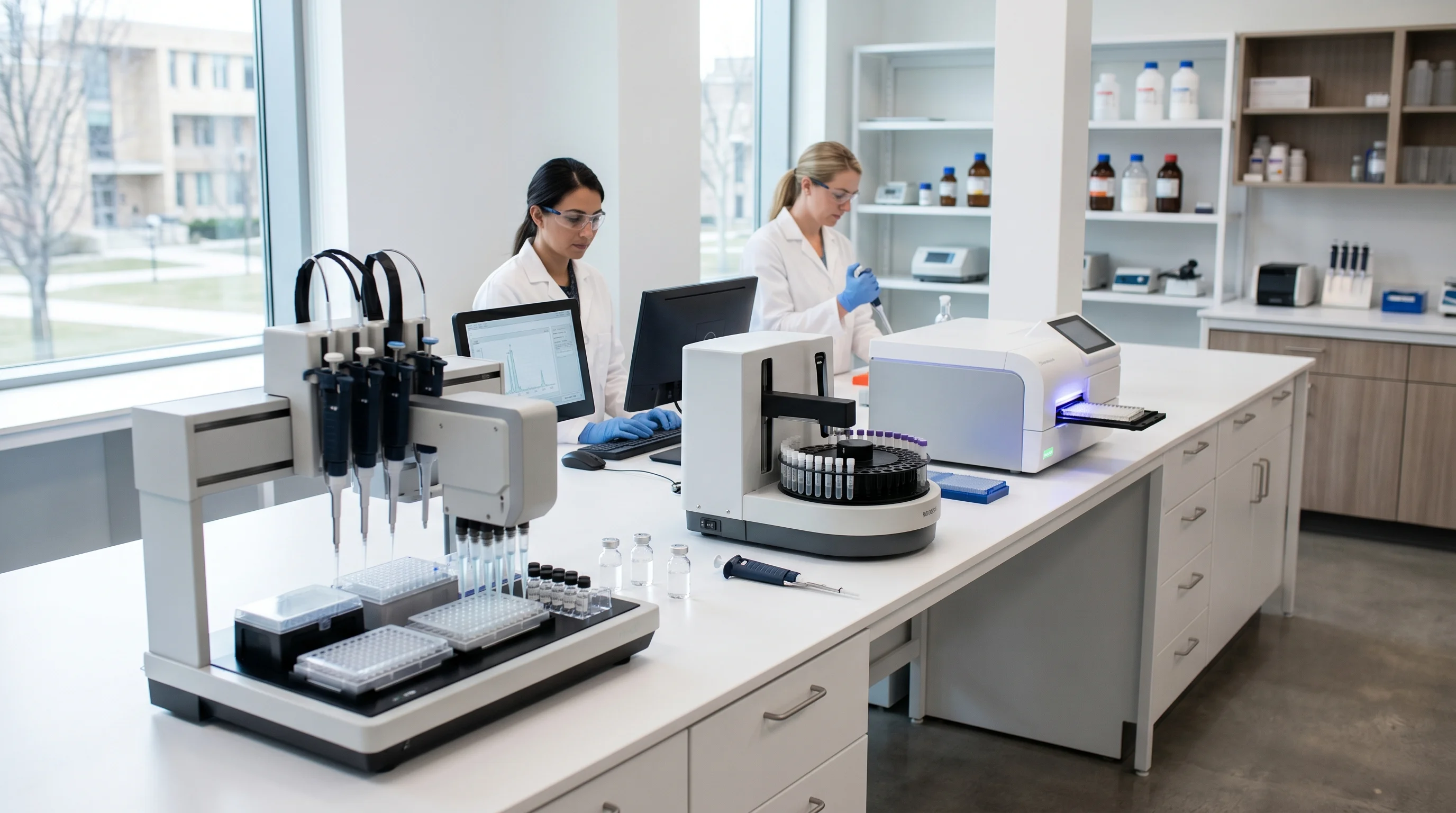
The standards question remains frustratingly open. SiLA 2 is the most mature instrument communication protocol, with a growing library of feature definitions and that new AI working group. LabOP and Autoprotocol provide domain-specific languages for protocol representation. MCP servers, popularized by Anthropic, offer a lightweight way to expose tool capabilities to language models.
But no single standard dominates, and interoperability is patchy at best. Infera's claim to "output to open formats" and Benchling's 200-plus instrument integrations suggest a pragmatic middle path: support everything, hide the complexity behind the API. Whether that scales or fragments further depends on how vendors play the next 18 months.
Workforce implications deserve more attention than they're getting. The Society for Laboratory Automation and Screening received a Sloan Foundation grant in January to develop educational guidelines for lab automation—a signal that the talent pipeline hasn't caught up to the technology. If natural language interfaces truly abstract away the programming barrier, the skill profile for lab staff shifts. Less "can you code" and more "can you reason about protocols and catch AI mistakes." That's different expertise. Perhaps more critical. Certainly harder to train.
The battle over controlling lab instruments with natural language isn't really about syntax, of course. It's about who defines the abstraction layer between scientific intent and physical execution—and whether that layer remains open or becomes a walled garden. Infera, Benchling, Ginkgo, Opentrons, Biosero, and a dozen startups you haven't heard of yet are betting that labs will pay handsomely for the system that makes robots feel like colleagues rather than cryptic machines.
The market will decide. But the timeline is compressed. KPMG's May Global Tech Report noted that 44% of life sciences organizations report limited maturity in scaling AI and automation—which means there's a land grab happening among the 56% who are ready to move.
The vendors who solve for compliance, interoperability, and trust—not just impressive demos—will own the next decade of laboratory infrastructure. That much seems certain. Who those vendors are? Ask again in a year.


