

The welder you need doesn't exist. At least not in sufficient numbers to matter.
America employs roughly 771,000 welders today, according to the American Welding Society. By 2029—a little more than three years from now—the industry will need an additional 320,500 professionals just to stay even with retirements and rising demand. Call it what you want: a skills gap, a workforce shortage, a demographic cliff. Julian Fried, who spent years as a welding foreman in Eastern Pennsylvania before co-founding a robotics startup, has a blunter assessment. "It's a chasm," he says.
Into that void, a wave of startups is deploying machine vision, AI models, and robotic arms that learn from every bead they lay. Advanced Metal Research—Fried's three-person team, fresh out of Y Combinator's Spring 2026 batch—frames the problem differently than most. Not as a headcount issue, but as a learning bottleneck. Their Los Angeles operation builds American-made robotic welding cells equipped with computer vision for real-time seam tracking and post-weld inspection. The pitch, per their YC profile, is audacious: scale welding knowledge itself. Cells that learn from every weld.
Whether that vision materializes remains to be seen. But the urgency behind it is undeniable.
A Market Under Pressure
The numbers tell a stark story, though perhaps not the one you'd expect. The AWS Welding Digest estimated last October that over 157,000 welders are nearing retirement. Meanwhile, shipbuilding alone faces its own reckoning: on January 13, 2026, the Secretary of the Navy announced that the industry must hire 250,000 workers over the next decade to support the "Golden Fleet" expansion—a term that sounds aspirational until you consider the current state of U.S. naval shipyards. Infrastructure projects, data center construction, semiconductor fabs—all are pulling from the same depleted talent pool.
Globally, the robotic welding market reached approximately $8.1 billion in 2025, with projections climbing toward $27.9 billion by 2034, according to Fortune Business Insights. In North America, the first quarter of 2026 saw 9,055 robot orders totaling $543 million. Collaborative robots—cobots, in industry parlance—now represent 18.1% of units sold, a share that's been climbing steadily.
What's changed isn't just the scale of the shortage. It's the convergence of labor scarcity with technological capability—machine learning mature enough to handle the variability of real-world welds, vision systems robust enough to work through arc flash and spatter. Deloitte's 2026 Manufacturing Industry Outlook, published last December, highlighted persistent skilled labor constraints even as AI acceleration continues. Competition from mega-projects concentrates demand for skilled trades, making automation less of a cost play and more of a survival strategy. You automate or you don't ship.
Three Forces Reshaping the Landscape
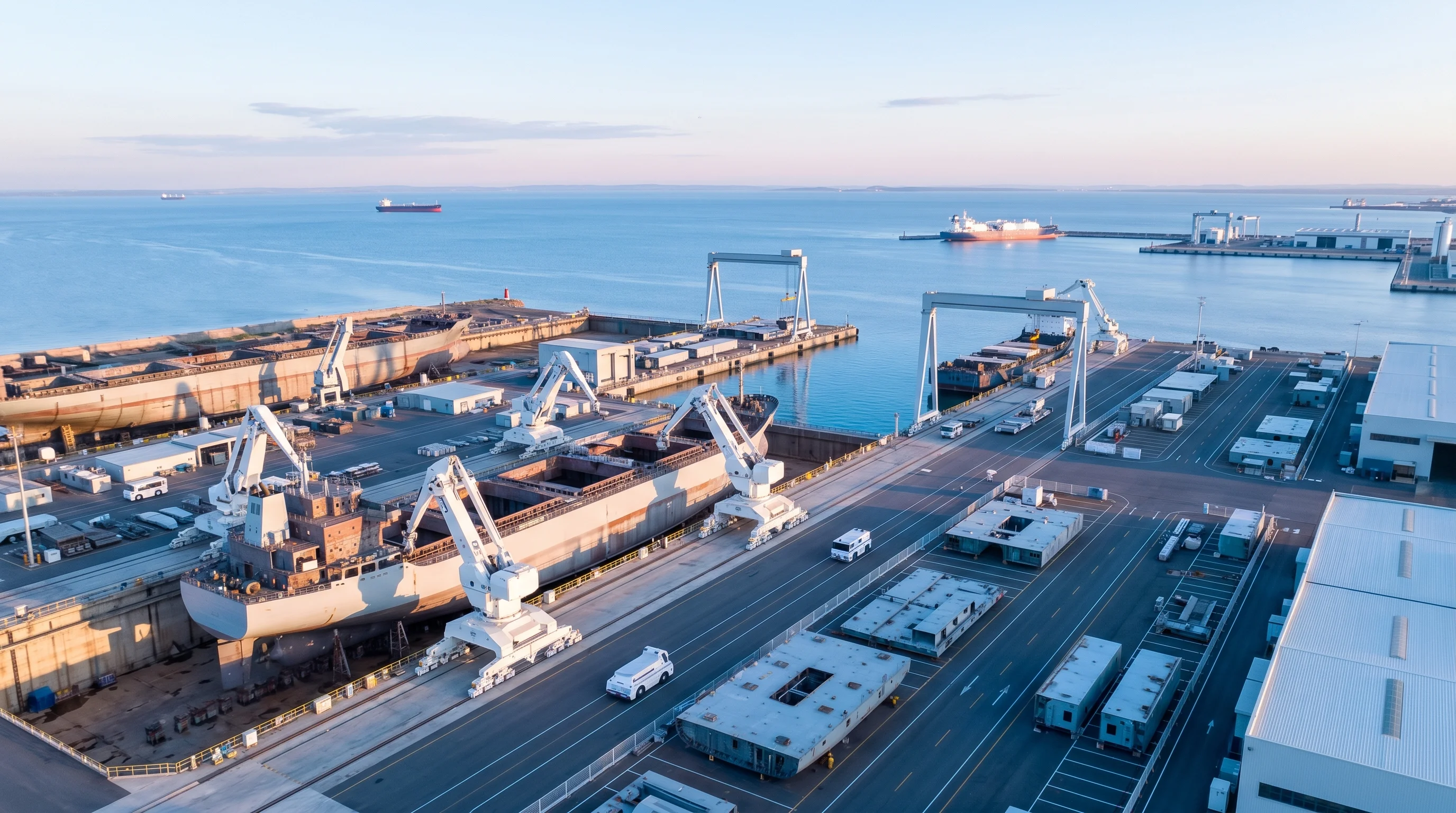
Policy comes first. The Navy committed $448 million in December 2025 to its "Ship OS" AI and autonomy initiative, explicitly aimed at accelerating shipbuilding. The Maritime Administration's Small Shipyard Grant program saw its 2026 funding pool surge to $35 million—a 200% increase from 2025's $8.75 million, according to industry press. Then there's the Build America, Buy America Act, with OMB guidance finalized in October 2023, requiring U.S.-produced iron and steel for federally supported infrastructure. That's an indirect lift for domestic fabrication and welding activity, though how much remains difficult to quantify.
Technology maturity, second. Path Robotics announced its Obsidian foundational model for welding in September 2025, then followed this April with Rove, a mobile robotic welding system leveraging what the company calls "physical AI"—a term that sounds like marketing until you see the demos. The company signed a memorandum of understanding with Huntington Ingalls Industries in February to integrate physical AI into shipbuilding operations. Novarc Technologies launched its NovAI vision and cognition platform in May 2025, adding machine vision to cobot welding. Miller Electric introduced its Copilot Builder cobot in March 2025, with AI-driven weld recommendations rolling out through 2026.
The academic pipeline is delivering, too. Research published over the past year demonstrates multi-layer seam tracking under arc interference, real-time girth weld tracking, and lightweight YOLO variants for surface defect detection—all signs that vision systems can now operate in the harsh environments that stymied earlier generations. It's incremental progress, maybe, but the kind that compounds.
Third, the cobot economy. Cobots represented 18.1% of robot units ordered in Q1 2026, and their share is climbing because they solve a programming problem. Hirebotics offers app-programmed cobot welders with cloud-connected Beacon software and 24/7 in-app support. Universal Robots' ecosystem includes turnkey welding packages that eliminate pendant programming entirely. A case study from Vectis Automation, Universal Robots, and Centerline Brackets documented over one million welds with ROI in under three months, according to the AWS Welding Digest last November. That's the kind of payback period that gets CFOs to lean forward.
The Builders
Advanced Metal Research arrives at an interesting moment—perhaps more interesting than the founders initially expected. CEO Angus Muffatti brings machine learning optimization and aerospace facilities experience. Fried, his co-founder, has the shop-floor credibility. Stephen Lin, the third member, previously worked at NASA on spacewalks and planetary exploration, building systems used by mission control for 19 spacewalks. That combination—academic AI, welding foreman, mission-critical systems—reflects the problem's nature. Welding is both craft knowledge and high-stakes engineering, and you need fluency in both languages.
AMR positions itself around "scaling welding knowledge," not just automating repetition. Their robotic cells incorporate real-time seam tracking and post-weld inspection, closing the loop between execution and feedback. Details on funding, deployments, and customer traction remain undisclosed as of late May, but the YC backing signals confidence in the approach. Whether confidence translates to contracts is the next chapter.
Path Robotics has moved faster into deployment. Its February MOU with HII targets shipbuilding integration of both manned and unmanned systems. Shipyards present brutal conditions for automation—tight spaces, irregular geometries, variable material prep—but they also face some of the most acute labor shortages. The Government Accountability Office testified in April and May that persistent workforce shortfalls in welders, pipefitters, and machinists are driving schedule and cost risk across defense contracts. That's Washington-speak for: projects are late and over budget because we can't find people.
Elsewhere, FANUC case studies show 95% cycle-time reductions on laser welding applications. Novarc's SWR cobot deployments in mechanical contracting achieve 300-345 feet of weld per day with 6.8 hours of arc-on time per shift, addressing shortages of certified pipe welders. Lincoln Electric, despite a challenging 2025 for automation sales tied to lower capital expenditures, expects recovery in 2026 as end markets normalize. Management commentary from a February 12 earnings call cited automation as a growth vector once capex spending resumes. Translation: companies have been holding off on big equipment purchases, but that freeze won't last forever.
What Comes Next
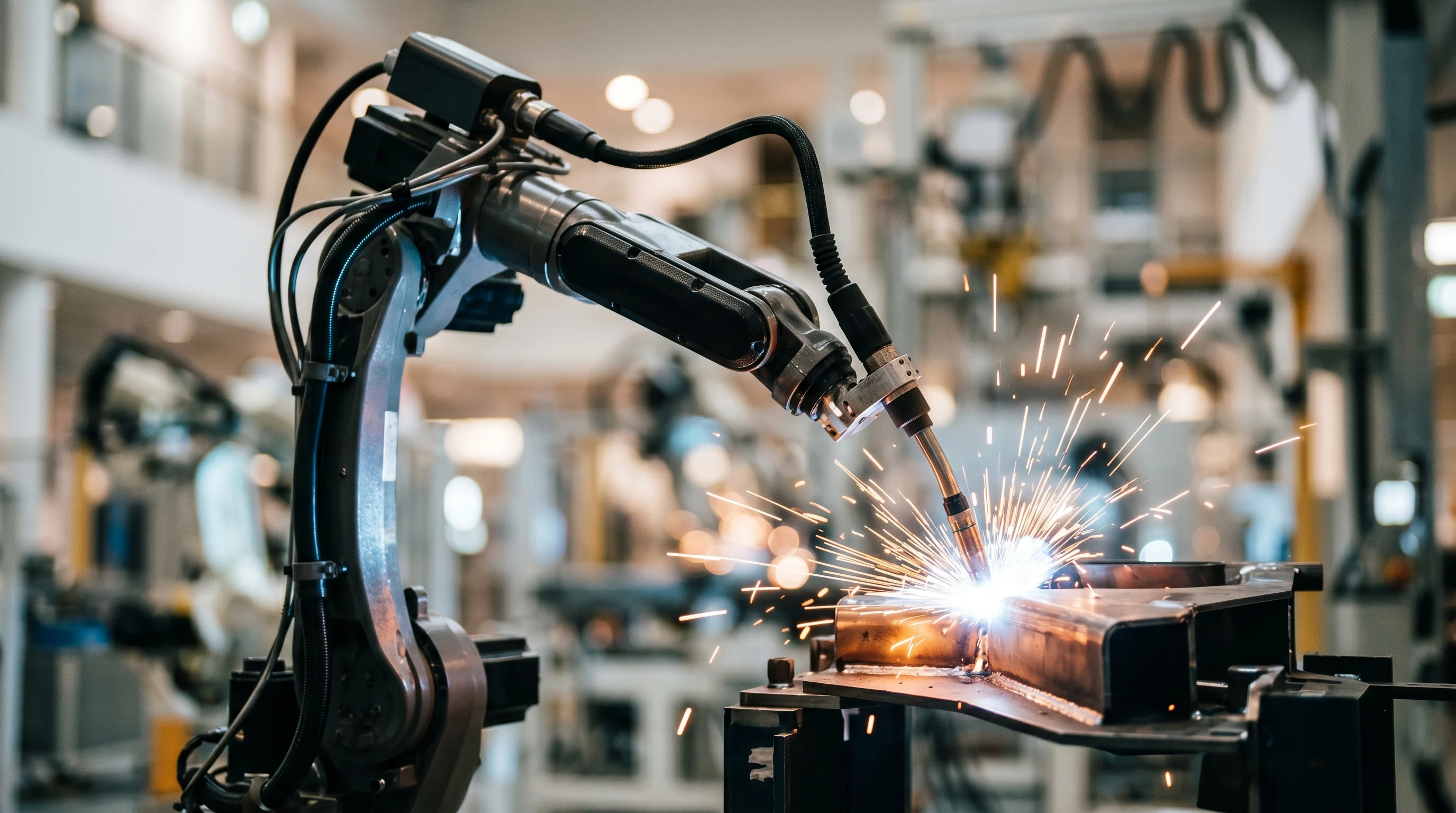
The 320,500 figure—320,500 new welding professionals by 2029—has become something of a rallying cry. It appears in AWS publications, startup pitch decks, policy briefs. Whether AI and robotics can fully close that gap is an open question, and probably the wrong question. What seems more likely is a hybrid model: robots handle high-volume, repetitive welds; human welders focus on setup, complex geometries, inspection, and quality assurance. The AWS Welding Digest argued in March that robotic welding can shift human welders to higher-value tasks, particularly on long-cycle, large weldments. That's optimistic framing, but not unrealistic.
The regulatory environment is evolving in parallel. The updated AASHTO/AWS D1.5M/D1.5:2025 Bridge Welding Code introduced revised undercut tolerances. OSHA's hexavalent chromium standards (29 CFR 1910.1026) and general welding safety requirements remain in force. ISO 10218-1/2 for industrial robots saw revisions in 2025. These aren't obstacles so much as guardrails—and they create demand for automated systems that can document every weld, every parameter, every adjustment. Compliance becomes easier when the machine keeps the receipts.
McKinsey's analysis of AI in manufacturing, published across 2025 and 2026, emphasizes that scaling requires robust data infrastructure and IT-OT integration. Embodied AI and "robots as coworkers" demand supply-chain maturity that the industry is still building. Lincoln Electric's Fori Automation acquisition, Miller's Blue IQ platform, and the broader push toward cloud-connected, software-defined welding cells all point in that direction. It's infrastructure work—unglamorous but necessary.
For manufacturing executives, the calculus is straightforward, if uncomfortable: welders are scarce and getting scarcer, automation costs are dropping, and technology is finally catching up to the complexity of real-world production. For investors, the $8 billion global robotic welding market growing toward $28 billion by 2034 offers upside, but the real opportunity may lie in the software and vision layers—the intelligence that turns a robot arm into something that learns. Hardware is getting commoditized. Intelligence isn't.
The question isn't whether AI tackles America's welder crisis. The question is how fast the industry can adopt, integrate, and scale—and whether three-person startups emerging from Y Combinator can compete with industrial giants who've been selling welding equipment for a century. That's the story worth watching. The chasm is real. Whether it gets bridged by incumbents or insurgents remains to be seen.


