

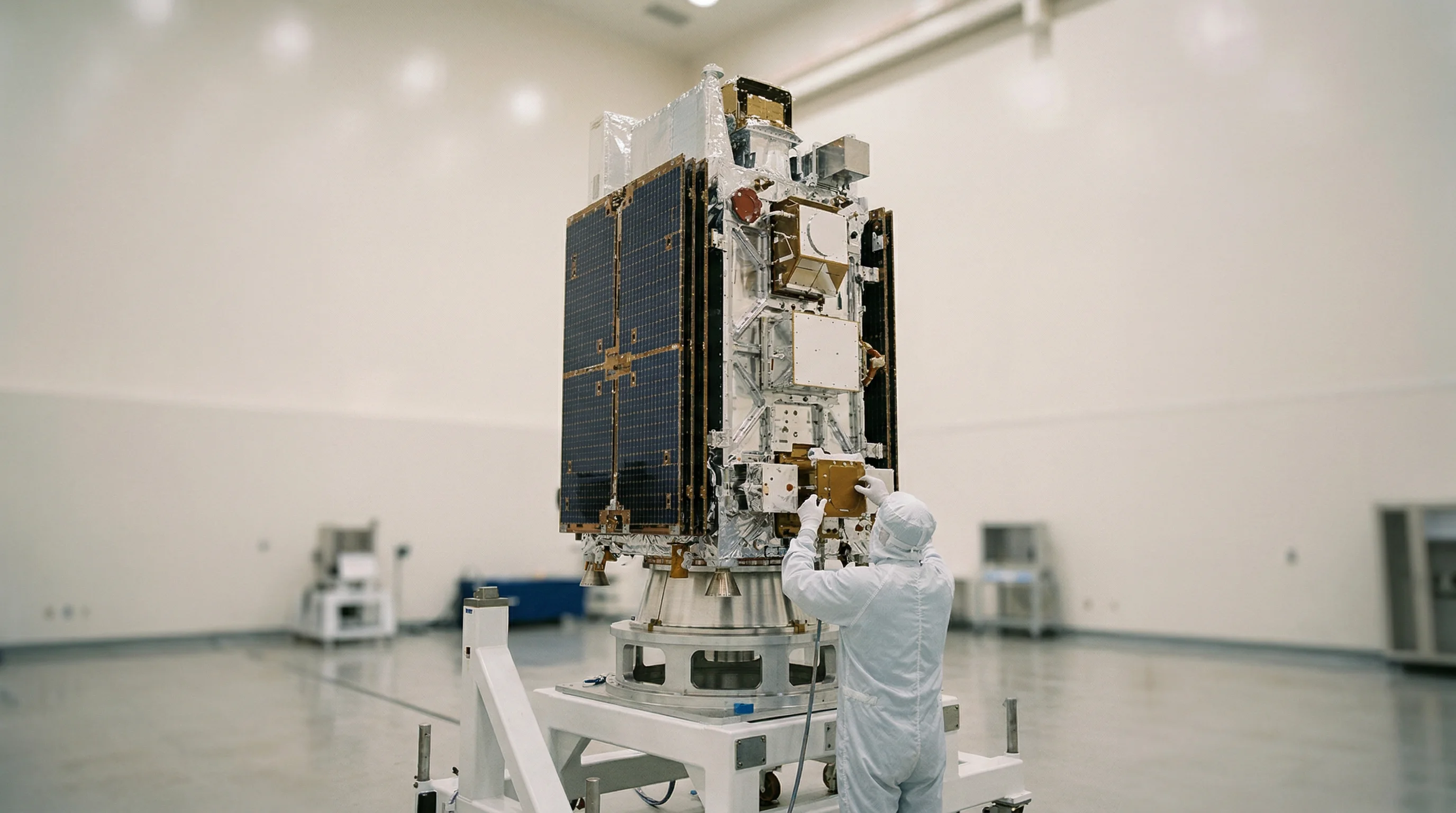
The satellite was no larger than a suitcase when it launched. But for Tomorrow.io, it represented something bigger: a bet that the future of weather forecasting wouldn't come from government agencies alone, but from scrappy startups willing to launch their own eyes in the sky.
That bet, it seems, is paying off.
The Boston-based climate tech company announced this month it has secured $175 million in equity financing—a round led by Stonecourt Capital and HarbourVest Partners that brings its total raised to roughly $500 million, according to third-party estimates. The money will accelerate deployment of DeepSky, Tomorrow.io's constellation of AI-driven weather satellites that the company says can do something traditional systems can't: update global forecasts every hour.
Israeli business outlets have pegged Tomorrow.io's valuation north of $1 billion following the round, though the company declined to confirm the figure. Goldman Sachs advised on the deal. Existing backers Square Peg, Canaan, Activate Capital, Pitango, ClearVision, and Fontinalis all participated.
Thirteen Satellites, and Counting
Tomorrow.io has already put 13 satellites into orbit. In January, those spacecraft achieved what the company calls "60-minute global revisit capability"—meaning they can sweep the entire planet and refresh weather data once an hour. It's the kind of cadence that might sound unremarkable until you consider the vast infrastructure typically required to achieve it.
The satellites themselves are what Tomorrow.io describes as "AI-native," built not just to observe weather patterns but to feed machine learning models directly. Each carries multiple proprietary instruments capable of multi-modal sensing across much of the electromagnetic spectrum. How many satellites will constitute the full DeepSky network? The company isn't saying yet. Perhaps even they don't know—constellation buildouts have a way of expanding as ambitions grow and capital allows.
This is, after all, a domain where orbital geometry and atmospheric physics collide with venture capital timelines.
The NOAA Stamp of Approval

What Tomorrow.io has secured, though, is something arguably more valuable than another funding round: government validation.
In late January, NOAA—the National Oceanic and Atmospheric Administration—released an operational-grade assessment of Tomorrow.io's microwave sounder data as part of its Commercial Data Pilot program. The verdict? The data is "generally comparable to ATMS," NOAA's flagship microwave instrument. That's not faint praise. ATMS is a cornerstone of U.S. weather forecasting infrastructure.
The validation followed Tomorrow.io's December integration into AWIPS2, NOAA's weather visualization platform used by forecasters at the National Hurricane Center. The company also holds a contract with NOAA's commercial weather data program—a foot in the door of an agency that for decades built and launched its own satellites.
The government's interest in commercial weather data is accelerating. Just last September, NOAA awarded PlanetiQ and Spire Global contracts totaling over $35 million for radio occultation observations. The message is clear enough: federal agencies, facing budget constraints and aging satellite fleets, are increasingly willing to buy atmospheric intelligence from private operators.
Commercial Customers With High Stakes

Tomorrow.io isn't waiting around for government contracts alone. The company says it now serves more than 250 organizations worldwide—a roster that includes Amazon and BNSF Railway, both of which offered endorsements in the funding announcement.
That client list matters. Amazon's logistics operations are notoriously weather-sensitive; BNSF moves freight across North America on rail networks where storms, floods, and temperature swings can halt billions of dollars in commerce. These aren't customers experimenting with weather APIs for fun—they're enterprises where forecast accuracy translates directly into operational efficiency or costly delays.
Tomorrow.io has also struck partnerships that suggest broader ambitions. It's working with Palantir on defense and enterprise applications. And just last week, it became an Official Partner of the FIA, the governing body of Formula 1, to integrate satellite weather intelligence into motorsport operations. (Because nothing says "we've made it" quite like F1.)
The product portfolio reflects this diversification: a Resilience Platform for enterprise clients, developer-facing weather APIs, raw satellite data products, and Gale AI—a decision agent built on Microsoft's Azure OpenAI stack that the company unveiled last September.
What Comes Next
So what does Tomorrow.io do with $175 million?
More satellites, for one. Constellation density drives forecast resolution, and resolution drives competitive advantage. The company is positioning itself at the center of a market shift—one where atmospheric intelligence increasingly flows from private infrastructure, not just government observatories.
Whether Tomorrow.io can sustain that trajectory depends on execution: launching satellites on schedule, maintaining data quality, and proving to both government buyers and corporate clients that its forecasts justify the investment. The technical milestones are impressive—60-minute revisits, NOAA validation, operational integrations. But the space industry has a way of humbling even well-funded ventures.
For now, though, Tomorrow.io has momentum. It has capital, orbital assets, and customers with real stakes in accurate weather intelligence. In a sector where incumbents once dominated and startups struggled to break through, that combination is worth watching.
Weather forecasting, it turns out, may be entering its own high-growth phase—one satellite at a time.


