

Markus Söder doesn't show up to just any factory opening. But on a cold January morning in Bavaria, the Minister-President was there—hard hat optional—watching robotic arms assemble what may become Europe's answer to a problem Ukraine made impossible to ignore: how do you stop cheap drones without bankrupting your defense budget?
The factory belongs to TYTAN Technologies, a Munich startup that's betting its future on a deceptively simple proposition. Instead of firing million-euro missiles at thousand-euro threats, why not build autonomous interceptors that hunt drones the way a hawk takes down prey—fast, precise, and decidedly more affordable.
On February 24, TYTAN closed a €30 million Series A round that reads like a who's who of Europe's suddenly energized defense investment ecosystem. The NATO Innovation Fund and German firm Armira co-led. Lakestar came in. So did OTB Ventures, Visionaries Club, Magnetic, 10x Group, and D3—a Ukraine-focused VC whose involvement suggests battlefield lessons are now shaping where capital flows. Total funding since the company's 2023 launch: roughly €46 million.
The Financial Times pegged TYTAN's valuation north of €100 million, though whispers from people close to the deal suggest it landed closer to €150 million. Not bad for a company that most outside defense circles hadn't heard of until recently.
When NATO Becomes Your Investor
The syndicate composition tells its own story about how European defense financing has shifted—perhaps more than the founders expected when they started building prototypes at Technical University of Munich.
The NATO Innovation Fund isn't your typical venture outfit. It's a €1 billion multi-sovereign vehicle designed to funnel institutional capital into dual-use technology, the kind that works for both military and civilian applications. This TYTAN investment came months after NIF announced its inaugural deals in June 2024, signaling the fund is now actively deploying across the continent.
Then there's Armira, managing roughly €5 billion across DACH technology and German Mittelstand holdings. Not traditionally a defense player, but increasingly convinced that the old boundaries between commercial tech and military procurement are dissolving.
Lakestar's involvement carries a certain symmetry: chairman Klaus Hommels also chairs the NATO Innovation Fund. The firm has launched an explicit defense initiative, a move that would've seemed eccentric for a consumer internet investor just three years ago. OTB Ventures counts NIF as a limited partner in its €170 million-plus Fund II. D3's check? That's Ukrainian operational reality flowing directly into European capital allocation decisions.
The Volume Game
TYTAN plans to use the capital for something refreshingly concrete: making more stuff. Specifically, 3,000 interceptors monthly by year-end, up from current production levels the company declined to specify.
That target isn't arbitrary. Last October, TYTAN signed what it describes only as a "multi-hundred-million-euro" contract with the Bundeswehr. The deal includes verification testing for a demonstration system in Q1 2026—which is to say, right now. Meeting those milestones means proving the company can manufacture at scale, not just build clever prototypes in a university lab.
The new Bavaria production facility, opened that January morning with Söder in attendance, is part of that expansion. So is the plan to broaden the product line beyond interceptors into missile variants, a natural progression once you've mastered autonomous targeting systems.
Regional government support matters here. Bavaria has positioned itself as Germany's defense manufacturing hub, and Söder's appearance was as much political theater as industrial policy. The optics work: homegrown technology, local jobs, strategic autonomy. All the buzzwords that resonate in an era when European leaders talk openly about not relying on American defense guarantees.
What Combat Actually Teaches You
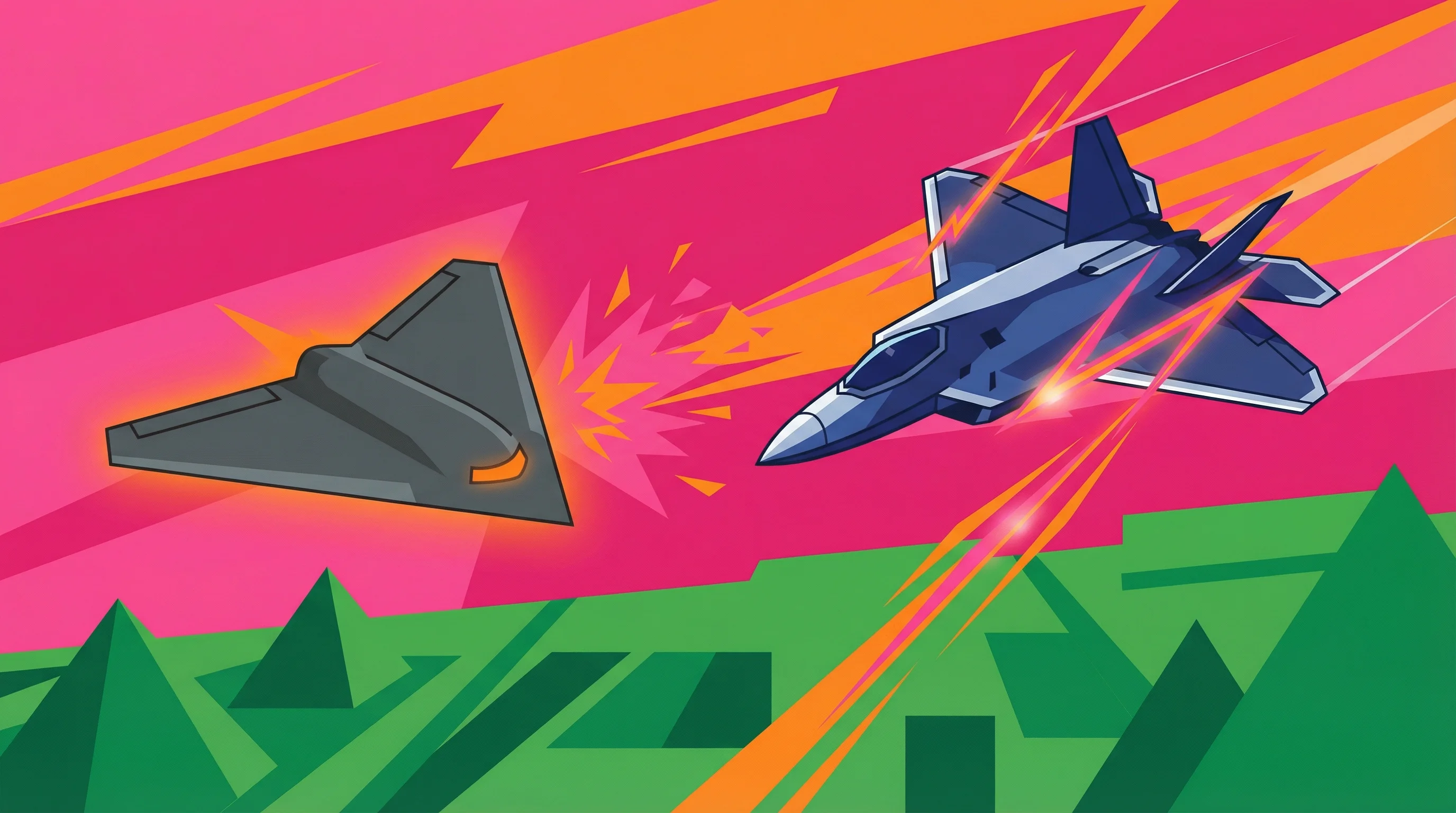
TYTAN's interceptor has seen something most venture-backed hardware never does: real combat.
The company confirmed operational deployment in Ukraine, with defense publication Janes reporting usage as early as January 2025. That's not a test range. That's Russian Shahed-136 drones—Iranian-designed loitering munitions that have terrorized Ukrainian cities—being hunted by autonomous systems built in Munich.
The interceptor itself weighs about 5 kilograms, carries a 1-kilogram payload, and flies north of 300 km/h with a 15-20 kilometer range. Computer vision handles terminal guidance, meaning the drone makes final targeting decisions itself. A containerized launcher automates deployment and ties into external sensor networks, creating what TYTAN calls a cost-effective air defense layer.
That last phrase—cost-effective—is doing heavy lifting. The entire premise depends on building interceptors cheap enough that commanders won't hesitate to use them. If each unit costs as much as the threat it's stopping, you haven't solved the problem. You've just created a different kind of attrition math.
Ukraine's battlefield has become an involuntary R&D lab for this technology, and that experience feeds back into product development faster than any traditional procurement cycle would allow. When your systems face live threats daily, iteration happens at venture speed, not Pentagon speed.
Plugging Into the Establishment
For all its startup credentials, TYTAN is moving quickly to embed itself within traditional defense infrastructure. In late January and early February, the company signed memoranda of understanding with HENSOLDT and KNDS—German defense primes with decades of NATO contract experience.
The HENSOLDT agreement integrates TYTAN interceptors with the Elysion Mission Core command-and-control platform, essentially giving the startup a seat at the table for how Germany coordinates air defense. KNDS will embed the Interceptor-S variant into its BOXER RCT30 armored vehicle, following successful trials during the Bundeswehr's Experimentalserie Land exercises last fall.
These aren't vanity partnerships. They're procurement channels. Defense ministries buy from established contractors, and those contractors are now positioning TYTAN's technology within mobile defense platforms. It's the startup equivalent of getting your product onto Walmart shelves—distribution suddenly becomes someone else's strength.
The integrations address both fixed-site protection and frontline counter-UAS requirements, which matters when you're trying to scale beyond niche applications. A system that only works at airbases won't capture the market TYTAN is chasing.
The Bigger Picture

CEO Balázs Nagy and CTO Batuhan Yumurtacı founded the company fresh from Technical University of Munich. LinkedIn lists the headcount at 11-50 employees, though that's almost certainly climbing given the production targets. Small team, enormous ambition—the classic startup narrative, now playing out in an industry that traditionally moves at glacial speed.
On the same day TYTAN's funding hit the news, the Financial Times and Sifted reported Estonia's Frankenburg Technologies raised €30 million for similar technology. Coincidence, perhaps, but more likely evidence of broader investor appetite for affordable air defense solutions. Multiple bets are being placed on variations of the same thesis.
Defense analysts describe the underlying problem as a cost-exchange crisis. When a $3 million Patriot missile shoots down a $20,000 drone, you're winning tactically but losing economically. Scale that across hundreds or thousands of engagements, and you've built an unsustainable defense posture. Ukraine's skies have made this dynamic impossible to ignore, and European capitals are scrambling for alternatives.
TYTAN's approach—autonomous interceptors manufactured at scale—is one answer. Whether it's the right answer depends on execution that hasn't happened yet. Can they actually hit 3,000 units monthly? Will battlefield performance hold at volume? Do the economics work once you factor in maintenance, training, and integration costs?
Those questions won't be answered by the funding announcement. They'll be answered in Bavarian factories and Ukrainian skies over the next twelve months. The capital is there. The contracts are signed. Now comes the hard part: delivering on the promise that a small team from Munich can help rewrite how Europe defends its airspace.
And if they pull it off? Söder might show up for the next factory opening too.


