

Most startups spend nine months just finding office space and arguing about equity splits. UMA, a Paris-based robotics venture, spent that time building a full-scale humanoid robot.
The reveal came at Station F on July 7, 2026, during the Machina Summit. CEO Rémi Cadène—formerly of Tesla's Autopilot and Optimus teams—stood on stage with what the company calls "Version Zero," a 30-person effort assembled in Paris that's meant to signal something: European robotics can move quickly. Maybe even quickly enough to matter.
"We developed this in under nine months with a small team," Cadène told The French Tech Journal afterward. Whether that's hubris or proof of concept depends largely on what comes next.
The prototype, which some outlets have called "Northstar" (UMA's official materials don't use the name), isn't headed to production as-is. But it's functional, it's been demonstrated publicly, and it represents a particular gamble—that adaptability and safety architecture might matter more than raw task optimization in the next phase of industrial automation.
Built for Warehouses, Not Living Rooms
This isn't a consumer play. UMA's humanoid is designed for logistics and manufacturing floors, the kind of environments where repetitive motion meets variable conditions and human workers still outnumber machines by a wide margin.
The robot itself is deliberately understated. No face, just a neutral visor. Joints intentionally exposed through a soft technical shell. Human-scale proportions, but considerably lighter—UMA says "much lighter than a human," though exact specs haven't been disclosed. The aesthetic choice is strategic: approachable without the unsettling attempt at human mimicry that tends to backfire.
Pilots are slated for sometime in 2026, according to UMA, focused initially on logistics and manufacturing clients. The company is in conversations with around 50 potential customers, per reports from Electrek and The French Tech Journal, though no signed customer names have been disclosed. By year's end, UMA plans to ship a wheeled dual-arm configuration—a practical middle step before the full humanoid hits the market.
The go-to-market approach is Europe-first, with teams spread across Paris, London, and Geneva. Cadène and his co-founders are positioning the company as a regional counterweight to the robotics push coming out of the U.S. and China, where capital and deployment timelines have left European players scrambling.
The Real Bet: Learning, Not Hardware

If you're looking for the technical story here, it's not the physical robot—it's what UMA calls "Real-Time Learning."
The idea, in broad strokes: instead of programming every task manually, you demonstrate what you want the robot to do. It learns through observation, then adapts when conditions shift. At the Machina Summit, UMA ran the robot through durability scenarios designed to show how it handles unfamiliar situations and improves through experience. The pitch is that this eliminates the tedious, brittle work of writing task-specific code for every workflow variation.
Safety is baked into the architecture rather than bolted on. UMA's system uses redundant, independent compute layers and what they describe as a predictive world-model—essentially, the robot simulates the consequences of an action before executing it. The low mass is intentional, meant to reduce the physical risk when robots and humans share space.
It's an elegant theory. Whether it works at scale, in messy real-world environments, under commercial pressure? That's the unanswered part.
A Team That Doesn't Need to Learn Robotics
UMA's founding roster is the kind that makes investors reflexively interested. Cadène led Tesla's Autopilot and Optimus projects before running LeRobot at Hugging Face. Pierre Sermanet, the Chief Science Officer, logged over two decades at Google Brain and DeepMind working on AI and robotics. Rob Knight, Chief Robot Officer, brings 25 years in humanoid design, including stints on CRONOS, ECCERobot, and the SO-100 open-source arm. CTO Simon Alibert co-founded Hugging Face's LeRobot initiative with Cadène.
The advisor bench includes Yann LeCun, Thomas Wolf, Matthieu Cord, and Youssef El Manssouri—names that carry weight in AI circles and suggest the company is thinking about branding and reach beyond just the technical community.
UMA emerged from stealth on December 1, 2025, with backing from Greycroft, Relentless, Unity Growth, Factorial, ALM Ventures, Kima Ventures, and a handful of prominent angels including Xavier Niel and Olivier Pomel. The company hasn't disclosed total funding figures, and there haven't been additional rounds announced since that initial unveiling.
This isn't a group learning how to build robots from scratch. It's a team that built robots elsewhere—at some of the most well-resourced organizations in tech—and decided to do it under their own roof.
Into a Suddenly Urgent Market
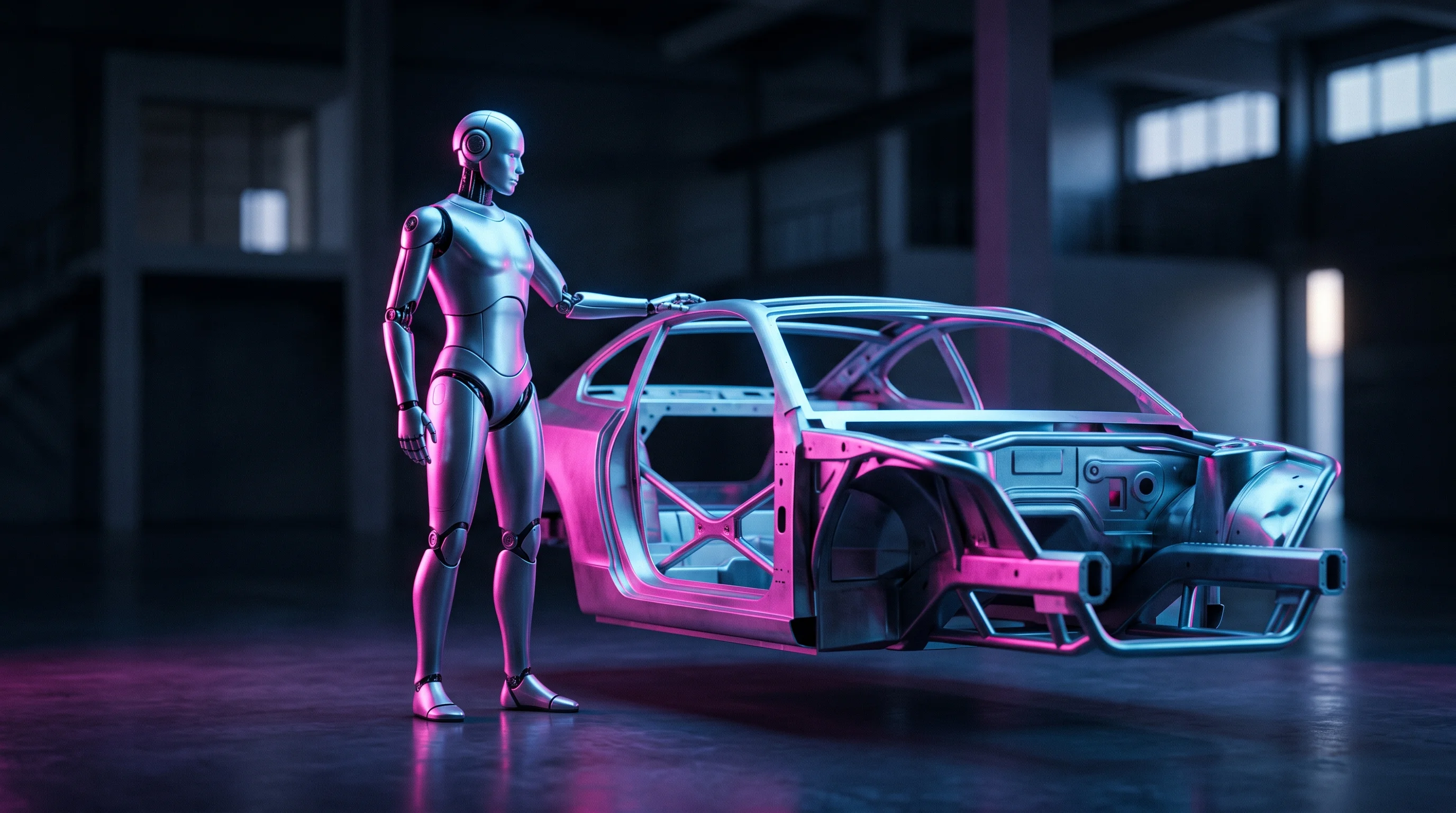
UMA is arriving just as the humanoid robotics race has shifted from speculative to something closer to real. Figure AI's Figure 02 recently wrapped a ten-month pilot at BMW's Spartanburg plant, where it supported production of more than 30,000 BMW X3 vehicles. Figure 03 is now being deployed for logistics sequencing at the same facility. Boston Dynamics showed off a production-ready version of Atlas at CES this past January, with industrial deployment planned for Hyundai's U.S. EV operation by 2028. NVIDIA announced the Isaac GR00T reference platform in June—a broader infrastructure play meant to standardize how humanoid robots are developed and trained.
UMA's angle is different, or at least that's the positioning. They're emphasizing adaptability over task-specific optimization. Safety through predictive modeling rather than just physical constraints. A design language meant to sidestep the uncanny valley problem that has plagued other attempts at human-like machines.
Whether that's enough to carve out a defensible position in a field that's getting crowded—and well-funded—remains an open question.
The prototype is tele-operated for now. Full autonomy is coming, UMA says, but not immediately. The near-term focus is on proving the learning architecture holds up in real environments, then scaling from there. Sensible, perhaps, though it also means the company is launching into a market where some competitors are already past that milestone.
Fifty Conversations Isn't Fifty Contracts
UMA says pilot programs will begin sometime this year. No customer names have been made public. The company is targeting warehouses first, with that wheeled dual-arm system as the initial commercial offering by the end of 2026. The full humanoid will follow, though the timeline there is less defined.
Fifty potential customers in the pipeline is a data point, not a business model. But it suggests that logistics and manufacturing executives are at least willing to take meetings, which in this market is not nothing. The European angle matters here more than it might elsewhere—data sovereignty concerns, tighter labor regulations, and a general wariness of U.S. tech platforms create an opening for a homegrown alternative that might not exist in other sectors.
The nine-month development timeline is the narrative UMA wants to anchor on: that a small, experienced team can out-execute the incumbents, that European robotics doesn't have to mean bureaucratic and slow, and that the next wave of automation might originate somewhere other than California or Shenzhen.
It's a compelling story. Whether it's a durable one depends on execution over the next year—customer traction, product iteration, the messy reality of deploying complex hardware in environments where downtime carries real costs.
For now, UMA has a working prototype, a credible team, and a window of opportunity that may or may not stay open long enough for them to build a business. In robotics, as in most of tech, nine months can feel like a long time or no time at all, depending on what you're racing against.


