

The number is almost too round to believe: 800 times more efficient than traditional models. When a British startup makes that kind of claim about its AI controllers, the natural response from anyone who's covered technology long enough is a polite smile and a mental note to check back in six months.
But Luffy AI's £8.1 million Series A—announced on July 7, 2026, with backing from BGF, MIG Capital, and existing investors—arrived at an odd moment in manufacturing's long, stuttering courtship with artificial intelligence. Efficiency isn't just a buzzword anymore. It's becoming the constraint that determines which companies survive the next decade. Data centers are on track to consume more than 945 terawatt-hours annually by 2030, according to the International Energy Agency. Meanwhile, factory floors still run on hand-tuned motor controllers and cloud-dependent AI that can't deliver real-time adaptation when a bearing starts to overheat or a pressure valve needs adjustment in microseconds, not milliseconds.
The gap between those two realities—hyperscale computing burning through electricity on one side, analog control systems resisting change on the other—is where a new generation of companies is trying to build something different.
Vendor Claims and Market Realities
Luffy's 800x figure comes from an investor impact report published in September 2025. The company's internal benchmarks, measured against DeepMind's DeepRL reference, point to 400 times less compute per inference and 200 times greater sample efficiency. These are vendor claims pending independent replication, and treating them as gospel would be a mistake. But the broader thesis they represent—that neuroplastic algorithms running on microchips could replace cloud-heavy AI in physical control systems—is gaining traction across an industry that has spent years piloting artificial intelligence without ever quite committing to full-scale deployment.
Edge AI in manufacturing is no longer theoretical. The market was valued at $30 billion in 2026 and is projected to reach $118.7 billion by 2033, per Grand View Research. ABI Research pegged edge AI chipset revenue at $34.4 billion this year in its second-quarter analysis, climbing to $96 billion by 2031. Manufacturing is expected to drive the majority of that growth.
Yet adoption on actual factory floors remains stubbornly patchy. A study published in AEA Papers & Proceedings this past May found that only 22.8% of U.S. plants reported any AI use as of 2021—and intensity-weighted adoption was far lower. A Federal Reserve Bank of Minneapolis supplement from early this year broadened the definition and found roughly 20% firm-level AI use across sectors, with manufacturing still trailing the national average. The disconnect between market projections and ground-level implementation suggests the industry is still searching for practical, deployable solutions rather than proof-of-concept demos that look good in PowerPoint.
What's changed recently, perhaps, is that the infrastructure vendors are no longer waiting. Siemens brought specialized edge-native AI models to its Xcelerator marketplace in October 2025 through a partnership with rhobot.ai. Rockwell Automation showcased edge-based generative AI using NVIDIA's Nemotron-Nano at Automation Fair last November. NVIDIA itself announced IGX Thor and the Halos safety stack for robotics and industrial edge on June 22. These aren't pilots. They're product launches from Tier 1 automation vendors, signaling that the infrastructure for edge-native AI is now shipping—whether or not factories are ready to buy it.
Three Forces Pushing AI Local
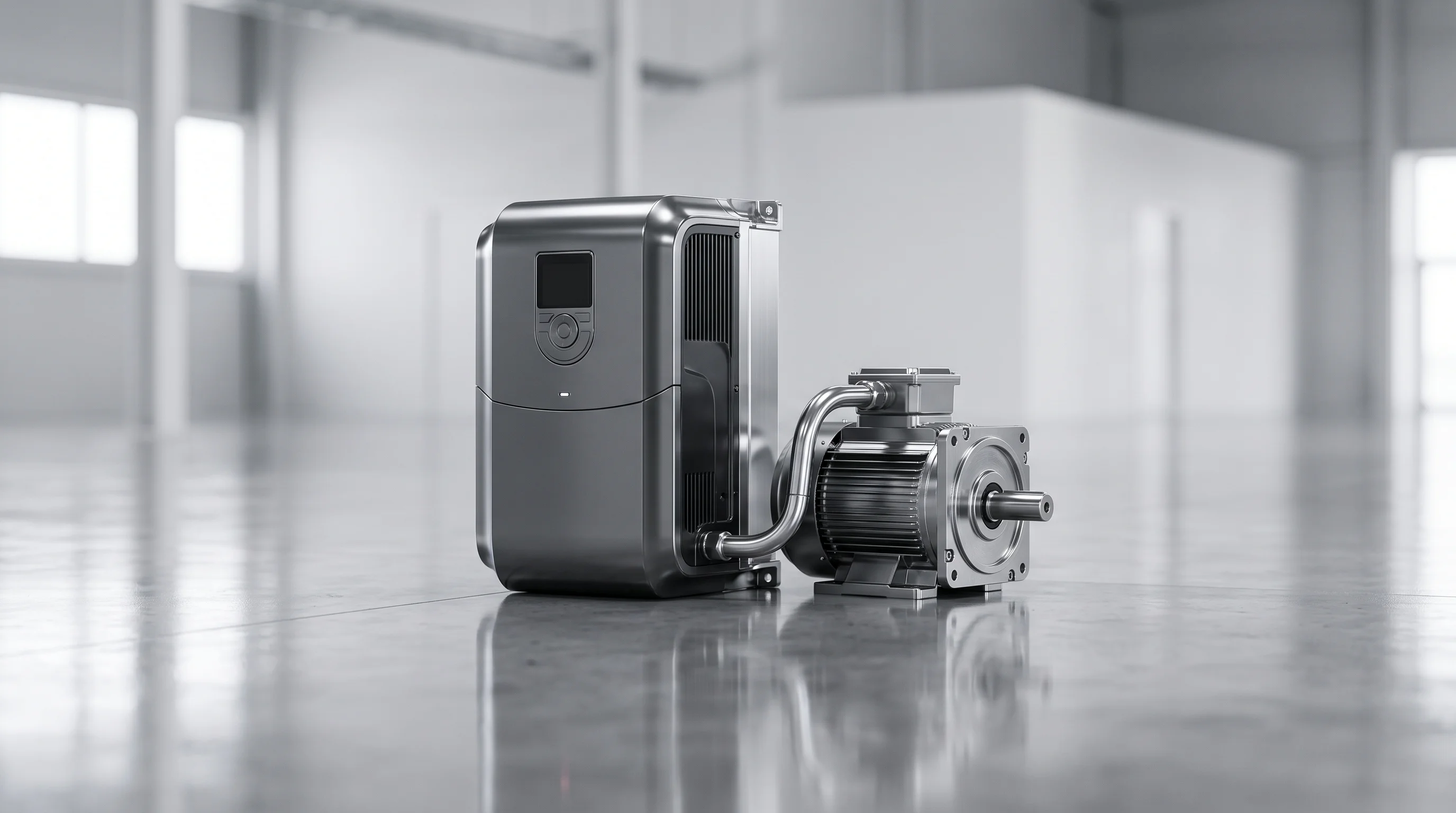
Three dynamics are pushing artificial intelligence out of the cloud and onto the factory floor, and they're converging faster than many observers expected.
The first is latency. Real-time control can't tolerate round-trip delays to a data center. A variable-frequency drive controlling a motor, a thermal controller managing an injection-molding process, a UAV adjusting rotor speed in flight—these systems need decisions measured in microseconds, not milliseconds. Luffy's controllers claim 21-microsecond inference times with a 10-kilobyte model footprint, deployable on programmable logic controllers and microcontroller units already embedded in industrial hardware. Whether those numbers hold across diverse environments is still being tested in the wild, but the direction is clear: control loops are moving local, and they're not moving back.
Energy efficiency has shifted from a sustainability talking point to an economic necessity, and the timeline is tighter than most boardrooms anticipated. The IEA projects data centers will account for 2.6 to 3% of global electricity demand by 2030. The U.S. is expected to see roughly half of its grid demand growth come from data centers between now and 2030. A survey of data center operators this past July—referenced in coverage by Capgemini—found expectations of 30% electricity growth over the next three to five years, along with rising concerns about whether the grid can deliver it reliably.
Meanwhile, electric motors consume a staggering portion of industrial electricity. Variable-frequency drives in pumps, fans, and conveyors represent a massive optimization surface that's largely untapped. Companies that can improve motor efficiency by 10%, as Luffy claims to have done in an October 2024 case study with Surface Generation, are addressing what amounts to a trillion-dollar energy problem. That's not hype. That's arithmetic.
Regulation is the third accelerant, and it's proving more consequential than many anticipated. The EU AI Act entered force in August 2024, with phased applicability rolling out through 2028. The EU Machinery Regulation becomes applicable January 20, 2027, and includes provisions for cybersecurity and self-evolving behavior in AI-enabled machinery. Functional safety standards like IEC 61508 and IEC 61800-5-2 remain compliance anchors for any AI-aided drive or control system. Edge deployment—where models run locally, with known latency and deterministic behavior—is easier to certify than cloud-dependent systems with variable response times and opaque update cycles. That's a technical reality that's shaping architecture choices across the sector.
The Neuroevolution Bet

Luffy AI's approach is rooted in neuroevolution, a technique that trains compact neural networks through evolutionary algorithms rather than gradient descent. The company was founded in 2019 by Dr. Matthew Carr and Dr. Alex Meakins, both formerly of the UK Atomic Energy Authority, and operates out of Culham Campus in Oxfordshire—a location that signals its roots in high-stakes, energy-intensive research environments.
Its November 2024 whitepaper describes controllers that are "hundreds of times more compute and memory efficient than Deep RL" and use "300–400× fewer parameters than equivalent Deep RL agents." The whitepaper remains current on the company's site as of mid-2026 and includes references to UAV rotor control and injection-molding thermal management. Whether those parameter reductions translate to real-world performance gains is still being validated across deployments.
The Surface Generation case study, published in October 2024, reports 10% energy efficiency gains, 33% reduction in compressed air use, and 40% improvement in temperature tolerance after deploying Luffy's adaptive neural system in what the study describes as a "pixelated" heated tooling setup. The study quotes an unnamed representative calling Luffy "the most credible team on the market"—though it's worth noting this is a vendor case study rather than third-party validation. Luffy raised a strategic investment led by Momenta in June 2024, prior to the BGF-led Series A this summer. Total disclosed capital raised stands at least £8.1 million as of mid-2026, though the company hasn't disclosed earlier seed rounds in detail.
A Crowded, Fast-Moving Field

Luffy isn't operating in a vacuum, and the competitive landscape is more crowded than it was even a year ago. Micropsi Industries has deployed vision-guided robot control systems using its retrainable MIRAI platform across multiple industrial settings. Realtime Robotics showcased collision-free motion planning for robotics at iREX 2025 in Japan and has updated its collateral into 2026. Alphabet's Intrinsic is developing Flowstate and industrial perception models, with demonstrations at Automate earlier this year. QPT launched what it calls the world's first "AI-ready" motor drive for collaborative robots using gallium nitride power electronics, indicating a convergence between drive hardware and edge AI control that wasn't visible two years ago.
SiMa.ai secured strategic investment from Micron on April 8 to scale what both companies term "physical AI" at the edge using the Modalix MLSoC platform. That partnership signals growing confidence that edge inference is moving from niche applications to volume deployments.
Chip and platform vendors are following suit, and the pace is accelerating. STMicroelectronics' STM32N6 family, featuring a neural processing unit, has been shipping into industrial applications since late 2024. Texas Instruments published an application brief in March outlining "Achieving edge AI-enabled motor control" with NPU-offloaded loops on TI microcontrollers. Hailo demonstrated mass-market edge AI across consumer and commercial segments at CES. These aren't research projects. They're production silicon and BSP-aware deployment frameworks designed for engineers building systems today, not in some hypothetical future.
The Execution Gap
Microsoft framed manufacturing's next phase as "agentic" orchestration in a March 2026 blog post, positioning the shift from isolated pilots to integrated, end-to-end intelligence across the shop floor and supply chain. That vision—compelling in theory—requires small, fast, safe, local models and controllers that can operate autonomously while coordinating with broader systems. It also requires a level of trust and technical maturity that most factories don't yet possess.
Wevolver's "2026 Edge AI Technology Report," published in late June, documents the shift to edge-native architectures and highlights physical AI and robotics as entering a zero-to-five-year "time-to-impact" window. ABI Research's second-quarter outlook notes that edge AI chipset revenue is set to nearly triple from 2026 to 2031, with manufacturing leading the revenue mix. Alvarez & Marsal published a scenario in March suggesting that a major share of AI workloads could migrate to the edge by 2035—a thesis rather than a consensus forecast, but one that reflects growing industry confidence in local inference.
The technical building blocks are maturing faster than many expected: activation-aware quantization to INT8 and INT4, distillation techniques, sparsity and pruning methods, small language models for on-device agents, event-based vision, edge multimodal transformers. Academic work published this year covers BSP-aware deployment frameworks, auto-tuning for industrial drives via Bayesian optimization, and hybrid classical-plus-learning control loops in power electronics. The infrastructure, in other words, is arriving.
The challenge now is execution. PwC's 2026 manufacturing leadership survey, based on 2025 data, found that manufacturers see AI's value but struggle to scale beyond pilot projects. Use-case hot spots—quality inspection, production optimization, logistics—are well understood. What's less clear is how to integrate adaptive, self-learning controllers into legacy infrastructure without triggering compliance nightmares or operational disruption. Changing a motor controller on a production line that's been running for fifteen years isn't a software update. It's a risk calculation that involves insurance, liability, and the real possibility that something breaks in ways the neural network never saw in training.
Companies like Luffy are betting that the answer lies in radical simplicity: tiny models, microsecond inference, and deployment on hardware that's already installed. It's an elegant pitch. Whether it works depends less on the efficiency multiples in investor decks and more on how well these systems perform under the messy, non-linear dynamics of real factory floors—where temperatures fluctuate, materials vary, and the consequences of failure can be measured in downtime, scrap, or worse.
Luffy's Matthew Carr framed the opportunity in an April 2026 appearance on the Project Flux podcast: "Efficiency is a sustainability story. Smaller, smarter models at the edge beat giant cloud models for most control problems." That claim still needs independent validation at scale, and it's worth noting that "most control problems" is doing a lot of work in that sentence. But the direction of travel—toward local, adaptive, energy-efficient AI control systems—is no longer speculative. The infrastructure is shipping. The regulatory framework is crystallizing. The economic case is strengthening with every data center power bill.
What remains to be seen is which architectures, which companies, and which approaches will define the next decade of industrial automation. The race is early, the stakes are high, and the efficiency claims—however eye-catching—will ultimately matter less than whether these systems can survive contact with the factory floor.


