

The auction listing appeared in January 2025 with a certain grim poetry: $8 million in vertical farming equipment from Dream Harvest's Houston facility, most of it pristine. Unused, really. LED grow lights still sealed in their original packaging. Climate control systems that had never hummed to life.
If you wanted a single image to capture an entire industry's miscalculation, that might be it.
By November 2024, when Bowery Farming shut its doors for good, the vertical farming sector wasn't just struggling—it was hemorrhaging companies. Plenty Unlimited filed for Chapter 11 in March 2025, despite backing from Jeff Bezos and a roster of other marquee investors. AeroFarms had already traveled that same bankruptcy road in June 2023. AppHarvest, Kalera, Upward Farms, Infarm, Eden Green Technology. The casualties kept mounting, a who's who of agtech companies that had, not so long ago, promised to revolutionize food production.
The money tells you everything you need to know. Venture capital pouring into U.S. indoor farms peaked at $2.1 billion across 76 deals in 2021, according to Wall Street Journal reporting from June 2025. By 2024, that figure had collapsed to $277 million. By mid-2025? Just $57 million.
That's not a correction. That's a 97% freefall in four years.
The Math Problem No One Could Engineer Away
Here's the thing about vertical farming's demise: the technology actually worked. The problem was never whether you could grow lettuce in a warehouse under LEDs. The problem was whether you could do it without losing money on every head you sold.
Electricity eats up to 40% of operating expenses in fully lit vertical farms. Lighting and dehumidification drive most of that consumption. Recent peer-reviewed modeling puts the specific energy consumption for lettuce at 11.34 kilowatt-hours per kilogram—translating to production costs between $3.78 and $6.48 per kilogram under what researchers called "optimized scenarios."
Now compare that to what people actually pay for lettuce. Retail romaine averaged $2.83 to $3.47 per pound ($6.24 to $7.65 per kilogram) throughout 2024 and into December 2025. That's retail—what consumers see at the checkout counter, not what farmers get at the farm gate. Once you back out the retailer's margin, distributor costs, and logistics, the economics crater. Wholesale terminal markets for iceberg lettuce commonly trade in the mid-teens to low $20s per 24-count carton.
There's simply no margin left for vertical farms trying to compete on commodity greens.
A 2024 study in Computers & Electronics in Agriculture put precise numbers to the energy challenge. In a container vertical farm model, lighting consumed roughly 78% of specific energy, with dehumidification claiming another 19%. Using waste CO2 supplementation could cut costs by about 22%, the researchers found. But even pulling every optimization lever available, the unit economics remained stubbornly, maddeningly upside down.
Perhaps most damning: multi-region research published in 2026 concluded that lettuce production in vertical farms would require fully decarbonized energy sources just to achieve emissions parity with imported field-grown lettuce. That sustainability promise that helped attract billions in funding? It turned out to be predicated on access to clean, cheap electricity that most operators simply didn't have. And weren't going to get.
The Capital Trap
The operating costs alone would have been difficult enough. But vertical farms also faced punishing upfront capital requirements. Industry analyses from 2023 and 2024 estimate these facilities run 8 to 15 times the capital expenditure per square meter compared to greenhouses, with LED systems and HVAC infrastructure topping the expense list.
Bowery reportedly raised over $470 million before closing. Plenty had secured substantial backing from Bezos, SoftBank, and others before bankruptcy. When the asset auctions followed these collapses, they revealed an uncomfortable truth: specialized indoor farming equipment has limited resale value when the entire sector is imploding simultaneously.
The capital intensity created a vicious cycle that some operators recognized too late. High upfront costs demanded substantial fundraising. That funding created pressure for rapid scaling to deliver venture-scale returns. But scaling multiplied operating costs before anyone had proven the unit economics actually worked—and nearly everyone was competing in a commodity market where they were structurally disadvantaged against field agriculture's inherent advantages.
It was, in retrospect, entirely predictable.
The Premium Crop Pivot
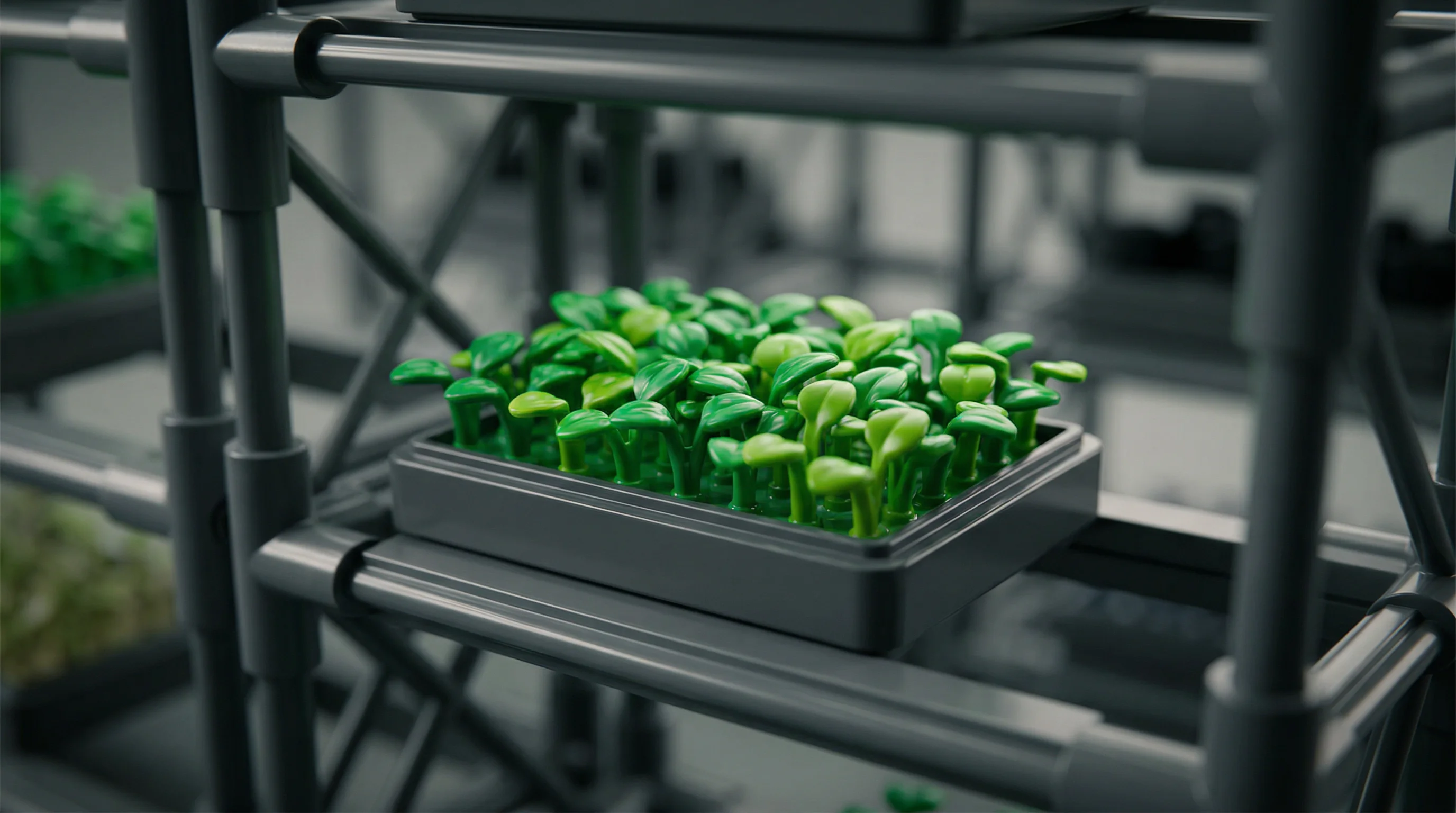
The handful of operators who found a path to survival—not just survival, but profitability—did so by abandoning commodity crops entirely.
AeroFarms emerged from its September 2023 bankruptcy restructuring with a radically narrowed focus: microgreens at its Danville, Virginia facility. By mid-2025, the company was reporting profitable quarters. The turnaround came from embracing crops with fundamentally different economics.
Microgreens retail for roughly $25 to $50 per pound—an order of magnitude above commodity lettuce. They harvest in 7 to 14 days instead of 30-plus. That combination of premium pricing and rapid turnover transforms the entire equation. AeroFarms secured placement at Whole Foods, H-E-B, and Costco, targeting customers willing to pay for perceived quality and freshness.
Oishii pursued a similar strategy with premium strawberries, closing a $150 million Series B in November 2024. The company managed to bring tray prices down from around $50 in 2018 to $9.99 to $15 by late 2024 through automation improvements. But make no mistake: the entire business model depends on maintaining that premium brand position. These aren't commodity berries competing with California and Florida growers. They're luxury produce for consumers who value flavor and year-round availability enough to pay for it.
Notably absent from the success stories? Anyone who tried to scale commodity lettuce and herbs to supermarket price points. Those operations faced an impossible squeeze: competing against field agriculture's cost structure while paying urban real estate rates and industrial electricity bills.
Innovation That Couldn't Save Them
It would be unfair to say the industry didn't innovate. LED efficacy improved substantially during this period, with commercial toplighting systems from Signify and Philips reaching 3.7 to 3.9 micromoles per joule by the 2022 through 2025 timeframe. That represents meaningful progress in photon delivery per watt of electricity consumed.
Sophisticated control strategies emerged as well. Research published in 2024 demonstrated that vertical farms could participate in demand response programs and time-of-use pricing optimization without harming yields, potentially reducing energy costs by 20% or more. Model predictive control systems allowed operators to shift lighting loads to cheaper off-peak hours while maintaining the total daily light integral plants needed to grow.
But here's the brutal reality: efficiency gains of 20% or even 30% couldn't bridge a gap where your production costs exceeded the entire retail price of the product. The technology got better, certainly. The underlying economics did not.
What the Wreckage Revealed

Plenty's March 2025 Chapter 11 filing was instructive, if you knew how to read it. The company had already closed its Compton, California leafy greens facility before bankruptcy, pivoting to focus on its Virginia strawberry operations. The message was clear, even if unspoken: commodity greens couldn't achieve sustainable economics, even with Bezos-level backing and years of development.
The company secured debtor-in-possession financing from existing investors to continue strawberry operations during restructuring, suggesting at least some capital still sees potential in premium indoor crops. But that leafy greens ambition that originally attracted much of the funding? Quietly abandoned.
Bowery's November 2024 shutdown reportedly followed pathogen contamination issues that disrupted production. But operational challenges like that are almost certainly symptoms rather than root causes. The margins were never robust enough to absorb normal operational variance, let alone significant disruptions. When you're already losing money on every unit, any problem becomes existential.
The Greenhouse Distinction That Matters
Some greenhouse-based controlled environment agriculture has fared considerably better, a fact worth examining. Gotham Greens' CEO claimed profitable greenhouse units in 2022, though these operations are fundamentally different animals from windowless, fully-lit vertical farms. Greenhouses rely on natural sunlight supplemented by artificial lighting, dramatically reducing the energy intensity that proved fatal to many vertical farms.
This distinction matters enormously. When industry observers talk about "indoor farming," they're often conflating greenhouses—which have existed profitably for decades—with the newer wave of vertical farms using entirely artificial lighting in urban warehouses. The physics and economics of these two approaches aren't remotely comparable.
The New Reality of Financing
The collapse of venture enthusiasm has forced remaining operators toward alternative capital sources, marking a significant shift in how these projects get funded. AeroFarms refinanced its debt in May 2025 with asset-based lending—a telling departure from the equity funding rounds that characterized the sector's boom years. Vertical Harvest secured approximately $58 to $59.5 million in project financing for its Westbrook, Maine facility in April 2024, partially backed by USDA programs. (Recent litigation over unpaid broker fees on a related loan reveals the complications that can arise in complex financing structures, but that's another story.)
Private credit and government-backed lending now play a larger role than venture capital for vertical farming projects. This may actually be appropriate for what has proven to be a capital-intensive, operationally complex, low-margin business. It looks more like commercial real estate or infrastructure than software, despite what the pitch decks suggested.
Due Diligence for a Chastened Industry
For investors and operators still evaluating opportunities in controlled environment agriculture, the survivors offer a clear template. The metrics that actually predict viability have surprisingly little to do with production capacity or technology platform sophistication.
Crop and SKU mix comes first. What's the realized net pricing per kilogram by sales channel? Microgreens and premium berries at $25-plus per pound create fundamentally different economics than lettuce at $3 per pound retail. Shrink and waste rates vary dramatically by SKU as well—something several failed operators learned too late.
Energy metrics demand granular analysis. Kilowatt-hours per kilogram by crop, broken out by lighting, HVAC, and dehumidification subsystems. What's the utility tariff structure? Can the operation participate in time-of-use pricing or demand response programs? Are there hedging strategies or on-site generation to manage exposure?
Capital expenditure per square meter of cultivation area—and more importantly, per annual kilogram of production—separates viable projects from science experiments. What's the LED efficacy in micromoles per joule? What automation level has been proven at scale, not just in pilot facilities?
Labor hours per kilogram by SKU, automation system uptime rates, and biosecurity protocols matter enormously. AeroFarms' successful pivot to microgreens depended partly on the crop's short cycle minimizing exposure to contamination events.
Offtake agreements and retail penetration—not plans, but actual executed contracts with demonstrated fill rates—separate serious operations from aspirational business plans. What are the realized retail prices versus chargebacks? How do logistics costs compare to traditional supply alternatives?
Lessons Beyond Agriculture
The vertical farming collapse offers uncomfortable lessons that extend well beyond agriculture. It's a case study in how environmental ambition and venture capital enthusiasm can combine to fund business models with fundamentally flawed unit economics at scale.
The industry attracted billions with a compelling narrative: local food production reducing transportation emissions, drought-resistant agriculture for a warming planet, fresh produce in food deserts. The problem wasn't the narrative's appeal—it was that the physics and economics didn't support it at commodity price points. Wanting something to be true doesn't make it economically viable.
For climate tech founders and investors, the vertical farming experience poses questions worth sitting with. How many other "sustainable" business models are being funded based on aspirational efficiency gains that won't overcome structural cost disadvantages? Where else might we be confusing technology progress with economic viability?
The funding crash from $2.1 billion to $57 million isn't just market correction—it's a recalibration toward reality. Premium crops in specific applications can work. Oishii's $150 million Series B suggests some investors still see paths to returns, but only by targeting the highest-value segments with customers willing to pay substantial premiums.
The mass extinction of vertical farming companies growing commodity lettuce wasn't a failure of execution or bad luck. It was what happens when an industry tries to scale before solving—or even honestly confronting—the core economic equation that determines whether it should exist at all.
Those sealed LED grow lights sitting in a Houston warehouse told that story more clearly than any pitch deck ever did.


