

The sales pitch fits on an index card: bolt an inductive charging pad to a utility pole, and you've unlocked roughly 1,000 square miles of drone coverage. No ground crews. No battery swaps. No helicopters burning fuel at $2,000 an hour.
Voltair, a Y Combinator graduate that launched commercially in March 2026, is betting that rural electric cooperatives—the kinds of outfits inspecting thousands of miles of power lines with pickup trucks and binoculars—will pay for autonomous drones that recharge themselves mid-mission. The startup launched its service commercially on March 14, positioning itself not as a hardware manufacturer but as a "drone data provider," a careful semantic distinction that signals how it wants to be valued.
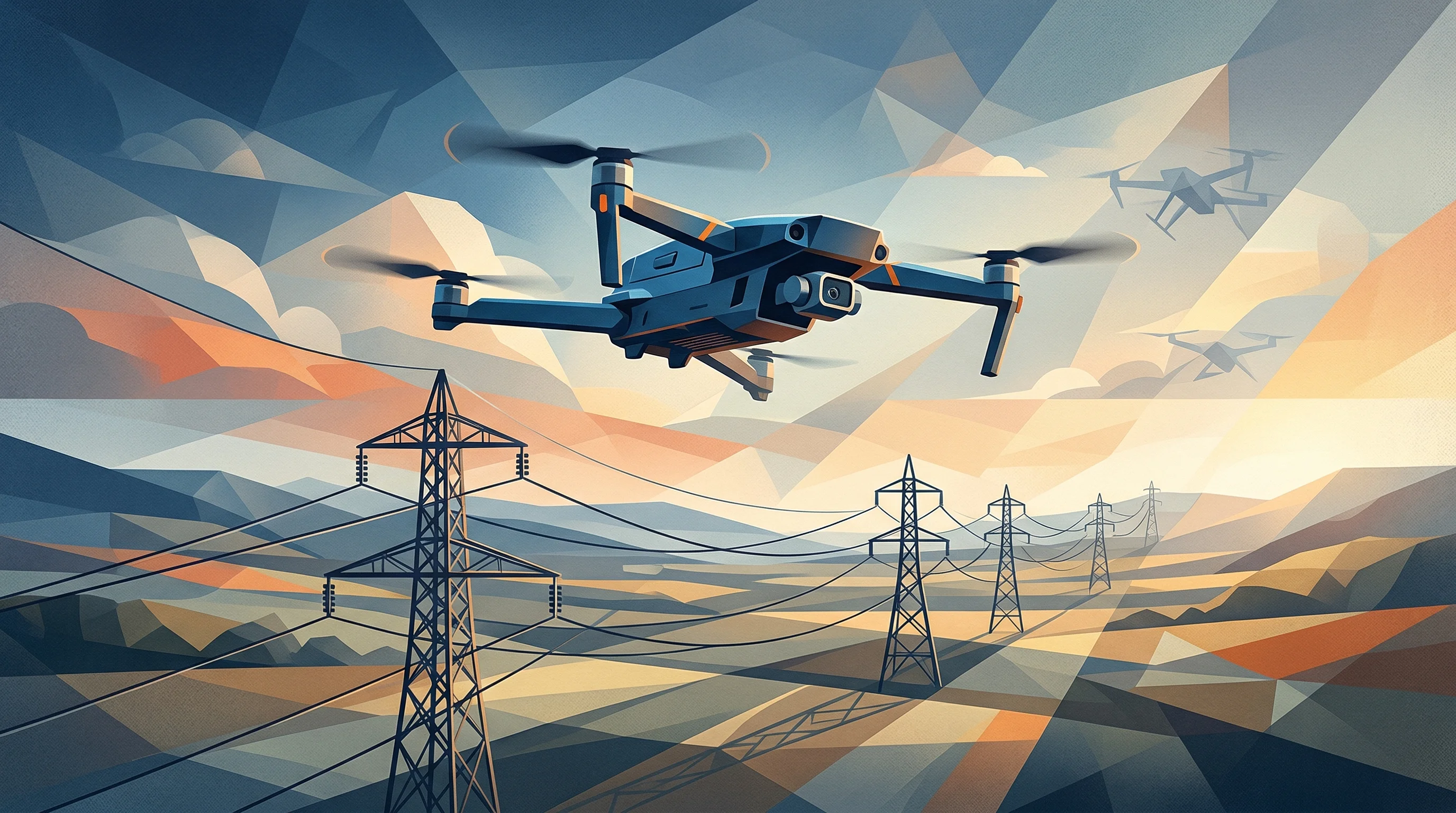
The concept is simple to describe, maddeningly complex to execute. Fixed-wing aircraft take off vertically, fly inspection routes autonomously, return to charge on solid-state pads mounted to wooden poles, then resume flights without human intervention. If it works at scale, it's a different category of tool than what utilities have today. If it doesn't, Voltair joins a lengthening list of drone companies that discovered persistent autonomy is harder than the demo suggests.
The Infrastructure Play
What sets Voltair apart—at least in theory—from the wave of drone-in-a-box vendors that emerged over the past few years is where it wants to put the boxes. Instead of centralized depots housing aircraft, the company installs charging infrastructure directly on the grid itself. One pad per pole. Drones hopscotch between them, theoretically extending range indefinitely.
The operational promise is "persistent autonomous coverage," industry jargon for drones that stay airborne (or flight-ready) without constant human oversight. Utilities and co-ops submit inspection jobs through a web portal; Voltair dispatches hybrid VTOL drones that return high-resolution RGB imagery, thermal scans at 640×480 radiometric resolution, and LiDAR corridor maps. The company says its aircraft handle rain, snow, wind, and temperature extremes, with a 70-mile range between charging stops.
That 1,000-square-mile coverage claim appears in investor materials and on Y Combinator's public launch page, though the company hasn't published independent validation or detailed the assumptions behind it—altitude, cruise speed, weather downtime, revisit frequency. For a technology play staking its economics on distributed autonomy, those details matter more than the headline number.
A Pivot From Wildfire Tech

Voltair has roots at the University of Washington, where co-founders Hayden Gosch, Ronan Nopp, Avi Gotskind, and Warren Weissbluth initially developed prototypes aimed at wildfire prevention. Gosch spent time interning at Seattle City Light before the team went full-time on the venture, collecting seed funding from pitch competitions—$25,000 from the Dempsey Startup Competition plus a $5,000 IoT Prize, and $15,000 from UW's Environmental Innovation Challenge, both in the spring of last year.
Early technical concepts involved inductive charging directly on live transmission lines—physically perching on high-voltage conductors to sip power—a feature the company described as "patent-pending" in materials from that period. The current product messaging has shifted to pole-mounted pads, a more practical (if less dramatic) deployment model that likely emerged during the startup's time in Y Combinator's Winter 2026 cohort. The company's website no longer highlights line-perching as imminent, though archived pages still reference the R&D lineage.
Voltair's first development partner was Big Bend Electric Cooperative, a rural utility in Washington State, and the startup has framed co-ops as its initial wedge market. It exhibited at NRECA TechAdvantage and PowerXchange in Nashville earlier this month, a three-day trade show where distribution utilities—not large investor-owned transmission operators—come to evaluate new technology.
That targeting makes sense. Rural co-ops face inspection economics that look brutal on a spreadsheet: thousands of pole miles, aging infrastructure, tight labor markets, and budgets that don't accommodate helicopter surveys every quarter. If Voltair can deliver usable data cheaper than a truck roll, it has a value proposition. Whether it can do so profitably is another question.
Money and Headcount
The company stated in a LinkedIn post late last month that it raised $2.5 million in funding from Convective Capital, a climate-focused venture firm, though no press release or SEC filing has surfaced publicly to verify the round. The round's structure—pre-seed, seed, whether other investors participated—remains unclear, and Voltair has not responded to inquiries seeking clarification.
LinkedIn shows the company employing somewhere between two and ten people, a range that suggests early-stage pilots rather than production-scale deployments. The startup's listed headquarters toggle between San Francisco (per Convective's portfolio page), Pullman, Washington (LinkedIn), and a Chicago address that may be vestigial. For a business promising distributed autonomous infrastructure across hundreds of square miles, the current team and capital base hint at a company still finding its operational footing.
Voltair's website includes a "Plan Your Mission" request portal, but key metrics remain opaque: how many charging pads are live in the field, how many drones are flying commercial jobs, what pricing looks like compared to helicopter surveys or ground patrols. The company declined to share those figures.
The Autonomy Arms Race
Voltair is hardly alone in chasing grid inspection with autonomous drones. Percepto has operated beyond-visual-line-of-sight (BVLOS) flights for utilities since around 2023 and launched a dedicated utility package last year. Skydio secured FAA approval in March to let a single pilot manage up to four drones simultaneously—a regulatory milestone that matters more than it might sound. The New York Power Authority holds a multi-drone waiver running through 2030, demonstrating that incumbents can scale autonomy without necessarily adopting distributed charging infrastructure.
A closer technical analog might be Nomadic Drones, a Munich-based startup that similarly explored inductive perching on live power lines. Coverage in trade publications described charge times dependent on line current—roughly two hours under certain conditions—a reminder of the engineering complexity Voltair is tackling.
Then there's PowerLight Technologies, which skips the pole-mounted network entirely and beams kilowatts of laser energy to drones at ranges up to two kilometers. Different approach, same problem: how do you keep a drone aloft long enough to make the economics work?
What Regulators Will Allow
The timing may favor Voltair, at least on paper. U.S. aviation regulators have accelerated BVLOS waivers for critical infrastructure, and multi-drone operations are shifting from experimental approvals to routine deployments. Skydio's recent permissions and NYPA's long-term waiver suggest the FAA is increasingly comfortable with higher levels of autonomy for utility inspections, which could smooth Voltair's path to commercial scale.
Still, questions linger that the company hasn't addressed publicly. Mean-time-between-service compared to traditional methods? Per-mile inspection costs against helicopter or ground crews? Detect-and-avoid protocols in mixed airspace? And perhaps most pressingly for a distributed model: what happens when a drone needs maintenance 300 miles from the nearest technician?
The U.S. grid spans somewhere between 160,000 miles of high-voltage transmission and millions of miles of distribution lines, depending on how you count and what you include. If Voltair's coverage economics prove out, the addressable market is vast. If the 1,000-square-mile claim turns out to require ideal weather, flat terrain, and regulatory waivers that don't yet exist at scale, expectations will need resetting. Quickly.
For now, Voltair has a product launch, a wedge market in rural co-ops, and backing from a firm that writes checks to climate infrastructure plays. Whether that translates into a business depends on delivering drones that actually fly for days, recharge autonomously on working poles, and produce data utilities trust enough to stake compliance on—all while navigating the glacial, risk-averse procurement cycles that define the power industry.
That's the napkin sketch, anyway. The hard part comes next.


