

Picture this: a drone settles onto a live transmission line, thousands of volts humming through the conductor beneath its perch. Instead of flying back to base for a battery swap, it simply begins drawing current—refueling directly from the grid it's inspecting.
That's the premise behind Voltair, a Y Combinator-backed venture that spun out of the University of Washington and launched with considerable fanfare earlier this year. The company's founders speak of drones that can "remain deployed indefinitely," treating electrical infrastructure as an inexhaustible power source for inspection flights and wildfire surveillance.
It's an arresting vision, particularly for utilities grappling with deteriorating transmission networks and climate disasters that seem to arrive with greater frequency each season. Yet a closer look at Voltair's current operations reveals something more prosaic than the launch-day swagger suggested. The path from demonstration video to deployed fleet appears longer—and more conventional—than the initial pitch implied.
What They're Actually Building
When Voltair announced its Y Combinator participation, the emphasis fell squarely on transmission line perching: drones landing on energized conductors, recharging in place, resuming flight. "Infinite range" was the phrase the company used. The demonstration footage showed it could be done.
But visit Voltair's website today and the story shifts. The product description centers on something altogether different—"solid state inductive charging pads" mounted on utility poles. These pads form what the company calls a distributed network, with each station extending coverage across roughly 1,000 square miles. It's a more incremental infrastructure play, less dramatic than a drone sipping electricity mid-flight from a 230-kilovolt line.
The aircraft itself is a hybrid fixed-wing VTOL—vertical takeoff and landing—designed for 70-mile range and speeds reaching 80 mph. Voltair says it can reach any point in its service area within five minutes, assuming adequate charging pad density. The company handles the full operational stack: hardware, charging infrastructure, regulatory compliance, flight coordination. What utilities receive on the other end is annotated inspection data, formatted for engineering review.
There's reason to believe the live-line charging capability remains very much in development. A recent job posting seeks engineers for "precision control and perching" work, specifically targeting "perching on power grid infrastructure." The language suggests active R&D rather than mature deployment. Perhaps the pad-based network is serving as a revenue bridge while the company perfects the headline technology.
The Team and Early Traction

The founding team brings credible technical depth. CEO Ronan Nopp reportedly turned down an offer from SpaceX to pursue Voltair, leveraging prior experience in electric vertical takeoff and landing control systems. CTO Hayden Gosch cut his teeth at Seattle City Light and Schweitzer Engineering Laboratories, the latter a specialist in electrical grid protection. Avi Gotskind, handling growth, previously navigated regulatory mazes at Virgin Galactic and Amazon's Project Kuiper satellite venture. Warren Weissbluth, the COO, adds operations research background.
The company took $15,000 at the University of Washington's Environmental Innovation Challenge in April 2025, then entered Y Combinator's Winter 2026 cohort. According to Voltair's own LinkedIn updates, Big Bend Electric Cooperative served as an early development partner. More recently, the team demonstrated the system with Kit Carson Electric Cooperative in Taos, New Mexico, and exhibited at the NRECA TechAdvantage conference in Nashville—a gathering of rural electric cooperatives, the kind of customers Voltair presumably hopes to win over.
Voltair has announced raising $2.5 million from Convective Capital, a climate-focused investment firm, though this figure has not been independently verified through public filings as of mid-March.
The Science Is Real. The Deployment Isn't.
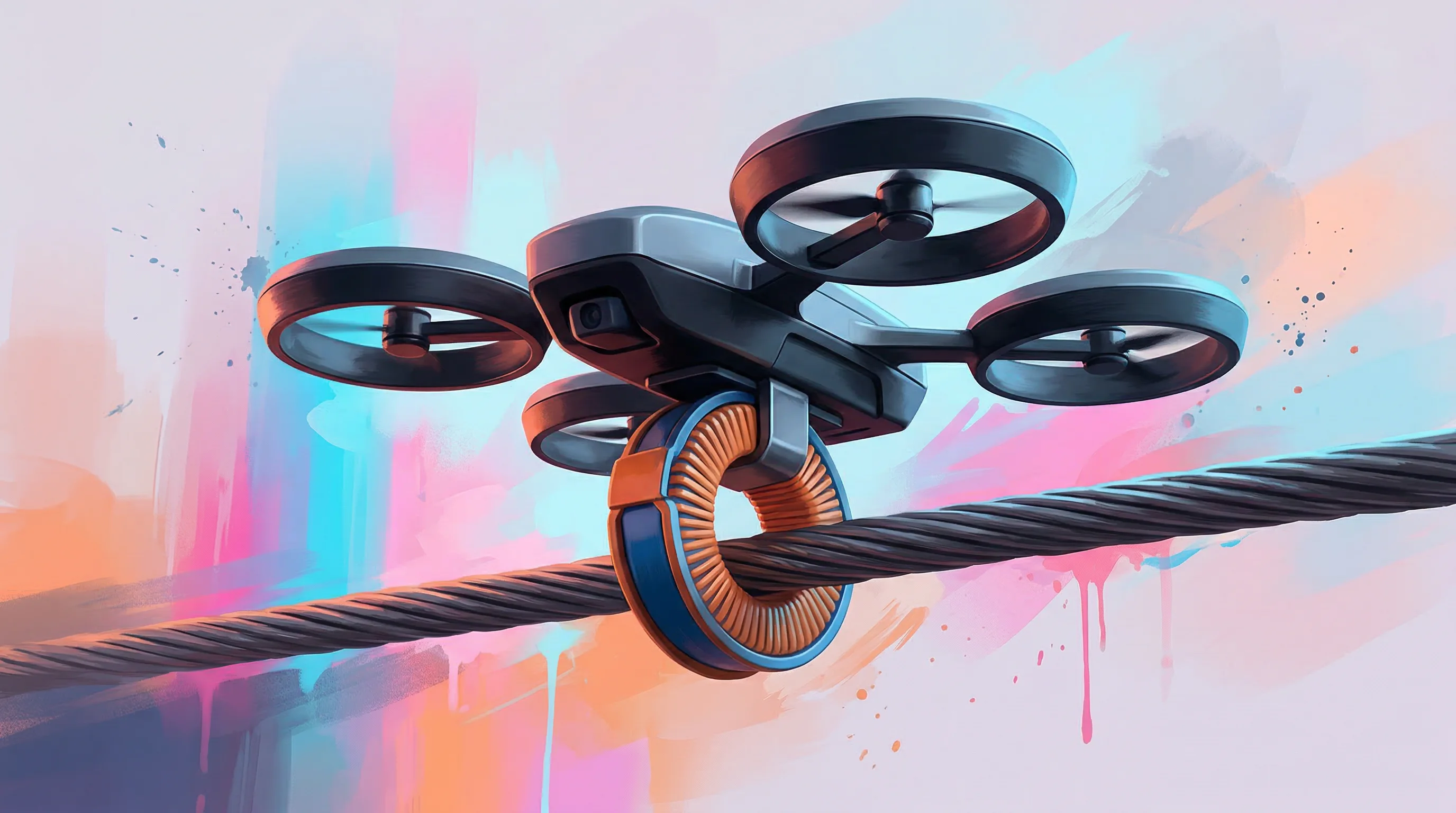
The core concept has academic validation. A 2024 paper from the University of Southern Denmark demonstrated autonomous landing on power lines and recharging via split-core current transformer—basically a donut-shaped coil that wraps around the conductor without requiring direct electrical contact. The researchers achieved what they termed "essentially unlimited operational endurance" through repeated flight-perch-recharge cycles.
Earlier studies showed harvested power varies with line current, ranging from as little as 5 watts during low demand periods to 148 watts when the grid is working harder. That's enough to meaningfully extend flight time, though charging duration depends on battery capacity and real-time grid conditions.
Then come the engineering headaches. Operating near high-voltage conductors means robust shielding to protect avionics from electromagnetic interference. Any system that physically interacts with energized infrastructure requires explicit approval from utility operators, who tend to be conservative about modifications to critical equipment—for good reason.
Regulation may pose the steeper challenge. Beyond Visual Line of Sight operations remain tightly restricted in the United States. The FAA issued a notice of proposed rulemaking in August 2025 aimed at standardizing BVLOS approvals, but that's a long way from routine authorization for autonomous drones flying over power grids. Competitors have secured waivers for specific use cases; scaling that to widespread deployment is another matter entirely.
Betting on Two Futures

Voltair is essentially pursuing a dual strategy: deploying the pad-based network now, while developing the more ambitious line-perching technology in parallel. It's a pragmatic approach, assuming utilities are willing to adopt distributed charging infrastructure as an interim solution.
Whether they will remains an open question. Utilities move slowly, and capital expenditures on new monitoring systems compete with grid hardening, renewable integration, and a backlog of deferred maintenance. Voltair is asking them to install charging stations on poles and trust autonomous aircraft to handle inspections that, until recently, required helicopters and ground crews.
But in a sector where post-storm damage assessment can take days and where a single undetected fault can spark a catastrophic wildfire, the appeal is obvious. Drones that don't need to return home, that can loiter over trouble spots and recharge without human intervention—that's a capability worth paying for, if it works.
The question isn't whether the technology is possible. The academic literature says it is. The question is whether Voltair can build something reliable enough, safe enough, and affordable enough to convince utilities to replace decades-old inspection practices with flying robots that drink from the grid.
For now, the company is installing charging pads and accumulating flight hours with cooperative partners. The live-line perching? That's still in the lab. Which means Voltair's most audacious promise remains just that—a promise.


