

As Waymo circles the same turf, a British startup with a contrarian approach to self-driving cars assembles an unlikely coalition—and a 2026 deadline
The investor list alone tells you something unusual is happening.
When venture capitalists, pension fund managers, semiconductor titans, and legacy automakers all write checks for the same startup, they're either chasing the same mirage or they've glimpsed a credible path through one of tech's most notorious graveyards. For Wayve, the London-based autonomous driving company that just closed a $1.2 billion equity round—with an additional $300 million contingent on hitting robotaxi milestones with Uber—the question is which.
The Series D values Wayve at $8.6 billion and ranks among the largest AI funding rounds in European history. But the valuation is almost beside the point. What matters is the breadth of the bet: Eclipse, Balderton Capital, and SoftBank Vision Fund 2 co-led the raise, bringing in Microsoft, NVIDIA, three major automakers (Mercedes-Benz, Nissan, Stellantis), institutional players like Ontario Teachers' Pension Plan, Baillie Gifford, and Schroders Capital, and even £25 million ($31 million) from the UK government's British Business Bank.
Venture capital and sovereign wealth don't usually share cap tables with automotive OEMs and chipmakers. The fact that they do here suggests Wayve has assembled something resembling both the compute backbone and the commercial partnerships necessary to survive what comes next.
London, 2026—With Company
Wayve plans to launch a robotaxi service in London in 2026 through its partnership with Uber, then push into more than 10 markets worldwide. Uber's $300 million isn't guaranteed upfront; it unlocks in tranches tied to deployment milestones, a structure that keeps both sides honest.
The timing isn't accidental. The UK's Automated Vehicles Act received Royal Assent in May 2024, greenlighting commercial autonomous operations by 2026—just as Wayve intends to go live. But London won't be a solo debut. Waymo announced plans in October 2025 to launch there the same year, fresh off a $16 billion raise in February 2026. Three years ago, a head-to-head in London would have seemed improbable. Now it's shaping up as a high-stakes test case for two fundamentally different approaches to the same problem.
The Contrarian Wager
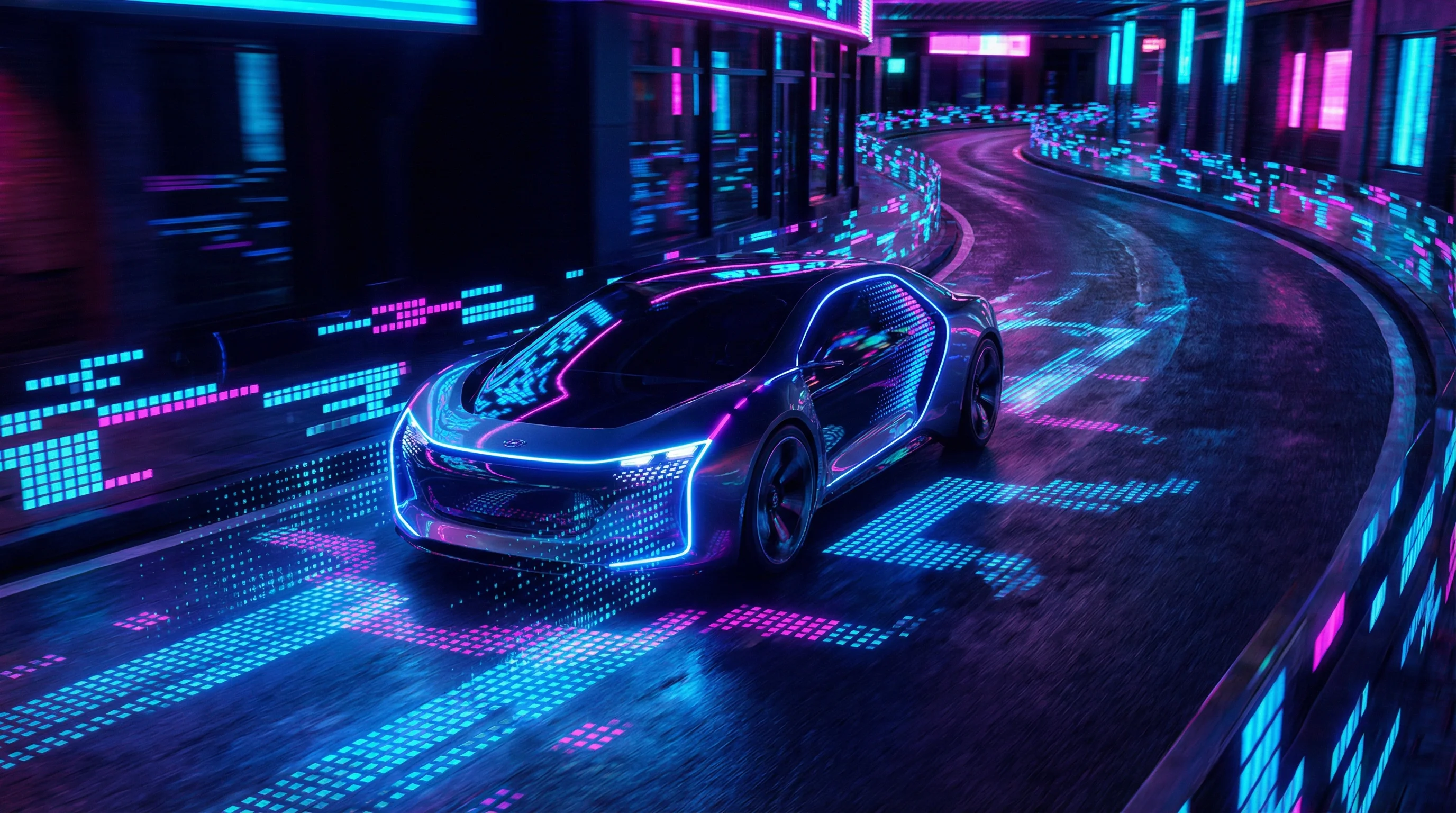
Wayve's pitch hinges on what it calls "AV2.0," or embodied AI—a camera-first, end-to-end deep learning system designed to generalize across environments without the high-definition maps and sensor-laden hardware stacks that Waymo and Cruise built their businesses around. The company argues its approach is hardware-agnostic, meaning automakers can integrate Wayve's software into existing sensor arrays rather than re-engineering vehicles from the ground up.
Whether that's visionary or wishful thinking depends largely on who you ask. Wayve claims to have tested its system across more than 500 cities in what it describes as "zero-shot" generalization—driving in new locations without city-specific training data. Recent US testing showed performance levels approaching its UK benchmarks with just 500 hours of local data, according to the company.
The technical infrastructure backing this relies on NVIDIA's DRIVE AGX Thor platform for in-vehicle compute and Microsoft Azure for large-scale training. Wayve also recently unveiled GAIA-3, a 15-billion-parameter generative world model built on 10 times more data than its predecessor, aimed at scenario simulation and safety validation. It's the kind of capability that sounds impressive in a pitch deck; the real test will be whether it translates to smoother rides—and fewer interventions—on Piccadilly Circus at rush hour.
Production Timelines, Real Commitments
Beyond robotaxis, Wayve is chasing the production vehicle market. Nissan signed definitive agreements in December 2025 to integrate Wayve's AI into its next-generation ProPILOT system, with consumer rollout slated to begin in fiscal year 2027. Stellantis and Mercedes-Benz have also invested, though neither has disclosed integration timelines.
The distinction matters. Robotaxis generate headlines; production vehicles generate revenue at scale. If Wayve can deliver software that works across multiple OEM platforms without requiring bespoke hardware, it solves a go-to-market problem that has bedeviled the industry for years. If it can't, the company risks becoming another well-funded cautionary tale.
Founded in 2017 by CEO Alex Kendall and Amar Shah, Wayve has now raised more than $2.5 billion across four rounds, according to the Financial Times—though some tallies exceed $3 billion depending on how you count contingent capital. The company pulled in $1.05 billion in its Series C in May 2024, $200 million in Series B in January 2022, and $20 million in Series A back in November 2019.
The fresh capital will fund continued scaling of its AI stack, expansion of engineering leadership, and preparations for commercial robotaxi ops. Wayve acquired German data quality firm Quality Match in December 2025 to shore up its safety validation pipelines and opened new testing hubs in the US and Germany throughout 2025.
Convergence in 2026

What happens next year in London will clarify quite a bit. Three autonomous systems—Waymo's mapping-heavy approach, Wayve's camera-first generalization, and whatever else emerges—will converge on one of the world's most challenging urban driving environments. Narrow streets, aggressive cyclists, unpredictable pedestrians, weather that shifts hourly. It's the kind of stress test that separates functional prototypes from scalable businesses.
Wayve's backers are betting that its approach—lighter on hardware, heavier on generalization—can compete with incumbents who've spent years and billions perfecting city-specific systems. Perhaps they're right. Or perhaps London will reveal that some problems still require brute-force mapping and sensor redundancy, no matter how elegant the alternative sounds.
Either way, the autonomous vehicle industry is about to get more interesting. And considerably more crowded.


