

The robots at Encord's new facility in Hayward, California, won't exactly be autonomous—not yet. They'll be remotely operated, sometimes clumsily, capturing the kind of first-person video footage that teaches machines how the world actually works. It's an unglamorous corner of the artificial intelligence boom, this business of collecting training data. But it's where Eric Landau, Encord's co-founder, believes the next phase of AI development will be won or lost.
"The bottleneck isn't model size anymore," Landau said in an interview with The Information. "It's whether you have the right data."
On February 26, 2026, Encord announced it had raised $60 million in Series C funding to prove that thesis. Wellington Management led the round, which brings the San Francisco-based company's total capital raised to $110 million and values it at roughly $500 million pre-money, according to people familiar with the deal. Existing backers Y Combinator, CRV, N47 (the rebranded venture arm formerly known as Next47), Crane Venture Partners, and Harpoon Ventures joined the round, alongside newcomers Bright Pixel Capital and Isomer Capital.
The timing isn't accidental. While much of the AI industry has spent the past two years obsessing over large language models and chatbots, a quieter shift has been underway. Robotics companies, autonomous vehicle developers, and drone manufacturers—makers of what the industry now calls "physical AI"—have emerged as some of the most demanding customers for data infrastructure. They don't just need text scraped from the internet. They need video, LiDAR scans, point clouds, sensor telemetry, all of it labeled, curated, and ready to feed into models that must navigate the messy physical world.
Encord has hitched itself to that wave. Perhaps more completely than its founders initially expected.
When Data Becomes Three-Dimensional
The company's client roster reads like a who's who of companies betting on robots: Woven by Toyota, the automaker's mobility subsidiary. Zipline, which delivers medical supplies by drone. Skydio, the defense-focused drone maker. UiPath and AXA round out a customer base that now exceeds 300 organizations.
Revenue from physical AI customers has jumped tenfold over the past year, the company says. More telling, perhaps, is what's happened to the sheer volume of data flowing through Encord's platform. Twelve months ago, the company managed about one petabyte of data. Today, it's more than five petabytes—roughly three times the amount used to train OpenAI's GPT-4, according to Encord's own estimates.
Managing that data isn't like organizing a text dataset. A self-driving car might generate terabytes in a single day of testing. A warehouse robot learning to identify and grasp objects needs thousands of hours of labeled video, shot from multiple angles, under varying lighting conditions. The annotation work alone—teaching the AI what it's looking at—can take weeks per dataset.
This is where Encord's platform enters the picture. The software handles annotation, data curation, model evaluation, and workflow orchestration for multimodal AI systems. Last June, the company launched a physical AI suite with beefed-up support for 3D data, LiDAR, and point cloud workflows—the spatial mapping technologies that help robots understand depth and distance. In October, it released E-MM1, an open-source multimodal dataset containing more than 100 million data tuples and a million human annotations.
It's technical, and it's tedious. And right now, it's in demand.
The Hayward Experiment
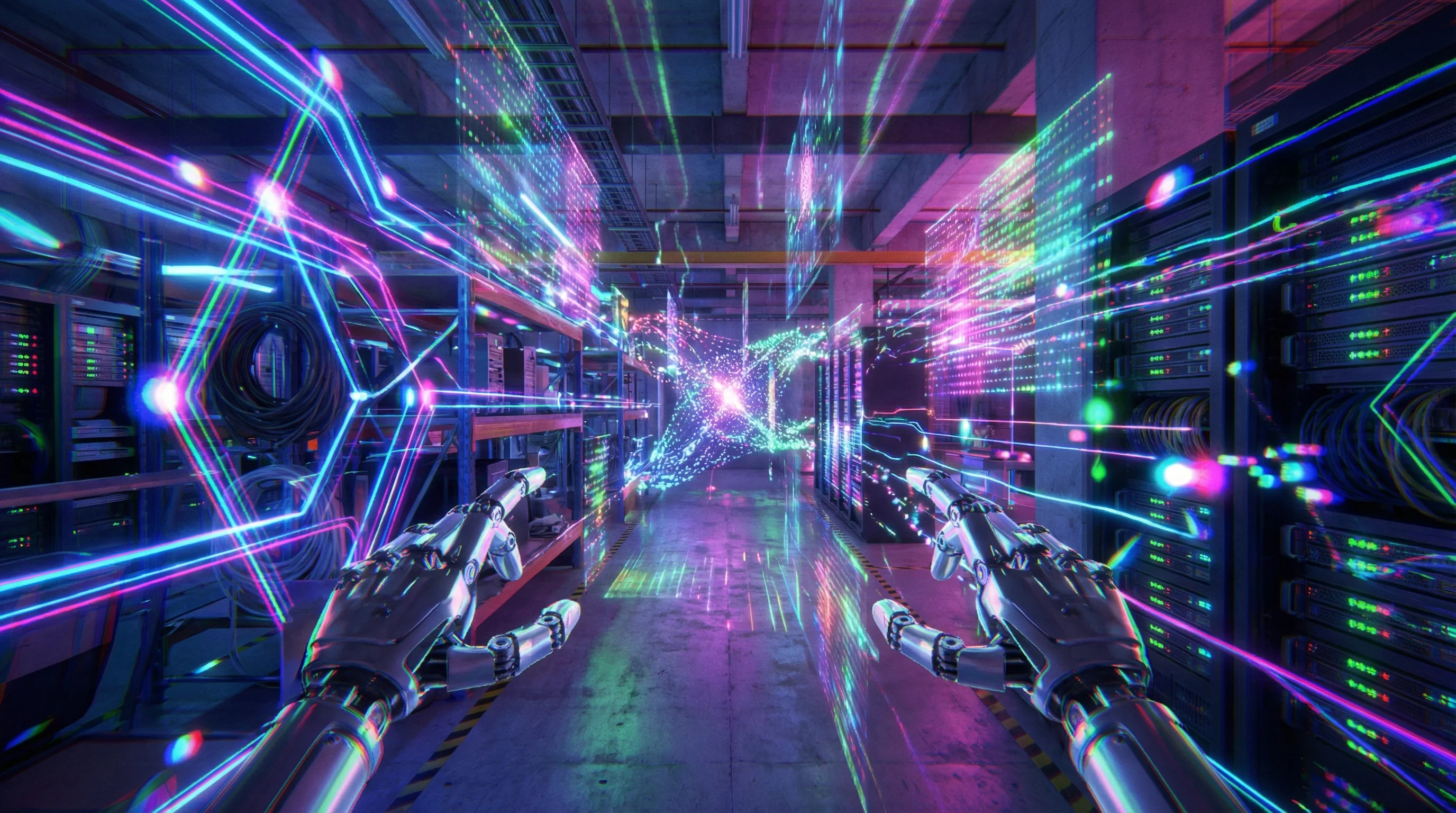
Which brings us back to that warehouse. The facility, according to Landau, will function as a data capture lab where Encord can remotely operate robots within a radius of about 3,000 kilometers. The company is particularly interested in first-person video—the perspective a robot "sees" as it moves through space—because that type of data is critical for training what researchers call world models.
These models attempt to teach AI systems how physics works, how objects behave, how environments change. It's the difference between a chatbot that can describe a kitchen and a robot that can actually navigate one without knocking over the coffee pot.
The Hayward facility represents a bet that data quality, not just data quantity, will separate winners from also-rans in physical AI. Encord isn't alone in thinking this way, but it is unusual for a software company to invest in its own hardware operation. Then again, if your business depends on understanding how robots learn, maybe operating a few yourself isn't such a strange idea.
A Crowded, Lucrative Arena
Encord's competition is formidable. Scale AI, the San Francisco data labeling giant, raised $1 billion in May 2024 at a $13.8 billion valuation—more than 20 times Encord's current worth. Snorkel AI, which focuses on programmatic data labeling, closed a $100 million Series D in May 2025 at a $1.3 billion valuation. Labelbox, V7, Dataloop, and Roboflow all jostle for market share among AI teams that need help wrangling their datasets.
What Encord has done, effectively, is find a lane. While Scale built a sprawling empire across multiple AI categories, Encord has burrowed deep into robotics and physical AI workflows. Whether that specialization proves defensible remains an open question—Scale, after all, has plenty of resources to chase the same customers.
But the market may be large enough for multiple winners. Goldman Sachs Research has estimated the humanoid robot market alone could hit $38 billion by 2035. UBS went further, projecting hundreds of millions of units in circulation by 2050. Those numbers sound almost fantastical today, when most people's only encounter with a humanoid robot is in a viral demo video. Still, venture capitalists are writing checks as if the forecasts might be conservative.
What Comes Next

Co-founder Ulrik Stig Hansen described this moment as an "inflection point" for physical AI—the kind of phrase that gets thrown around at funding announcements but occasionally turns out to be true. His argument is straightforward: The companies building robots don't have a model problem. They have a data problem. And solving that problem requires infrastructure purpose-built for multimodal, high-volume, physically grounded datasets.
Encord will use its new capital to staff up across its San Francisco and London offices, scale its platform, and get that Hayward warehouse operational. The company declined to disclose specifics on hiring targets or revenue figures, though the tenfold growth in physical AI revenue suggests it's well past the stage of struggling for product-market fit.
The harder question is what happens if the physical AI boom loses momentum. Robotics has disappointed before—decades of hype followed by incremental progress. For now, though, the data is flowing. Five petabytes and counting.
And in Hayward, the robots are getting ready to learn.


